
You've done your research, crafted your pitch, and dialed the number. Then, just as you're building momentum, it hits you like a brick wall: "Thanks, but we're happy with our current vendor."
If that scenario sounds painfully familiar, you're not alone. Sales reps everywhere report that their attempts to overcome this common objection are "falling flat." One sales professional on Reddit even compared it to "being in the DMs of a girl that has a boyfriend" — you're fighting an uphill battle against an established relationship.
But here's the truth: "We're happy with our current vendor" isn't a dead end. It's the beginning of a real conversation — if you know how to respond.
In this guide, we'll deconstruct what this objection really means, provide a tactical framework for your response, share proven scripts that get results, and most importantly, show you how to practice until your responses become second nature.
Before crafting your response, understand that "We're happy with our current vendor" can mean several different things. Shifting from a "rebuttal" mindset to a "diagnosis" mindset is your first step toward success.
This objection typically falls into one of these four categories:
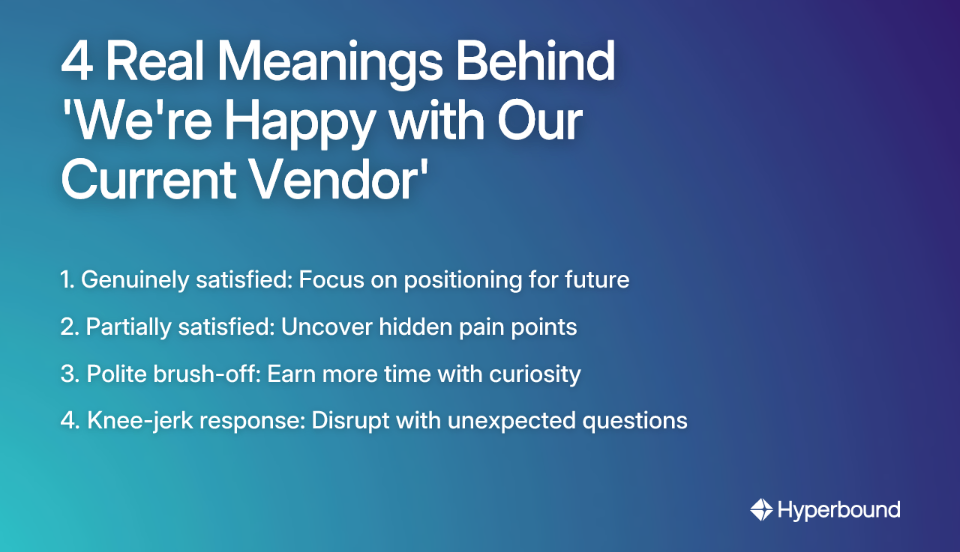
Once you understand which category you're dealing with, you can craft a more effective response.
While there's no magic one-liner that works in every situation, the LAER Method provides a reliable structure for handling this objection:
This framework ensures you're not just firing back with a canned response but engaging in a meaningful dialogue that might uncover opportunities.

Now let's arm you with specific, actionable responses for different scenarios:
.png)
How it works: Compliment their current vendor choice to lower their guard, then ask a precise question to find a crack in their satisfaction.
Script: "That's great, [Competitor Name] is a solid company. I'm curious, since no solution is perfect, if there was one thing you could change or improve about your experience with them, what would it be?"
This approach, recommended by B2B Sales Connections, works because it acknowledges their choice while creating space for them to share frustrations they might not have volunteered otherwise.
How it works: Address the challenge of prospects getting "cagey" when asked who they use. This tactic allows you to highlight differentiators without knowing the competitor.
Script: "I understand. We're not looking to rip and replace. Typically, companies in your space find that while their current solution handles X well, they still struggle with [common pain point #1] or [common pain point #2]. Have you experienced anything like that?"
This approach works because it focuses on common industry challenges rather than directly attacking their current vendor.
How it works: Acknowledge their current satisfaction and pivot the conversation to their future evaluation cycle. This is a low-pressure way to stay on their radar.
Script: "Totally understand and respect that. I'm not asking you to make a change today. Most teams we speak with evaluate their tech stack annually or when their contract is up for renewal. When does that process typically happen for you? I'd love to share some information closer to that time to be considered."
According to sales professionals on Reddit, this approach often prompts prospects to correct you with their actual evaluation timeline, giving you valuable intelligence for future follow-up.
How it works: If a full replacement is off the table, find a gap your product can fill as an add-on.
Script: "That makes sense. Many of our customers use us to supplement their current provider, specifically for [area where your solution excels]. For example, we helped [Client] solve [specific problem] which their main vendor couldn't address. Is that an area you're looking to improve?"
This approach acknowledges the existing relationship while positioning your solution as complementary rather than competitive.
Here's an uncomfortable truth: knowing these scripts isn't enough. The difference between average reps and top performers isn't just what they say—it's how confidently and naturally they deliver it under pressure.
Effective sales role-play builds the "muscle memory" needed to handle objections in real-time. When you hear "We're happy with our current vendor," you need to respond confidently without hesitation or awkwardness.
The benefits of deliberate practice through role-play include:
However, traditional role-play has significant limitations:
This is where modern solutions like AI-powered practice platforms come into play.

AI platforms offer a solution to the limitations of traditional role-play, providing anytime practice in a low-pressure setting with objective feedback for quicker skill improvement.
Hyperbound is specifically designed to help sales teams master objection handling through AI-powered role-plays. Here's how you can use it to practice handling the "We're happy with our current vendor" objection:
For sales managers, this approach allows them to scale effective coaching. They can analyze role-play data and even use Hyperbound's AI Real Call Scoring to see how the practice translates to live conversations, ensuring training sticks.
The difference between knowing how to handle the "We're happy with our current vendor" objection and masterfully navigating it in real conversations comes down to practice.
Remember these key takeaways:
As Harvey Mackay wisely noted, "Failure to plan is planning to fail." Don't just read about handling objections—practice them until they become part of your sales DNA.
By combining strategic understanding with deliberate practice, you'll transform this common objection from a conversation stopper into a valuable opportunity to demonstrate your unique value and build meaningful relationships with prospects, even when they're "happy with their current vendor."
The best way to respond is to first acknowledge their statement, then ask open-ended questions to explore the relationship further. Instead of a direct rebuttal, use a framework like the LAER Method (Listen, Acknowledge, Explore, Respond) to understand the context behind their objection and uncover potential pain points or future opportunities.
Prospects use this objection for several reasons, and it often isn't about complete satisfaction. It can be a genuine statement of contentment, a polite brush-off to end the call, a knee-jerk reaction to any sales call, or a sign that they are only partially satisfied but haven't considered alternatives. Understanding the underlying reason is key to crafting an effective response.
Deliberate practice is crucial, and modern tools can help you avoid the awkwardness of traditional role-playing with peers. AI-powered practice platforms like Hyperbound allow you to run hyper-realistic simulations in a private, low-risk environment. You can practice your responses against an AI buyer, receive instant, unbiased feedback, and repeat the scenario until you feel confident and natural.
If a prospect is genuinely happy, shift your goal from an immediate sale to positioning for the future. Acknowledge their positive relationship and use the "Future-Pacing" approach. Ask about their typical evaluation or contract renewal cycle and offer to provide information closer to that time, ensuring you stay on their radar as a valuable resource when they are ready to reconsider their options.
The LAER method provides a structured, empathetic approach to handling objections. It forces you to Listen without interrupting, Acknowledge their point of view to build rapport, Explore the situation with thoughtful questions to uncover the real meaning, and then Respond with a tailored, relevant value proposition. This turns a potential confrontation into a productive conversation.
If your product has premium pricing, you must reframe the conversation from cost to value and ROI. Acknowledge that many solutions compete on price, but explain how your product's unique features deliver a specific, positive business outcome that provides a much higher return on investment. Focus on the value they gain, not just the price they pay.










Use Cases
Legal