
You're staring at your call list, heart racing, palms sweaty. The first cold call of the day looms like a mountain to climb. We've all been there—that paralyzing moment before dialing when your mind floods with "what if" scenarios.
But here's the brutal truth: practicing on real prospects is a rookie move. As one seasoned sales rep put it on Reddit, "Practicing on prospects? Rookie move. Nail your skills before dialing." Every fumbled call with a real lead isn't just a learning experience—it's a potentially burned opportunity and damaged brand reputation.
The good news? You don't have to sacrifice real leads on the altar of your sales development. This article outlines a modern, risk-free approach to mastering cold calls without using a single live prospect.
Let's address the elephant in the room: most traditional cold call practice methods fall woefully short.
Talking to yourself in the mirror might help memorize a script, but it fails to simulate the dynamic, unpredictable nature of real conversations. Your reflection never interrupts you with "We're happy with our current provider" or "Send me an email instead."
A step up from solo practice, but still problematic:
While valuable, this method is reactive, not proactive. As another Redditor advised, "Listen to your calls if you have recording software," but by then, you've already practiced on real prospects—potentially burning valuable leads in the process.
.png)
The solution lies in creating a structured, repeatable, and realistic practice environment that allows for high-volume repetition without risk. Here's your 5-step routine for effective cold call practice:
Start by crafting a solid foundation—a script structure that guides your conversation without sounding robotic.
Key Components:
This is where modern technology has revolutionized sales training. AI sales roleplay software allows you to practice with AI-powered personas that simulate realistic buyer conversations—no human partner required.
The benefits are game-changing:
Platforms like Hyperbound offer AI Sales Roleplays that allow you to create customized practice scenarios tailored to your specific Ideal Customer Profiles (ICPs), products, and sales methodology. You can practice cold calls, discovery, objection handling, and more with AI personas that respond dynamically to your approach.
As one Reddit user noted, "Real calls offer invaluable experience. However, with the stakes so high, I'm cautious about using real prospects for practice." AI roleplays eliminate this dilemma, providing the experience without the risk.

Objections are the crucible where sales calls are won or lost. According to sales training experts, the goal isn't to avoid objections but to "address them respectfully and redirect discussions to potential value."
AI simulations are perfectly suited for objection handling practice because they can:
Practice until your responses become reflexive rather than reactive. The difference is subtle but profound—you'll move from panicking when hearing "We don't have budget" to calmly redirecting the conversation toward value.
The best cold calls quickly transition from a monologue to a dialogue. One effective framework is the SPIN questioning technique:
While practicing with AI, focus on transitioning smoothly between these question types based on the responses you receive. This develops your ability to think on your feet—what one sales rep called "reacting to something completely out of left field in real time."
The missing piece in most practice methods is objective, actionable feedback. As one sales leader noted on Reddit, "Management will not buy a tool like this on its own—they see feedback as being the most important element."
Modern AI coaching tools solve this problem by providing:
With Hyperbound's AI Coaching, reps receive instant, personalized feedback after each practice call. The platform analyzes performance against your company's specific sales methodology and talk tracks, providing data-driven insights that would traditionally require hours of manager review.
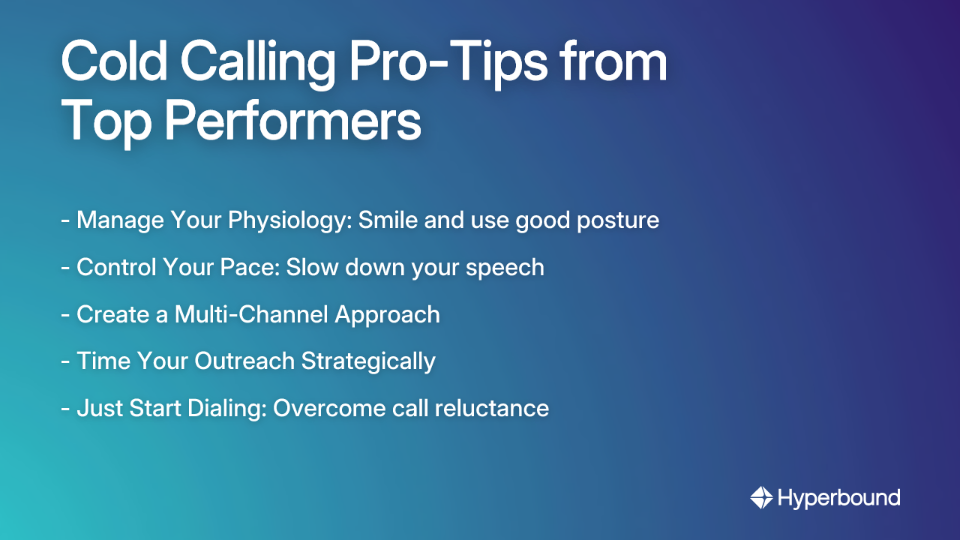
Beyond the core practice routine, here are quick-hit tips from top performers to elevate your cold calling skills:
"Smile, fix your posture, roll back your shoulders, it helps a lot." This small change in physicality dramatically impacts your tone and confidence. If possible, "use a standing desk" to maintain energy throughout your calling blocks.
"Slow it wayyy down," advises a seasoned caller on Reddit. "If you're new to sales...you're almost definitely speaking too fast." When nervous, we tend to rush—consciously slow your pace to sound more confident and give prospects time to absorb your message.
"Your voicemail should point to your cold email." Develop a cohesive outreach sequence where each touchpoint reinforces the others. This creates multiple opportunities for engagement and demonstrates persistence without being pushy.
While data suggests that "Thursday from 9-11 AM is ideal for cold calls," don't neglect unconventional opportunities. As one contrarian Redditor noted, "Friday afternoons are great for outreach to VPs and C-suite. Gatekeepers are gone, they're in a good mood."
"Just fucking do it. The hardest part of cold calling is making the first call." Overthinking leads to paralysis—commit to making your first call within 15 minutes of starting your day to build momentum.
The modern approach to cold call practice combines traditional script internalization with AI-powered simulation and data-driven feedback. This creates a virtuous cycle of:
This approach eliminates the need to "learn on the job" with real prospects. Instead, you can develop confidence and competence in a safe environment before engaging with valuable leads.
For teams looking to implement this approach systematically, platforms like Hyperbound combine all these elements into a comprehensive sales readiness solution. Their AI Sales Roleplays and AI Coaching capabilities enable reps to practice critical conversations across the entire sales cycle with hyper-realistic AI personas, receive objective feedback, and track improvement over time.
Cold calling doesn't have to be a sink-or-swim proposition where new reps burn through valuable prospects while learning the ropes. The combination of structured practice, AI simulation, and data-driven feedback creates a safe, scalable environment to develop cold calling skills without risking a single lead.
Remember, the goal isn't to eliminate nervousness entirely—even veteran reps feel the adrenaline before important calls. The difference is that well-practiced reps have developed the muscle memory to perform effectively despite those nerves.
So before you dial your next prospect, ask yourself: Have I put in the practice reps in a risk-free environment? If not, it might be time to explore how modern tools can help you master the cold call without sacrificing real opportunities in the process.
After all, your prospects deserve your best self—not your practice self.
The most effective way is to use a structured, risk-free environment, such as an AI sales role-playing platform. This modern approach allows for unlimited repetition, realistic scenario simulation, and instant, data-driven feedback on your performance, helping you master your skills before speaking to a single live prospect.
Practicing on actual prospects is a bad idea because it can lead to burned opportunities and damage your company's reputation. Every fumbled call with a potential customer is a lost chance at a sale and a negative brand interaction, whereas practicing in a simulated environment carries no such risks.
AI can significantly improve cold calling skills by providing a realistic and scalable practice partner. AI role-playing tools allow you to practice handling objections, refining your script, and adapting to different buyer personas in a safe environment. Furthermore, AI coaching platforms offer immediate, objective feedback on metrics like talk-to-listen ratio and filler word usage.
A successful cold call script should include three key components: a permission-based opener to respect the prospect's time (e.g., "Do you have a minute?"), a concise value pitch that focuses on benefits rather than features, and a clear close that defines the next step, such as booking a meeting.
You can get better at handling sales objections through consistent, targeted practice in a simulated environment. Using AI role-playing software, you can repeatedly face common objections like "I don't have time" or "We already use a competitor" until your responses become reflexive. The goal is to calmly address concerns and redirect the conversation toward value.
Yes, in many ways AI role-playing is more effective than practicing with colleagues. AI simulations are available 24/7, eliminating scheduling conflicts. They provide consistent, unbiased challenges and objective, data-driven feedback, whereas feedback from colleagues can be subjective and influenced by internal dynamics. AI also removes the "awkward factor" often associated with role-playing with coworkers.








Use Cases
Legal