
You've just finished a great demo. The prospect seems engaged, you've answered all their questions. Then comes the silence. What do you say next to move the deal forward without sounding pushy or desperate?
This moment—the closing moment—is where many sales conversations either advance to the next stage or stall indefinitely. While most reps know they need to improve their closing techniques, there's a fundamental challenge: practicing these critical skills is risky on live calls with actual prospects. One poorly phrased closing question can derail a deal that took months to build.
The good news? Mastering the art of closing isn't about memorizing a list of "killer" closing lines. It's about developing the confidence and conversational flow to guide a prospect to a natural decision. And this mastery comes from one place: deliberate, effective practice.
Let's start by shifting our mindset. The goal of closing isn't to "win" against your prospect or pressure them into a decision they're not ready to make. Instead, think of closing as opening a relationship. As Salesforce points out, a good close should feel like helping, not selling.
Modern closing questions serve four essential functions:
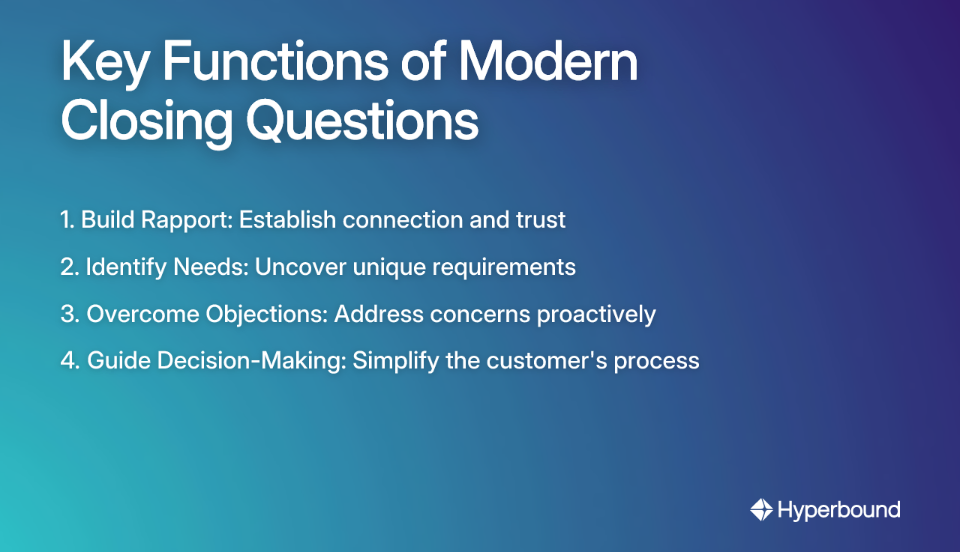
It's also critical to understand that closing isn't a single event at the end of a call. In today's B2B sales environment, closing is a continuous process of securing small commitments throughout the buyer's journey.
Let's explore some proven closing techniques that can transform your sales conversations. For each, I'll provide the strategy and examples you can adapt to your specific sales context.
This technique assumes the sale is made, encouraging a positive response.
Examples:
Summarize key benefits to reinforce value before the final ask.
Example:"To recap, our solution reduces costs, improves efficiency, and integrates with your existing tools. With that in mind, are you ready to move forward with the implementation plan we discussed?"
Create legitimate urgency for immediate action.
Examples:
Assess interest levels to tailor your pitch and uncover hidden objections.
Example:"On a scale of 1 to, how would you rate the importance of streamlining your processes?"
Present two options to guide the prospect toward a 'yes'.
Example:"Would you prefer option A or option B?"
Allow the customer to try before they buy, reducing perceived risk.
Example:"Why not take our software for a trial? You can experience the benefits first-hand."
Use strategic questions to lead to a positive decision.
Example:"Do you see our product helping you achieve your goal?"
At this point, you might think: "Great, now I have a list of closing techniques. Problem solved!"
Not quite.
There's a massive difference between knowing what to say and actually delivering it effectively in a high-pressure sales conversation. As the saying goes, "Reps who practice, win." Reading a list of questions is easy. Delivering them with confidence under pressure is hard.
Sales teams face several challenges when trying to improve their closing skills:

The solution? AI-powered sales roleplays that create a safe, repeatable environment to practice closing techniques without risking live deals.
Modern AI platforms can simulate realistic buyer personas that respond dynamically, just like a real prospect. With platforms like Hyperbound, you can tailor roleplays to your specific Ideal Customer Profile (ICP), products, and sales methodology.
This approach lets you practice the full range of conversations where closing is critical: outbound sales calls, discovery, demos, and even post-sales upsells and renewals.
After every practice call, AI provides instant, data-driven feedback. It analyzes your performance against your company's playbook, tracking key metrics like talk ratios, questions asked, and how well objections were handled.
This solves the pain point many sales teams experience: "Difficulty in getting actionable feedback from call transcripts." With AI coaching, reps can identify missed opportunities, weak responses, and off-track messaging immediately, without waiting for a manager review.
AI coaching tools provide a scalable way to ensure every rep gets consistent, high-quality practice. This reduces new hire ramp time and drives playbook adoption across the entire team.
Many platforms also include gamified training elements like leaderboards and scoring to foster healthy competition and motivate reps to improve their closing skills through repeated practice.
Ready to implement an effective closing practice program for your team? Here's a tactical approach:
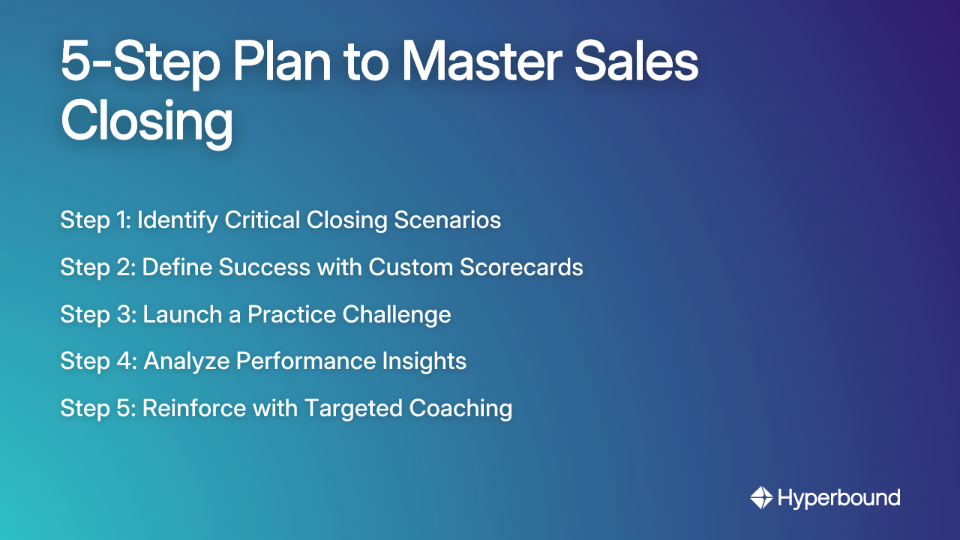
Where do your reps struggle most? Is it after the demo? Handling pricing objections? Asking for the referral? Pick 2-3 high-impact scenarios to start with.
For example, you might create scenarios for:
Align your practice with your sales methodology. What key phrases should be used? What questions must be asked? This directly addresses the need for "customizable assessment tools to evaluate and align sales rep skills."
In Hyperbound, you can build custom scorecards that automatically grade reps on the specific behaviors that lead to closed deals at your company. This creates an objective standard for what "good" closing looks like in your organization.
Assign the roleplay scenarios to your team. Encourage them to practice a scenario 3-5 times, focusing on improving their score with each attempt. The repetition builds muscle memory for the real conversations.
Look at the data from these practice sessions. Are reps consistently missing the summary close? Are they talking more than listening? This solves the "unmet need for tools that provide comprehensive analytics on call performance."
Use the platform's analytics to identify team-wide skill gaps and surface top-performing calls as examples of best practices for collaborative learning.
Use the data from the AI analysis to inform your 1:1 coaching plans. Instead of generic feedback, you can say, "I noticed in your roleplays you struggled with the pricing objection. Let's work on that."
Effective closing isn't about pressure; it's about guidance. Knowing the right questions is only half the battle – mastery comes from deliberate, repeatable practice in a safe environment.
Stop risking live deals. By embracing modern practice tools, you can equip your team with the skills and confidence to turn hesitant prospects into happy customers, moving every deal forward with purpose.
Ready to see how your team can master their closing skills? Try an interactive AI roleplay demo for free and experience the future of sales coaching.
The main goal of a closing question is to guide a prospect toward a final decision and advance the deal to the next stage. It's not about pressuring them but about opening a relationship. Modern closing questions help build rapport, identify needs, overcome objections, and simplify the decision-making process for the customer, making it feel like helping rather than selling.
Practicing on live calls is risky because one poorly phrased closing question can derail a deal that may have taken months to build, potentially losing a valuable prospect. The pressure of a live call is not the ideal environment for learning. A misstep can damage rapport and stall the sales process indefinitely, which is why a safe, risk-free practice environment is crucial.
Some effective closing techniques include the Assumptive Close, Summary Close, Urgency Close, Choice Close, and the Puppy Dog Close. For example, the Assumptive Close (e.g., "When should we schedule delivery?") assumes the sale is made, while the Summary Close reinforces value by recapping key benefits before asking to move forward. The best technique depends on the specific sales context and the prospect's needs.
The most effective modern way for sales reps to practice is through AI-powered sales roleplays, which provide a safe, repeatable, and risk-free environment. Platforms like Hyperbound allow reps to practice against realistic AI buyer personas tailored to their industry. They receive instant, objective feedback and data-driven coaching, helping them build muscle memory and confidence without jeopardizing live deals.
Closing is not a single event at the end of a call but a continuous process that happens throughout the buyer's journey. Sales reps should aim to secure small commitments, or "micro-closes," at every stage. This could be getting an agreement on the problem, securing the next meeting with a decision-maker, or confirming that a specific feature meets their needs. This approach builds momentum toward the final decision.
The key difference is mindset: traditional closing often focuses on high-pressure tactics to "win" a deal, while modern closing is a collaborative conversation aimed at helping the customer make the best decision. Modern closing emphasizes building trust, understanding needs, and guiding the prospect. It's about opening a long-term relationship, not just closing a short-term transaction.









Use Cases
Legal