A deal stalls inexplicably. A quarter misses target. A promising prospect suddenly goes dark. As a sales leader, these moments leave you searching for answers, often after it's too late to salvage the situation.
But what if you could spot the warning signs before they escalate into revenue problems?
The truth is, most sales performance issues don't appear overnight. They're the result of skill gaps that have been hiding in plain sight, gradually undermining your team's effectiveness until they finally impact your bottom line.
"I am looking for how to improve rep skill gaps not just on a deal or call. Then help me recommend what to change across all rep calls," shared one sales leader in a recent industry forum. This common frustration highlights the need to move beyond reactive, one-off coaching to identify systemic patterns across your entire sales organization.
In this article, we'll explore a data-driven framework for proactively identifying and addressing sales skill gaps before they derail your revenue targets.
To catch skill gaps before they impact revenue, you need to distinguish between two types of performance indicators:
Most sales leaders focus on lagging indicators—metrics that tell you what has already happened:
While these metrics are important to track, they're diagnostic rather than preventive. By the time these alarms sound, revenue has already been impacted.
To get ahead of skill gaps, you need to focus on leading indicators—early warning signs found in day-to-day selling activities:
By shifting your focus to these leading indicators, you can identify and address skill gaps before they manifest as missed targets.
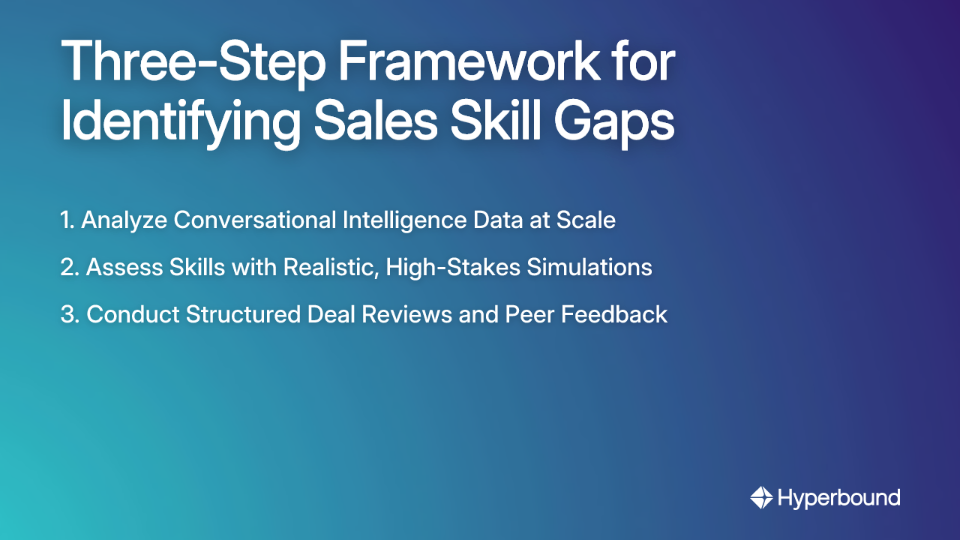
Let's examine a systematic, three-step approach to uncovering skill gaps across your entire sales organization:
The days of random call sampling and gut-feel assessments are over. Today's sales leaders need to leverage conversational intelligence platforms to analyze thousands of call transcripts and recordings, uncovering systemic patterns that individual observations might miss.
What to look for in your analysis:
Interestingly, despite the power of AI to transform this analysis, Salesloft reports that only 6% of sellers use AI for task prioritization, while 61% use it for engagement personalization and 51% for analyzing call recordings. This represents a significant missed opportunity to leverage technology for identifying skill gaps.
Traditional role-playing often fails to replicate the pressure and unpredictability of real sales situations. Modern skill assessment requires more realistic scenarios that truly test a rep's abilities.
AI-powered simulation platforms like Hyperbound allow reps to practice critical conversations—from cold calling to objection handling and renewals—against hyper-realistic AI buyer personas. These simulations create a safe, repeatable environment to assess skills without risking live deals.
The key advantages of simulation-based assessment include:
When implementing simulations, focus on creating customizable scorecards that evaluate reps against specific skills aligned with your vision and methodology. This ensures assessments directly connect to your strategic priorities.
While data and simulations provide valuable insights, there's still immense value in structured human analysis of deals—both won and lost.
Implement a formal process for reviewing deals with questions like:
Additionally, encourage peer evaluations and call shadowing with top performers to share best practices and provide constructive feedback. This creates a culture of continuous improvement and helps surface skill gaps that might not be apparent in data alone.
Identifying skill gaps is only half the battle. To drive real performance improvement, you need a systematic approach to closing those gaps through targeted coaching.
Generic training programs rarely address the specific skill deficiencies of individual reps. Once you've identified particular skill gaps, develop personalized coaching plans that target those exact areas.
This is where the "coaching deficit" often appears: according to Salesloft research, while 94% of managers claim to provide coaching, 37% of sellers report receiving little to no personalized feedback. This disconnect highlights the need for more structured, consistent coaching systems.
The reality is that most sales managers lack the bandwidth to provide consistent, personalized coaching to every rep. This is where AI-powered tools can dramatically extend coaching capacity.
Platforms like Hyperbound help scale coaching efforts through:
These tools don't replace manager coaching but rather amplify it, ensuring every rep receives consistent feedback aligned with your methodology. They also surface top-performing calls for peer learning and sharing of best practices across the team.
Proactively identifying and addressing sales skill gaps is no longer optional for revenue leaders—it's essential for building a resilient, high-performing organization that can adapt to changing market conditions.
By implementing a modern approach that leverages:
You can create a sales team that's always positioned for success, regardless of market shifts or competitive pressures.
Remember that skill development isn't just about hitting this quarter's number—it's about building sustainable competitive advantage through sales excellence. When you systematically identify and close skill gaps before they impact revenue, you're not just solving today's problems—you're preventing tomorrow's.

Take a moment to evaluate your current assessment and coaching processes. Are you catching skill gaps early, or are you waiting for lagging indicators to sound the alarm? The answer could be the difference between consistent growth and perpetual fire-fighting.
The most common sales skill gaps often involve inconsistent discovery, poor objection handling, inability to articulate value propositions, and a failure to engage senior-level buyers strategically. These gaps manifest as reps defaulting to technical pitches instead of focusing on business outcomes, struggling to advance deals through the pipeline, and deviating from proven sales methodologies. The "confidence-competence gap" is also a major issue, where reps believe they are strong in areas like prospecting, but their managers see critical risks being missed.
Lagging indicators are historical metrics that show what has already happened (e.g., missed quotas, low win rates), while leading indicators are early warnings found in daily activities that predict future outcomes (e.g., poor talk-listen ratios, deals stalling). Relying on lagging indicators means you're always reacting to problems after revenue has been impacted. By focusing on leading indicators like inconsistent discovery or low pipeline velocity, sales leaders can proactively identify and coach on skill gaps before they affect the bottom line.
You can systematically identify skill gaps using a three-step, data-driven framework: analyze conversational intelligence data at scale, assess skills with realistic simulations, and conduct structured deal reviews. This modern approach moves beyond gut feelings. First, use conversational intelligence to find patterns across thousands of calls. Second, use AI-powered simulations to test skills in a safe, consistent environment. Finally, complement this data with structured deal reviews and peer feedback to get a complete picture of your team's capabilities.
AI helps scale sales coaching by automatically analyzing calls, providing instant and personalized feedback to reps, and identifying specific areas for improvement without consuming manager bandwidth. Tools like AI Real Call Scoring can review every customer conversation against your playbook, while AI Coaching platforms provide real-time suggestions and reinforcement. This amplifies a manager's efforts, ensuring every rep receives consistent, targeted guidance to close their specific skill gaps and align with best practices.
AI simulations are more effective than traditional role-playing because they provide a consistent, scalable, and safe environment that better replicates the pressure of real sales scenarios. Unlike peer role-plays, AI simulations ensure every rep faces the exact same challenge, allowing for objective assessment. They can be scaled to the entire team simultaneously and customized for your specific buyers and products. This allows reps to practice and fail without risking live deals, building real confidence and competence.










Use Cases
Legal