
A rep who has memorized every objection response in the deck still freezes when a prospect says "this is too expensive" on a live call. That gap, between what a rep knows and what a rep can retrieve under pressure, is the actual problem in sales objection handling, and it is almost never the problem that objection-handling content addresses. Most guides hand sales teams another list of scripted responses. The scripts are rarely the missing piece. Recall under pressure is.
This piece skips the script list. It covers what happens biologically and mechanically in the seconds after an objection lands, the framework backed by call-data research for using those seconds well, and what a sales organization has to build so that the right response actually surfaces mid-call instead of thirty minutes later in the debrief.
Objection handling is the rep's response to buyer pushback, most commonly about price, product fit, timing, or internal buy-in, with the job being to address the concern and keep the deal moving rather than let it stall or die. Gong's analysis of 67,149 sales meetings, drawn from a database of five million recorded calls, set out to find what actually separates reps who navigate objections well from reps who do not. The findings are less about what to say and more about what happens in the rep's nervous system the moment the objection lands.
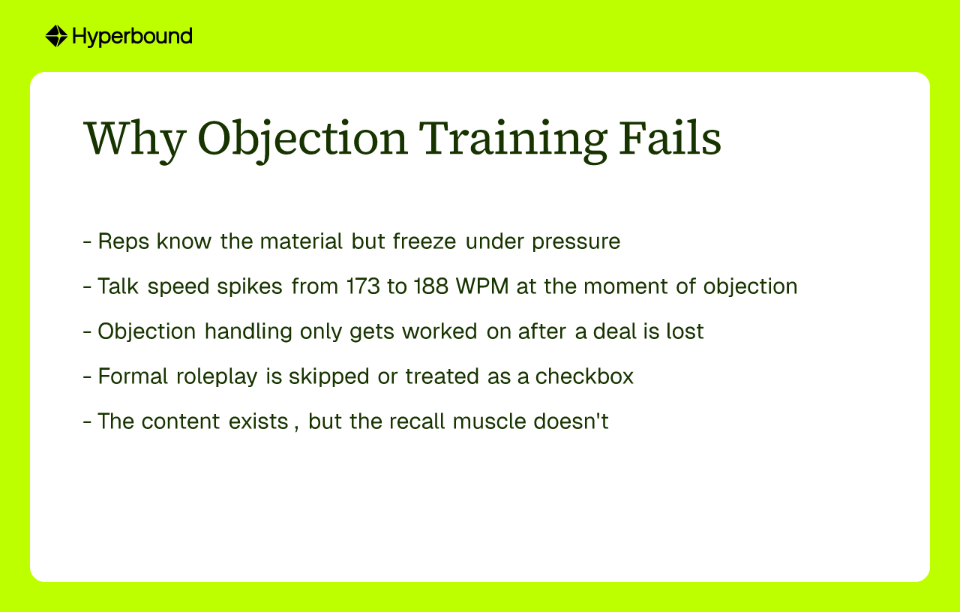
Here is the breakdown, in the researchers' own data: unsuccessful reps do the opposite of the correct first move. They interrupt and they speed up. Average talk speed across these calls runs about 173 words per minute, but flustered reps hit 188 words per minute the instant an objection surfaces. That acceleration is not a communication choice. It is a stress response, and it is exactly the pattern that makes an otherwise well-trained rep sound unprepared.
This is where the category-level failure of most enablement programs shows up. Sales teams invest in objection-handling content, run it in a workshop, put it in a wiki, and assume the job is done. Reddit's sales practitioner community describes the actual state of most teams bluntly: objection handling gets "worked on" only when it surfaces live on a call or gets picked apart in a post-deal review. Formal roleplay is either skipped or endured reluctantly. The content exists. The retrieval muscle does not.
This is not a discipline problem or a confidence problem. It is a documented cognitive one. Cognitive scientist Sian Beilock, author of Choke, explains why people "flub" performance in high-stakes moments: pressure causes a person to over-attend to the mechanics of a skill that should be running automatically, and that conscious re-construction is what disrupts the skill. A rep who has learned an objection response well enough to state it in a quiet training room has stored it as something close to automatic. Under live pressure, with a buyer waiting and the deal on the line, that automaticity breaks, the brain switches to consciously assembling the response piece by piece, and the assembly process is slower and more error-prone than the automatic version ever was.
Gong's talk-speed data is the symptom of exactly this mechanism. The rep who speeds up to 188 words per minute is not improvising confidently. That rep is scrambling to reconstruct, in real time, something that should have surfaced without effort, and speech accelerates because silence in that moment feels unbearable.
The fix implied by this research is not "know the material better." Most frozen reps already know the material. The fix is an external prompt that removes the need to reconstruct anything from memory in the first place, which is a different design problem than more training content.
The correct first move, according to Gong's data, is the opposite of what instinct tells a stressed rep to do. Top performers pause, and they pause longer immediately after an objection than at any other point in the call, as though the objection triggers a kind of slow motion. That deliberate calm, not the words that follow it, is what builds trust with the buyer in the moment.
This is not a sales-specific quirk. It shows up in negotiation research generally. A four-study paper published in the Journal of Applied Psychology, titled "Silence is golden," found that silent intervals of three seconds or longer tended to precede negotiation breakthroughs, and that breakthroughs were more likely to follow a silent pause than to occur at any other point in a conversation. The psychological reason reps resist this is well documented too: when put on the spot, people feel an urge to reply immediately or risk looking weak. But pausing does the opposite of what that instinct predicts. It shifts the mind out of defensive, fixed-pie thinking and into a more reflective state, one that is more likely to find an outcome that works for both sides.
So the pause is not dead air to be minimized. It is its own skill, and it is the first of the seven steps in Gong's data-backed objection-handling sequence:
Every step in that sequence depends on the rep having already done step one correctly. A rep who speeds up instead of pausing has already broken the sequence before it starts, no matter how good the reframe they eventually deliver would have been.
Step two in the sequence, starting with a question, is where most reps default to the wrong instinct: launching into a monologue that defends the product before understanding what is actually driving the pushback. Gong's data is specific about the failure mode to avoid here. Reps should never literally ask "why," because it reads as confrontational and puts the buyer on the defensive. The better construction is something closer to "Can you help me understand what's causing that concern?" It gets at the same information without triggering a defensive posture.
A second technique from the same research is mirroring, borrowed from Chris Voss's negotiation work in Never Split the Difference: repeating the buyer's last few words back with an upward, question-like tone. If a prospect says "this just isn't a priority right now," a mirrored response is simply "not a priority right now?" It is a low-effort prompt that reliably gets the buyer to keep talking and reveal the actual concern underneath the stated one, which is usually not the same as the words they led with.
This matters because most deals do not die on rare, out-of-left-field objections. They die on the small set of common ones that recur across nearly every deal in a given market. That is precisely why top reps study how the best in their organization handle the same handful of objections repeatedly, and it is why preempting the biggest one, price, by addressing it later in the conversation rather than the moment it comes up, is a deliberate tactic rather than an accident.
Given that most deals die on the same recurring objections rather than novel ones, waiting for the objection to surface is often the more expensive path. Because the common objections are predictable, they can be surfaced and partially defused earlier in the conversation, during discovery, before the buyer has committed to a defensive position on them. Gong's research frames this as a save-price-for-last tactic specifically: rather than letting a price objection ambush the rep late in the call when time pressure is highest, top reps address value and fit first and let price land in a context where the buyer already has reasons to say yes.
This is also where the manager-led process described by practitioners on Reddit becomes relevant, not as an abstract best practice but as the mechanism that makes preemption possible at all. A rep cannot preempt an objection they have not been told to expect. That requires the organization to know, systematically, which objections recur for which buyer type, and to put that expectation in front of the rep before the call, not after it.
The seven-step sequence is the same regardless of which of the four common objection types (price, product, timing, or internal buy-in) is on the table. What changes is only what the reframe and resolution target. Against a price objection, the sequence lands as a pause instead of an instant discount, a clarifying question like "Can you help me understand what's driving the price concern?" instead of defending the number, and an isolate step that confirms price is the real blocker rather than a stand-in for unclear ROI or a stakeholder who has not bought in. The reframe connects cost to the outcome it produces, and the resolution is stated once and left to stand, with no oversell piled on top.
The same holds for a timing objection ("we're not ready to move this quarter") or a buy-in objection ("I need to run this by my team"). Only the reframe and resolution adapt to the specific concern; the sequence itself does not change. That consistency is exactly what makes it teachable as a framework rather than a library of individual scripts. And "it's too expensive" is rarely about the number, either; it is usually a stand-in for a deeper concern, which is why the isolate step matters before reacting. We unpack what that phrase actually means in Why Your Clients Say 'It's Too Expensive' (And What They Really Mean).
Here is the sequence condensed into something a rep can hold in working memory, or better, something an organization can put in front of a rep at the moment it is needed rather than asking the rep to remember it cold:
StepWhat it looks likeWhy it matters1. PauseSilence for a beat before respondingSignals calm authority; silent intervals of 3+ seconds precede negotiation breakthroughs more often than any other point in a conversation2. Question"Can you help me understand what's causing that concern?"Surfaces the real driver without the defensive trigger of asking "why"3. ValidateAcknowledge the concern is reasonableLowers the buyer's guard before the response arrives4. IsolateConfirm this is the actual blockerPrevents solving the wrong problem5. Permission"Would it help if I..."Keeps the buyer in control of the conversation rather than being talked at6. ReframeConnect the concern to the outcome, not the featureMoves the conversation off the objection's own terms7. ResolveState the resolution plainlyCloses the loop without re-opening doubt through oversell
A card like this is deliberately not a script. Practitioners who manage reps day to day are explicit about why word-for-word scripts fail: top performers each have their own delivery style, and confidence in an objection response comes from product mastery, not from reciting someone else's lines. A framework that surfaces the points to hit, rather than the words to read, respects that reality. A teleprompter does not.
The trouble is that a card only helps if it is in front of the rep at the exact moment it is needed, and most teams have no system for putting it there. Individual reps already sense they need a memory aid in the moment; flashcards are the most common self-organized workaround. But that instinct is exactly the problem in miniature: it is ad hoc, individual, and never updates when a new objection shows up in the field. What follows are the steps that scale it into something the whole team can rely on.
1. Log the real objections, not the textbook ones. Have every rep write down what buyers actually said, who said it, and what could have been said better. Then run a team session to find the objections that recur most. Practicing against sanitized textbook phrasing does not transfer; practicing against the exact, messy way a real prospect said "we already have a tool for this" does.
2. Coach the framework with those objections. At the start of each session, rehearse the seven-step sequence against the real objections you just collected. This turns the framework from a concept into a retrieval exercise.
3. Put the likely objections in front of the rep before the call. Add a "most likely objections" field to the call planner so each rep walks in already anticipating what this specific buyer will say. Anticipation is what lets a recurring objection stop landing as a surprise.
4. Externalize the prompt a step further. The principle behind all of this is not new, and it works in far higher-stakes domains. The WHO's "Safe Surgery Saves Lives" checklist, led by Atul Gawande and documented in The Checklist Manifesto, was a single page run in minutes at three points in an operation. Across 7,688 patients in eight cities it cut major complications from 11 percent to 7 percent and inpatient deaths from 1.5 percent to 0.8 percent. Those surgeons were not better trained than surgeons before the checklist existed. The checklist worked because it put a handful of critical steps in front of them at the exact moment they were needed, so nothing depended on a stressed brain retrieving the right step from memory.
5. Accept that this has to live in the tooling, not in manager discipline. Frontline managers structurally cannot close this gap alone. Coaching is the first activity cut when a calendar fills up, and a manager cannot sit on every call or personally drill every rep on every recurring objection. The bottleneck is not content or willpower; it is manager bandwidth. The only durable fix is an external prompt that surfaces the right response mid-call, without a manager in the room.
That is the sales equivalent of the surgical checklist: a card that surfaces the right objection response the moment a price, competitor, or product trigger appears, rather than asking the rep to retrieve it from memory while the buyer waits. Hyperbound's Live Call Coaching ships this as a silent, read-only desktop side panel with two modes, Guided Coaching and Active Listening, surfacing the key points to hit during the call, with no bot joining the call. It is the difference between having good objection content and having a team that reliably executes it.
Hyperbound is the Revenue Activation Platform, closing the loop between analyzing real sales conversations, rehearsing them, and coaching reps at the deal level. That loop has three concretely different parts, and this problem sits on the boundary of two of them.
On the coaching side, Hyperbound Perform, the real-call scoring and deal-coaching part of the platform, gives managers objective evidence of whether the objection-handling sequence was executed on live calls, rather than relying on a rep to recall it or a manager to have caught it in review. On the rehearsal side, Hyperbound Practice includes AI roleplays for objection handling, built so reps rehearse against realistic buyer pushback before they are on a real call. The underlying model is straightforward: rehearse until the behavior changes, then score every real call to verify that it did. That pairing, Practice for rehearsal and Perform for real-call scoring, is how a manager can actually confirm an objection-handling program is working rather than assuming it from a workshop's attendance sheet.
Practice also compresses the repetition a rep would otherwise get only from months of live calls into concentrated rehearsal sessions, which is the same underlying principle: repetition under low-stakes conditions is what makes the response automatic before it has to be automatic in front of a buyer.
A few failure modes recur even after a team adopts the sequence above.
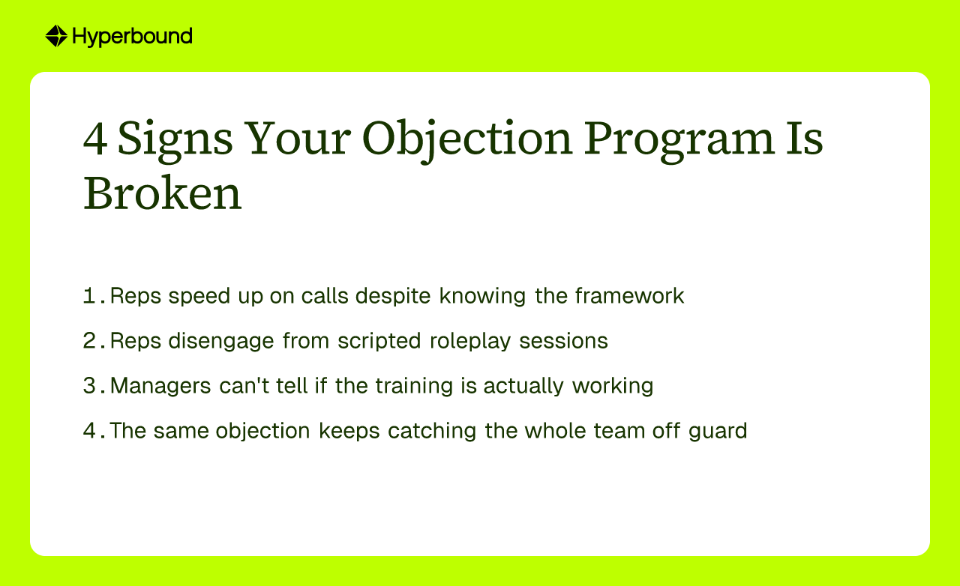
The rep memorizes the framework but still speeds up on the call. This usually means the practice conditions were too low-pressure to trigger the same stress response as a real objection. Roleplay against real, transcribed objections, not sanitized textbook phrasing, closes this gap, because the specific, awkward way a buyer actually says something is what triggers the freeze response in the first place.
Reps resent scripted roleplay and disengage. This is a legitimate signal, not a training-compliance problem to override. The fix is not more roleplay of the same kind. It is switching from word-for-word scripts to a points-to-hit framework that leaves room for a rep's own voice, since confidence in objection handling comes from mastery of the material, not from memorized lines.
Managers cannot tell if the program is working. Without scoring real calls, an enablement program is running on faith. Pairing rehearsal with objective scoring of live calls is what turns "we ran a workshop" into "we can show the behavior changed."
The same objection keeps catching the team off guard. This points to a gap in the anticipation step, not the response step. If a recurring objection is still landing as a surprise, it has not made it into the call planner or the pre-call anticipation process, and no response framework fixes an objection the rep did not see coming.
The best way is to use a structured seven-step sequence: pause, ask a clarifying question, validate the concern, isolate the real objection, get permission to respond, reframe around the outcome, and resolve without overselling. This works because it disrupts the stress-driven rush that causes reps to interrupt and speed up, and it keeps the conversation focused on the buyer's actual concern instead of a scripted rebuttal.
Freezing is a cognitive stress response, not a knowledge problem. Under pressure, the brain switches from automatic recall to conscious reconstruction, which is slower and more error-prone. On live calls, this often shows up as a talk-speed spike from about 173 to 188 words per minute, signaling scrambling rather than confidence.
Pause. Top performers pause longer immediately after an objection than at any other point in the call. A deliberate beat builds calm authority and creates space to respond intentionally rather than defensively.
Aim for at least three seconds. Negotiation research found that silent intervals of three seconds or longer tended to precede breakthroughs more often than any other point in a conversation, so the pause is not dead air; it is part of the response.
Start with a pause, then ask a clarifying question such as "Can you help me understand what's driving the price concern?" rather than discounting or justifying. After that, validate the concern, confirm price is the real blocker, get permission to walk through how similar buyers have thought about it, reframe around the outcome, and state the resolution without overselling.
Isolate by asking a question that confirms whether the stated concern is the actual blocker or a symptom of something else. For example: "Is price the only thing holding us back, or is there something else you're weighing?" This prevents the rep from solving the wrong problem.
Yes, when the objection is predictable. Because most deals die on a small set of recurring objections, top reps surface and address common concerns earlier in the conversation, before the buyer has committed to a defensive position. The research frames this as a save-price-for-last tactic: value and fit first, price later.
Regularly, in short cycles, using real objections. A manager-led cadence that collects actual objections, identifies the most recurring ones, rehearses them before calls, and adds likely objections to call planning works better than a one-time workshop or a static script library.
Yes, but only up to a point. Individual practice helps recall, and many reps already build personal flashcards for this reason. But recurring objections are team-level patterns, so systematic improvement also requires a shared process for identifying and rehearsing the most common objections.
An objection is a stated concern the rep can directly address, such as price or timing. A stall is often a symptom of an unstated objection the buyer has not surfaced yet, which is why the isolate step matters before responding: it confirms what is really blocking the deal.










Use Cases
Legal