
You've spent weeks perfecting your product messaging. Your marketing team has created beautiful slide decks, battlecards, and email templates. You've hosted multiple training sessions to explain the new positioning.
And yet, when you listen to actual sales calls, it's as if none of that ever happened.
One rep is still using last quarter's value props. Another is making up product capabilities on the fly. A third is undercutting your pricing strategy with unauthorized discounts.
Sound familiar?
If you're feeling like you're "just broadcasting information and hoping it lands," you're not alone. Many sales leaders and enablement professionals struggle with what seems like an impossible challenge: getting an entire sales team to consistently deliver the same message to customers.
The good news? Message consistency isn't about scheduling more meetings or training sessions. It's about building a system that reinforces your messaging through practice, feedback, and continuous improvement.
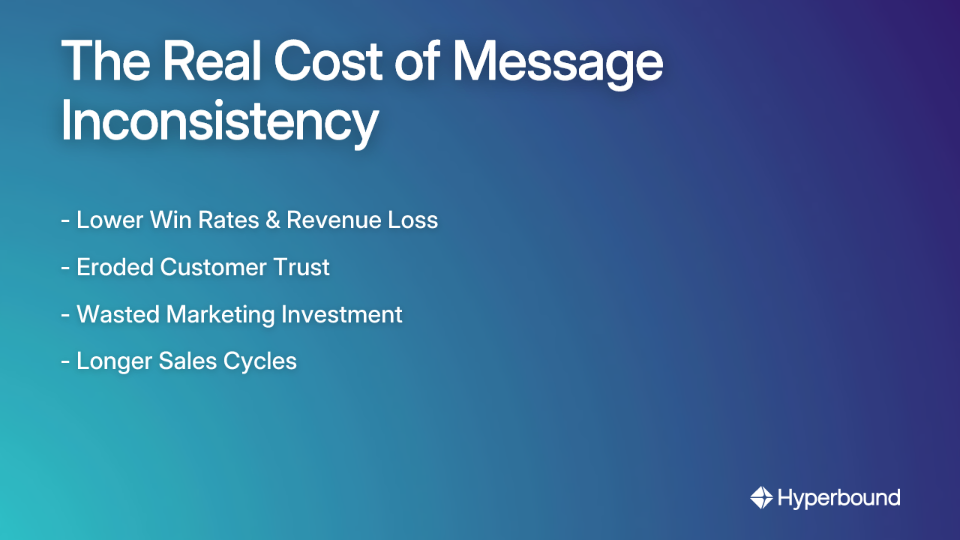
Before diving into solutions, let's understand why this matters so much. Message inconsistency isn't just an internal annoyance—it directly impacts your bottom line in several ways:
Companies with consistent sales messaging see significantly higher win rates. Even a modest 2-5% increase in win rates can drive exponential revenue growth over time. When reps deliver conflicting information about products, pricing, or positioning, they undermine customer confidence and lose deals.
Think about brands known for consistency—like Apple or Starbucks. When you interact with them, you know exactly what to expect. The same principle applies to your sales conversations. When prospects hear different messages from different reps, it creates confusion and erodes trust in your company.
Companies invest billions in creating cohesive brand messaging and market positioning. But this investment is squandered when the message breaks down at the critical moment of customer interaction. It's like carefully designing a beautiful storefront, then having your sales associates tell customers the store sells completely different products.
When prospects receive inconsistent information, they often need to verify details with multiple sources, request additional calls to clarify contradictions, or simply delay decisions until they can make sense of the mixed signals. All of this extends your sales cycle and decreases momentum.
If consistent messaging is so important, why is it so hard to achieve? The problem typically stems from three fundamental issues:
When marketing, product, and sales teams operate in silos, message consistency becomes nearly impossible. This misalignment often leads to disparate data, content misuse, and clunky handoffs.
The typical scenario plays out like this:
Traditional enablement methods are fundamentally flawed. As one sales leader bluntly observed: "Nobody is flipping through Google Slides on their own time, nor is anyone watching a recorded Zoom meeting."
Most companies rely on a passive model of information distribution:
This "high-fluff," low-engagement approach fails to make an impact, and critical information gets lost in the noise.
The most critical missing element in most messaging rollouts is practice. Even when reps understand the new messaging in theory, they haven't built the muscle memory to use it under pressure.
Without structured practice:
This explains why reps may nod enthusiastically during your training but never implement what they learned. It's not willful disobedience—it's lack of practical application.

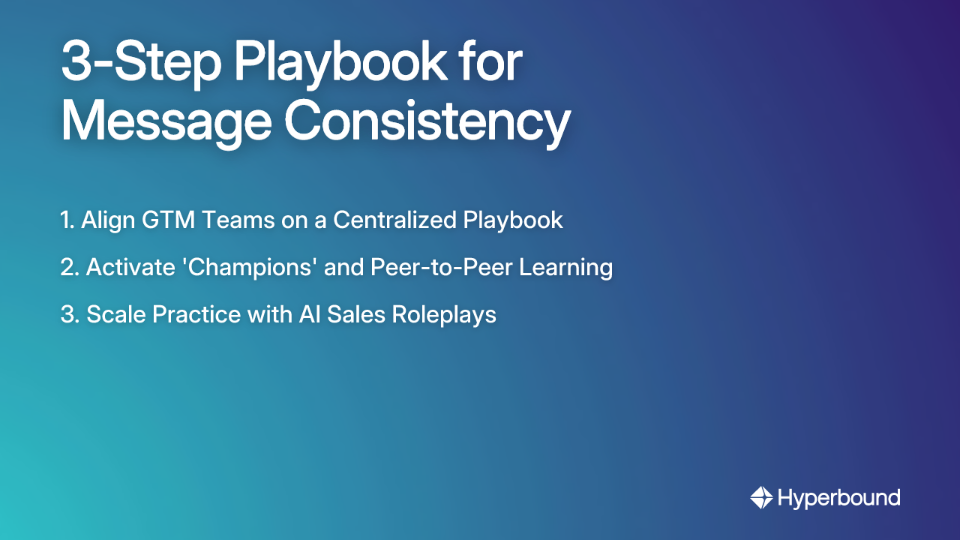
Now that we understand the problem, let's focus on solutions that don't require endless meetings. Here's a three-step playbook for driving message consistency at scale:
Before you can achieve consistent messaging, you need to ensure all teams are working from the same source of truth.
Instead of top-down enablement, leverage the power of peer influence:
The biggest lever for consistency is practice, but traditional roleplays are time-intensive and don't scale. This is where AI can transform your approach:
To ensure your messaging sticks, you need visibility into real conversations and a mechanism for continuous coaching:
Manually reviewing calls is impossible at scale. AI call analysis can automate the QA process to spot deviations from the playbook:
Once you identify a gap, AI can provide immediate, targeted feedback to the rep:
Message consistency isn't achieved in meetings—it's built through reps having the confidence and muscle memory from consistent practice. By implementing an asynchronous system of alignment, practice, and data-driven feedback, you can transform your sales team from a group of individual contributors into a cohesive revenue engine delivering a consistent, compelling message to every prospect.
Stop broadcasting and hoping. Start building a world-class sales team with AI-powered practice and coaching that scales across your entire organization.
Sales message consistency is the practice of ensuring every salesperson on a team communicates the same core value propositions, product information, and brand messaging to customers. This means that regardless of which rep a prospect speaks to, they receive a unified and coherent understanding of your company's offerings, pricing, and competitive advantages.
A consistent sales message is crucial because it directly impacts revenue and customer trust. When prospects hear a unified message, it builds confidence in your brand, leading to higher win rates, shorter sales cycles, and increased customer loyalty. Inconsistency, on the other hand, creates confusion, erodes trust, and wastes marketing investment.
The three primary causes of inconsistent sales messaging are disconnected teams, ineffective enablement, and a lack of practice. When marketing, product, and sales teams operate in silos, messages become fragmented. Traditional training methods like passive slide decks ("broadcast and hope") fail to stick. Most importantly, without structured practice, reps revert to old habits under pressure.
You can improve message consistency asynchronously by creating a centralized playbook, activating peer learning, and scaling practice with AI. A central playbook ensures everyone works from the same information. Activating "champions" and sharing peer-generated content fosters organic adoption. Finally, AI-powered roleplays allow reps to practice anytime, anywhere, building muscle memory without clogging calendars.
AI plays a critical role by providing scalable practice and data-driven feedback. AI sales roleplay platforms allow reps to practice key messaging against realistic buyer personas in a risk-free environment. Additionally, AI call scoring tools can analyze real customer conversations to measure message adherence, identify gaps, and deliver personalized coaching automatically, ensuring continuous improvement.
You can measure message consistency using AI-powered call analysis tools. These platforms automatically review and score real sales calls against your company's playbook and methodology. They track adherence to key talking points, value propositions, and objection-handling frameworks, providing objective data on how well the message is being delivered in the field.
To start creating a centralized sales playbook, begin by aligning your marketing, product, and sales teams on shared business objectives, not just individual metrics. Then, choose a single, accessible platform (like a sales enablement tool or a shared knowledge base) to house all current messaging, competitive intelligence, and content. Finally, involve sales "champions" in the content creation process to ensure it's relevant and useful.

Ready to drive message consistency at scale? Discover how Hyperbound's AI-powered platform can help your team master your messaging without clogging calendars.










Use Cases
Legal