
A sales battle card is a one-page reference that gives a rep the exact points to make in a specific competitive or objection situation, on the call, in seconds. Most battle card programs fail for one of two reasons: the cards are built wrong: too long, too generic, unsourced, stale within a quarter, or they are built correctly and nobody opens them mid-call anyway. This guide addresses both. The first half covers how to write cards that hold up under real call pressure. The second half addresses the adoption problem directly, because a well-written card that sits unopened in a shared drive delivers zero value regardless of how well it is written.
A battlecard exists to compress a competitive or objection scenario into what a rep needs to say in the fifteen seconds after a prospect raises it. It is not a competitor profile, not a feature comparison spreadsheet, and not a script. It is a decision aid built for the moment a prospect names a competitor, raises a pricing objection, or asks a pointed technical question. A rep has to respond before the conversation moves on without them.
This distinction matters because most of the thin content ranking for "sales battlecards" treats the card as a knowledge-base article: exhaustive, static, written once and left alone. A functioning card is the opposite. It is narrow by design, built around a single trigger, and treated as a living document that gets revised as the market moves.
Enablement teams building or auditing a battlecard program should hold two goals simultaneously: the card has to be right, and the rep has to reach for it. Most published guidance covers only the first. The second is where programs actually fail, and it is where this guide spends its second half.
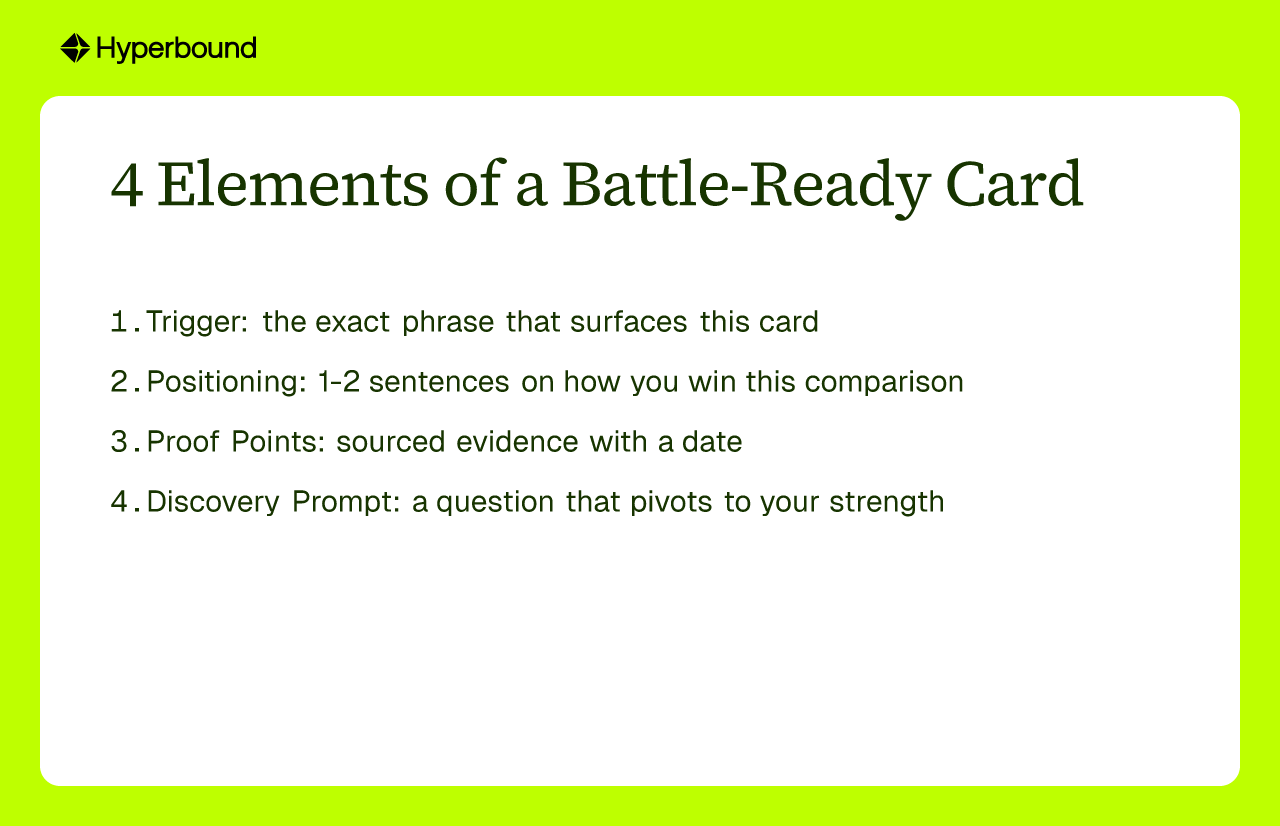
A battlecard built for use during a live call needs four elements, in this order of priority:
ElementPurposeFailure mode to avoidThe triggerThe exact phrase or situation that should surface this cardCards with no defined trigger sit unused because nobody knows when to reach for themPositioning statementOne or two sentences on how the product wins the specific comparison at handGeneric positioning that applies to every competitor equallyProof pointsThe specific evidence (a customer result, a certification, a spec) that backs the positioningClaims without a source or a dateDiscovery or pivot promptA question that redirects the conversation toward the strength being assertedA scripted rebuttal that only works if the prospect says the exact expected line back
Pricing cards need one additional element: the reframe. A pricing objection is rarely actually about price; it is about value not yet established. The card should give the rep a way to move the conversation from cost to outcome, not a discount authority table; discount logic belongs in a deal desk policy, not a battlecard. If the goal is to decode what a pricing objection is really signaling, the card should surface that signal rather than a lower number.
Feature comparison cards are the most commonly overbuilt asset in this category. A single card that tries to compare every feature against every competitor becomes unreadable at fifteen seconds of read time. The fix is scope discipline, covered next.
The most common structural mistake in battlecard programs is building one long document per competitor instead of one short card per situation. A rep on a live call with a prospect who just named a specific competitor does not need that competitor's entire company history, funding, and roadmap. The rep needs the two or three things that matter for the deal in front of them, in the next fifteen seconds.
The fix is to scope each card to a single trigger: one competitor mention, one objection, one pricing scenario, one technical question. A program covering three competitors and five recurring objections should produce roughly fifteen short cards, not five long ones. Each card should be readable in under a minute, because that is roughly the amount of attention a rep has to give it before the conversation moves on without them.
This scoping also makes maintenance realistic. A team is far more likely to keep fifteen one-page cards current than five master documents, because updating a single trigger scenario after a competitor changes its pricing takes minutes, not a full rewrite.
A card written as a script assumes the prospect will follow the expected line. Prospects do not cooperate with scripts. The moment a prospect's actual wording diverges from what the card anticipated, a scripted rebuttal breaks and the rep is left improvising anyway, except now they are improvising while also holding a document that no longer matches the conversation.
Points survive that divergence. A card built as three or four bullet points (the claim, the proof, the pivot) gives a rep the substance to work with regardless of the prospect's exact phrasing. The rep still has to deliver it in their own words, but they are not searching for a sentence that matches what is on the page. The alternative is a rep who recites while talking over the person they are selling to, which is the exact failure a scripted card invites. This is also why brevity is not a stylistic preference; it is the difference between a card that gets used at conversational speed and one that gets glanced at and abandoned.
Discovery prompts follow the same logic. A prompt written as "ask about their current tooling" gives the rep more to work with under pressure than a scripted question the prospect might answer in a way the card did not anticipate.
A claim on a battlecard that a rep repeats to a prospect and cannot back up if pressed damages trust in that specific claim and in every other claim the rep makes afterward. Every proof point on a card needs a source: a customer result, a named certification, a dated pricing change, and every card needs a visible last-updated date.
The date matters as much as the source. Competitive positioning decays quickly: a competitor ships a feature, changes its pricing tier, or loses a certification, and a card built six months earlier is now actively wrong. A card without a date on it invites a rep to trust stale information with no way to know it is stale. The fix is procedural, not clever: every card gets a review cycle, tied to whoever owns competitive intelligence for that competitor, and the date on the card reflects the last actual review, not the original creation date.
A battlecard that lives in a shared drive or a wiki page competes with the CRM, the dialer, and the meeting window for a rep's attention during a live call, and it loses that competition almost every time. The access point has to be somewhere the rep is already looking, which in practice means one of three places: an enablement platform surfaced inside the CRM, a CRM opportunity record itself, or a sales playbook tool integrated into the call environment.
None of these placements solve the deeper adoption problem on their own, and enablement teams that have shipped a battlecard library into any of these three locations and then measured actual open rates during live calls generally find the same result: low single-digit usage relative to the number of calls where a trigger scenario occurred. The placement determines whether the card is reachable. It does not determine whether the rep reaches for it mid-sentence while trying to hold a live conversation together. That gap is the subject of the second half of this guide.
A competitor-specific card should follow a fixed shape so reps can scan it the same way every time, regardless of which competitor was named. A workable structure:
Pricing cards need a different shape because a pricing objection is a negotiation moment, not a factual dispute. The card should reframe the conversation toward the outcome being purchased rather than defend the number. A pricing card that only gives a rep a lower number to concede to is not a battlecard; it is a discounting policy, and it belongs somewhere else entirely.
Objection cards (the third major category) follow the competitor-card shape but swap the trigger for the specific concern raised: implementation timeline, security posture, integration overhead. The proof point for these is usually a certification, an audited status, or an integration that already exists, and the card should state it as a fact the rep can lean on, not a hedge. The same discipline shows up in the objection handling training that turns these cards into practiced responses.
Everything above produces a good card. It does not produce a used card, and this is where most battlecard programs actually fail. A rep on a live call is managing the prospect's attention, their own train of thought, and usually a CRM tab in the background. Asking that same rep to also recognize a trigger, switch windows, scan a document, and translate a bullet point into a spoken sentence, inside the same fifteen-second window where the prospect is waiting for a response, is asking for a context switch that most reps simply will not make under live pressure. Enablement teams already know this. It shows up as high card-creation counts and near-zero usage data, and it is the single most common reason a well-resourced battlecard program produces no measurable change in win rate.
The honest diagnosis is that the card was never the constraint. The moment of retrieval was. A rep does not fail to use a battlecard because the card is poorly written; a rep fails to use it because reaching for a document mid-conversation breaks the conversation itself.
This is also where the category of live call coaching tools has emerged over the past year and a half, attempting to solve exactly this retrieval problem by surfacing guidance during the call instead of asking the rep to go find it. Early versions of this category were largely built on a teleprompter model that hands the rep words to read rather than points to hit; other approaches surface the points to hit and leave the wording to the rep. The category is young enough that the underlying technology only recently became good enough to attempt this well.
Hyperbound's Practice and Perform products address the battlecard adoption problem from two directions without requiring live call retrieval. Practice lets reps rehearse the exact scenarios a battlecard covers: a competitor named, an objection raised, a pricing question asked. Reps internalize the points through AI roleplays with buyer personas, so the card becomes instinct rather than a document to consult mid-call. Perform then scores real calls against the same battlecard criteria, surfacing where reps executed well and where they missed, with timestamps and coaching notes. This closes the loop between preparing for a conversation and executing it, without asking a rep to switch windows during the call.
For teams that want live call guidance, Live Call Coaching is now available in Hyperbound Perform. It runs as a silent, read-only side panel with two modes: Guided Coaching, which surfaces the playbook points to cover, and Active Listening, which reflects the prospect's own language.
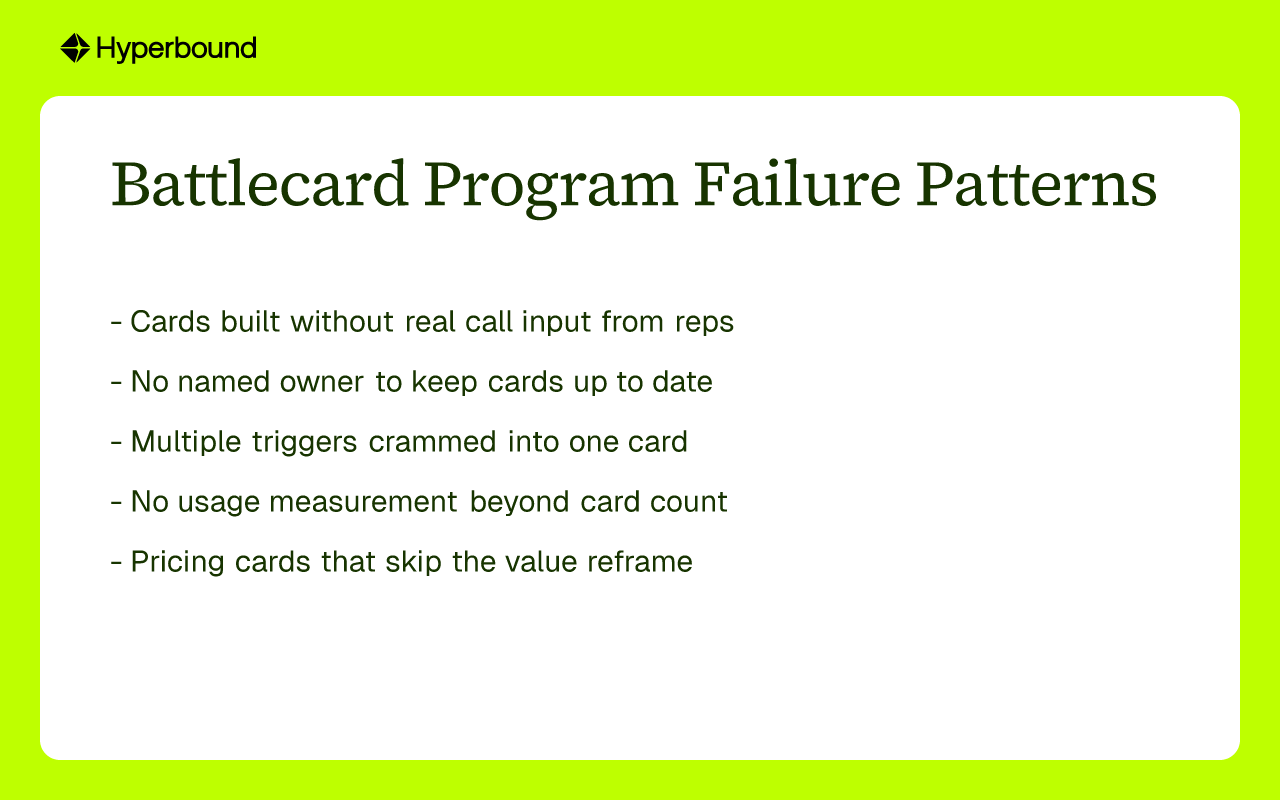
A few failure patterns show up repeatedly in battlecard programs, independent of whether a live coaching layer is in place:
The right number follows from the trigger list, not a target count. A team with three main competitors and five recurring objection types needs roughly fifteen to twenty short, single-trigger cards rather than a handful of long master documents: scope discipline keeps the count high but each card fast to read and easy to update.
Content ownership typically sits with whoever owns competitive intelligence, usually product marketing or enablement, but the card should be validated against real call recordings before publishing. A card that has never been checked against how reps and prospects actually talk tends to read well internally and fail on a live call.
On a fixed review cycle tied to a named owner, not on an ad hoc basis. Because competitive positioning and pricing shift quickly, a card without a visible last-reviewed date should be treated as unverified regardless of how recently it was written.
A battlecard built for live use needs four elements in priority order: a trigger that signals when to use it, a positioning statement that frames the win, sourced proof points with dates, and a discovery or pivot prompt that redirects the conversation. Without these, a card often becomes a generic competitor profile that reps ignore mid-call.
Battlecards should live where reps are already working: inside the CRM, in an enablement platform surfaced in the CRM, or in a sales playbook tool. A shared drive or wiki page competes with the meeting window for attention and almost always loses. Placement alone does not guarantee adoption, but it determines whether a card is reachable at the moment of need.
Most programs fail not because the cards are poorly written, but because reps do not retrieve them during a live call. The moment of retrieval is the bottleneck: asking a rep to switch windows, scan a document, and translate bullet points into speech while a prospect waits is a context switch most reps won’t make. High card-creation counts and near-zero usage data are the telltale sign.
No, it changes when and how the card reaches the rep, not whether the card needs to be well-written in the first place. A poorly scoped, unsourced card surfaced automatically mid-call is still a poorly scoped, unsourced card. The writing discipline covered earlier in this guide remains the foundation; automatic surfacing solves the separate problem of retrieval.
No. Conversation intelligence reports on what happened after the call has ended and has no bearing on the call in progress. Live call coaching, as a category, operates during the call itself, while the outcome is still changeable.










Use Cases
Legal