
You've invested in onboarding your sales team. You've run the bootcamps, delivered the product training, and shared the battle cards. Yet three months later, your reps still struggle with the same objections and fumble through critical moments in calls. Sound familiar?
The problem isn't your training—it's the lack of continuous practice. Most sales organizations treat practice as an event rather than a habit. Meanwhile, your reps spend less than 30% of their time actually selling, making every customer conversation precious.
The solution isn't more meetings or formal training sessions. It's embedding practice into your team's daily workflow—right where they already spend their digital day: Slack.
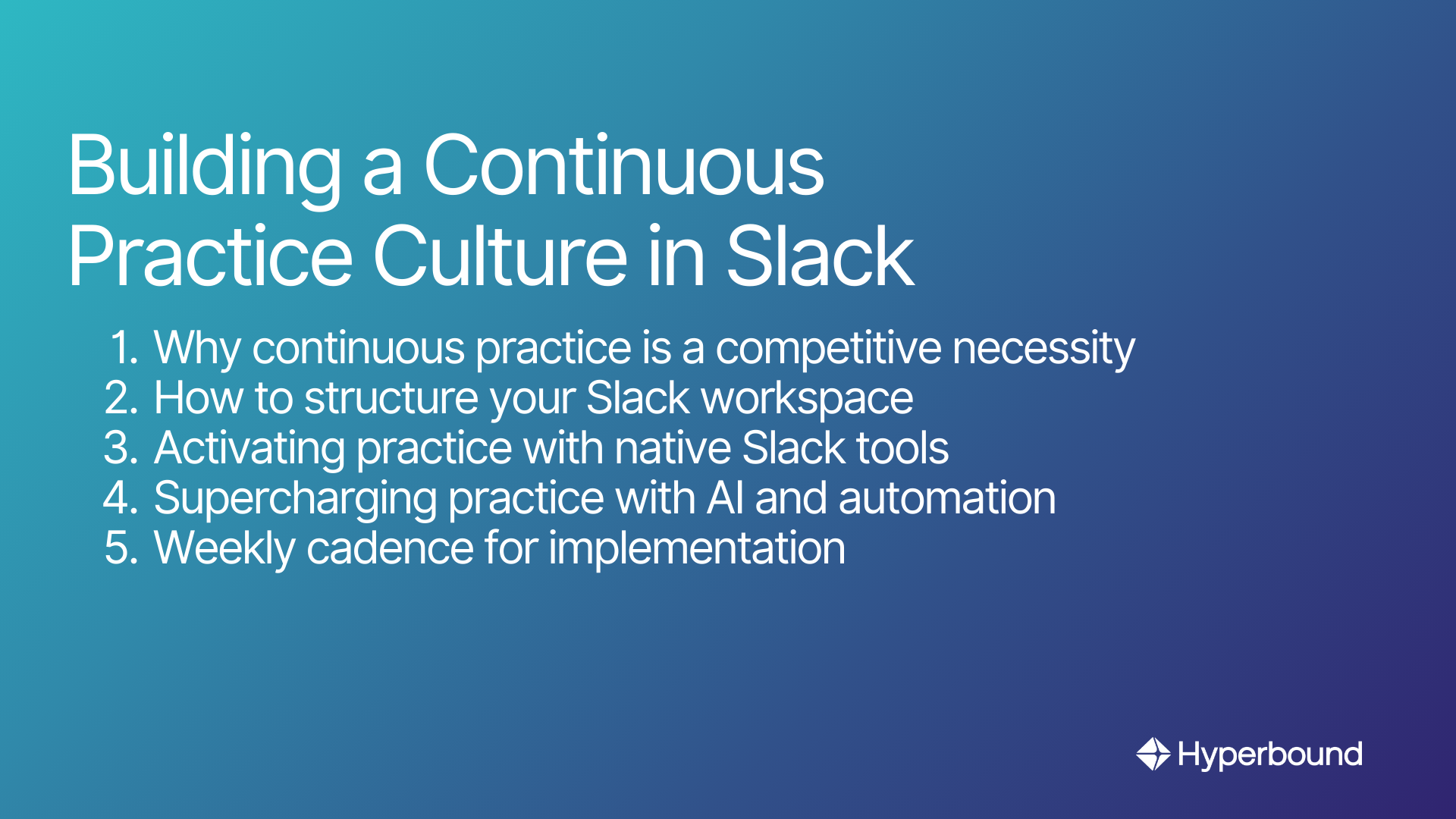
In this article, I'll show you how to transform Slack from a simple messaging app into your sales team's dedicated practice ground. We'll cover:
Let's get started.
The traditional approach to sales enablement—a 90-day onboarding program followed by occasional training when new products launch—is failing modern sales teams. Today's market moves too quickly, competitors evolve too rapidly, and buyer expectations shift too dramatically for static, point-in-time training.
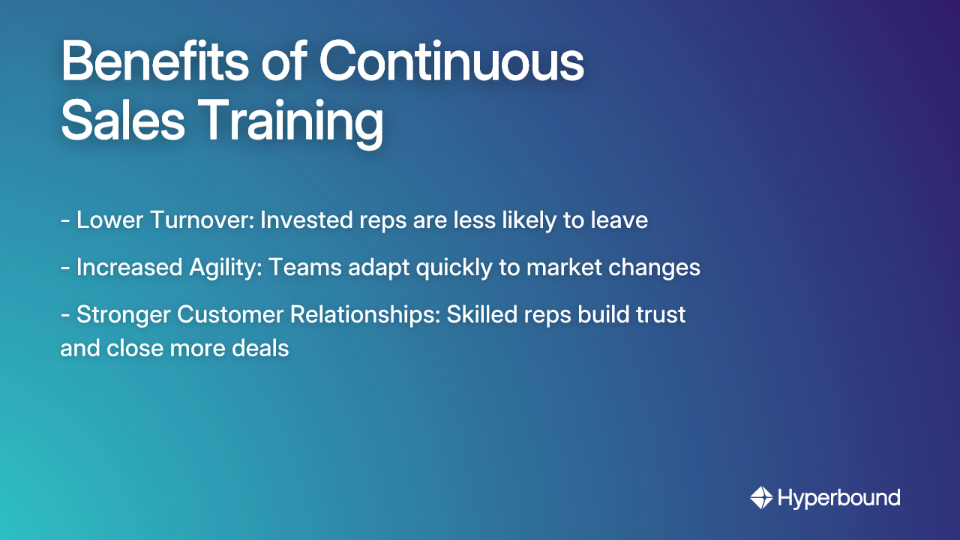
What's needed instead is what enablement experts call "everboarding"—a commitment to ongoing improvement, knowledge sharing, and skill development that never stops. Organizations with effective, continuous sales training are 4.9x more likely to get new reps to full productivity quickly.
The benefits go beyond just ramping new hires:
Building this culture sounds great in theory, but where do you start? The answer is right where your team already lives: Slack.
Before you can build a practice culture in Slack, you need to create order. Many teams suffer from what users call "channel sprawl"—an overwhelming number of channels with no clear organization. As one sales leader shared on Reddit, "Public information is hidden due to improper channel privacy settings," leading to fragmented communication and knowledge silos.
Here's how to create an organized foundation:
First, clean house. Archive inactive channels and consolidate redundant ones. Be ruthless—fewer, more active channels are better than many dormant ones.
Create clear prefixes for channel names:
team- for team-specific channelsproj- for project workcust- for customer-specific discussionsfeed- for automated notificationsSet up these dedicated channels for your practice culture:
#celebrate-wins: A place to share successes, closed deals, and positive customer feedback. This builds motivation and provides examples of excellence.#sales-playbooks: A central repository for the latest messaging, battle cards, and talk tracks. Use Slack Canvas to create living documents of your playbooks.#deal-desk-support: A channel where reps can get quick answers on complex deals from sales engineers or leadership.#roleplay-practice: Dedicated space for scheduling practice sessions, sharing recordings, and giving peer feedback.#competitive-intel: Real-time feed for sharing news and insights about competitors.With this foundation in place, you're ready to activate your practice culture.
You don't need expensive tools to start building your practice culture. Slack's native features provide everything you need to get started:
Slack Huddles enable quick, impromptu practice sessions without the formality of scheduled meetings:
Not everyone needs to be available at the same time to practice effectively:
Use Slack's Workflow Builder to create simple automations that prompt regular practice:
Here's a simple example workflow:
#roleplay-practice asking: "What was the toughest objection you faced this week? Let's workshop it."
While Slack's native tools are powerful, the real transformation happens when you integrate AI-powered coaching platforms. Some might be skeptical—as one sales rep noted on Reddit, "Sales skills cannot be effectively developed through AI simulations; real-life interaction is essential."
This is partially true. AI can't replace real human coaching, but it can provide something equally valuable: unlimited practice opportunities and data-driven insights at scale.

The most significant barrier to skill development is simply not getting enough "at-bats"—opportunities to practice in a safe environment before facing customers.
This is where tools like Hyperbound's AI Sales Roleplays become invaluable. These platforms allow reps to practice critical conversations against hyper-realistic AI personas that respond dynamically based on what the rep says.
The key benefits include:
The real power comes from connecting these AI tools directly to your Slack workspace:
#celebrate-wins channel, highlighting specific techniques the rep used effectively.#sales-playbooks channel.For example, Hyperbound's AI Real Call Scoring can analyze your team's actual sales conversations (from your existing call recording platform or its own native recorder) and automatically score them against your custom methodology. This addresses what one sales leader described as a critical pain point: "the lack of tools to assess and improve representative skill gaps beyond individual calls."
The ideal workflow combines human expertise with AI efficiency:
This creates a continuous feedback loop that scales coaching beyond what any human team could achieve alone.
.png)
To make this practice culture concrete, here's a simple weekly cadence you can implement immediately:
#sales-playbooks with relevant resources#roleplay-practice for peer feedback#celebrate-wins
Building a continuous practice culture in Slack transforms how your team develops and maintains sales skills. Instead of treating practice as an occasional event, it becomes woven into the fabric of your daily work.
The results speak for themselves. Teams using the platform effectively for sales see an average 27% increase in win rate and a 26% increase in productivity.
By combining a well-structured Slack environment with native practice tools and AI-powered coaching platforms like Hyperbound, you create a system where:
In today's competitive sales environment, the teams that win aren't just those with the best product or the biggest name—they're the ones that practice more effectively and adapt more quickly than their competition.
Start building your continuous practice culture in Slack today, and watch your team transform from occasional practitioners to sales athletes in constant training for peak performance.
A continuous practice culture is an approach where sales skill development is treated as an ongoing, daily habit rather than an occasional training event. It involves embedding practice activities directly into the team's daily workflow, shifting from traditional, point-in-time onboarding to "everboarding"—a commitment to constant improvement and skill refinement to keep reps agile and confident.
Slack is an ideal platform for sales training because your team already spends their digital day there, making it easy to integrate practice into their existing workflow. Instead of adding another tool, you can leverage native features like Huddles for live roleplays, Clips for asynchronous practice, and Workflow Builder for automated reminders, reducing friction and making practice a natural part of daily communication.
Encourage sales reps to practice by making it structured, accessible, and rewarding. Start by creating dedicated Slack channels like #roleplay-practice and #celebrate-wins. Implement a clear weekly cadence with specific activities, and use gamification elements like leaderboards from AI tools and public recognition for wins to build motivation.
The first step is to create a structured and organized Slack workspace by auditing existing channels and establishing clear naming conventions. Once your workspace is clean, create essential channels dedicated to practice and enablement, such as #celebrate-wins, #sales-playbooks for resources, and #roleplay-practice for dedicated practice sessions.
AI sales roleplaying provides unlimited, risk-free practice opportunities at scale, which perfectly complements the nuanced feedback of traditional peer practice. AI allows reps to practice any scenario, anytime, and receive instant, objective feedback. This builds muscle memory and confidence, allowing peer sessions to be used more strategically for complex scenarios and collaborative problem-solving.
The primary benefits are increased win rates, higher team productivity, and lower employee turnover. Teams that practice continuously adapt more quickly to market changes and build stronger customer relationships. This leads to tangible business results, including an average 27% increase in win rate for teams that use a structured practice system.








Use Cases
Legal