
You've set up a robust coaching program for your sales team, but as they've shifted to hybrid work, you're noticing troubling signs. Your reps are forgetting key company protocols during client calls. Team engagement in virtual meetings is declining. Your managers are overwhelmed trying to provide consistent coaching across different time zones and locations.
Meanwhile, your visibility into what's actually happening on sales calls has decreased dramatically, leaving you wondering if reps are truly representing your brand professionally when you can't see them.
These challenges aren't just frustrating—they're directly impacting your bottom line. The traditional coaching playbook simply wasn't designed for today's hybrid sales environment.
The shift to hybrid work has exposed critical weaknesses in conventional sales coaching approaches:
.png)
Manager Overload: Your sales managers are already juggling multiple responsibilities. In a hybrid environment, they're now expected to provide the same level of coaching while having less direct visibility. According to Insight7, virtual coaching can reduce prep time by up to 80%—but most organizations haven't adapted their processes to achieve these efficiencies.
Inconsistency at Scale: When some team members are remote and others in-office, delivering consistent coaching becomes nearly impossible. As one sales leader on Reddit noted, "People start deviating rapidly from company policy without reminders" in hybrid environments.
Limited Visibility: Managers simply can't observe all remote sales conversations, often relying on self-reporting from reps. This creates a significant blind spot in understanding what's actually happening with customers.
Widening Skill Gaps: The traditional quarterly training session can't keep pace with rapidly evolving market conditions, creating dangerous knowledge gaps that impact performance.
The solution isn't choosing between human coaches or AI technology—it's strategically combining them. According to Salesforce, 83% of sales teams using AI report revenue growth, compared to just 66% of teams not using AI. The winning formula is human expertise enhanced by AI capabilities.

AI coaching systems aren't just fancy chatbots—they're sophisticated platforms designed to analyze interaction data, performance metrics, and behavioral patterns to provide objective feedback. Here's what AI brings to your coaching strategy:
Data-Driven, Objective Insights: AI can analyze every single sales call, identifying patterns and coaching moments human managers might miss. This provides unbiased, data-backed feedback that eliminates subjective opinions.
Consistency and Scalability: AI ensures every rep receives coaching aligned with your company's core methodology, regardless of their manager or location. Organizations with structured technological solutions report win rates as high as 55.2%, according to TrainingPros.
Safe, On-Demand Practice Environments: AI allows reps to practice in realistic, low-stakes scenarios, building confidence and competence before engaging with actual customers.
24/7 Availability & Real-Time Feedback: AI provides continuous support and instant feedback, allowing reps to self-correct immediately after a call, without waiting for manager availability. As Elay Cohen, CEO of SalesHood, puts it, "The new way of sales training, especially with AI, is personalized. It knows who you are, your role, what you need, and how you're performing."
While AI offers tremendous value, human coaches remain essential. Here's why they're irreplaceable:
The "Empathy Gap": Technology-only approaches lack the human empathy required for nuanced sales situations and providing genuine emotional support. As TrainingPros explains, the most effective coaching combines technological efficiency with human connection.
Where Human Coaches Excel:
Michelle Richardson of the Brooks Group notes, "We still want managers coaching, but AI is providing additional tools to leverage their time and improve the quality of coaching."
Creating an effective hybrid coaching system requires a structured approach. Here's a practical framework to implement in your organization:
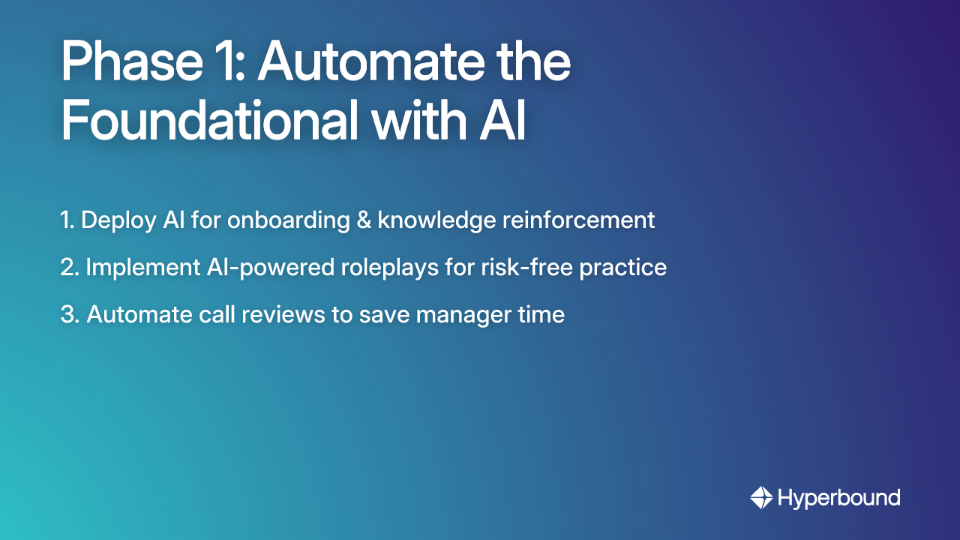
Goal: Build core skills, ensure playbook adherence, and establish baseline performance data.
Action Steps:
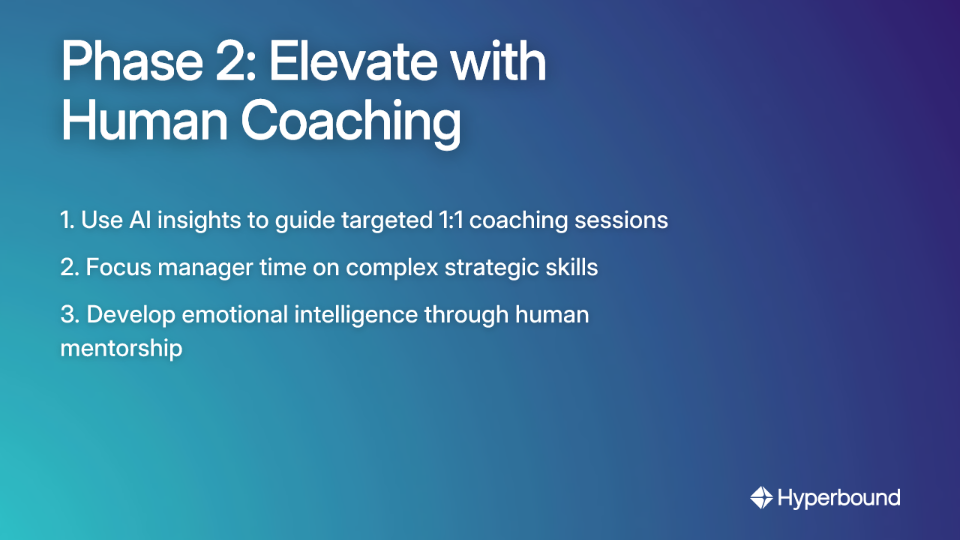
Goal: Free up managers to focus their time on high-impact, strategic coaching that requires human intelligence.
Action Steps:
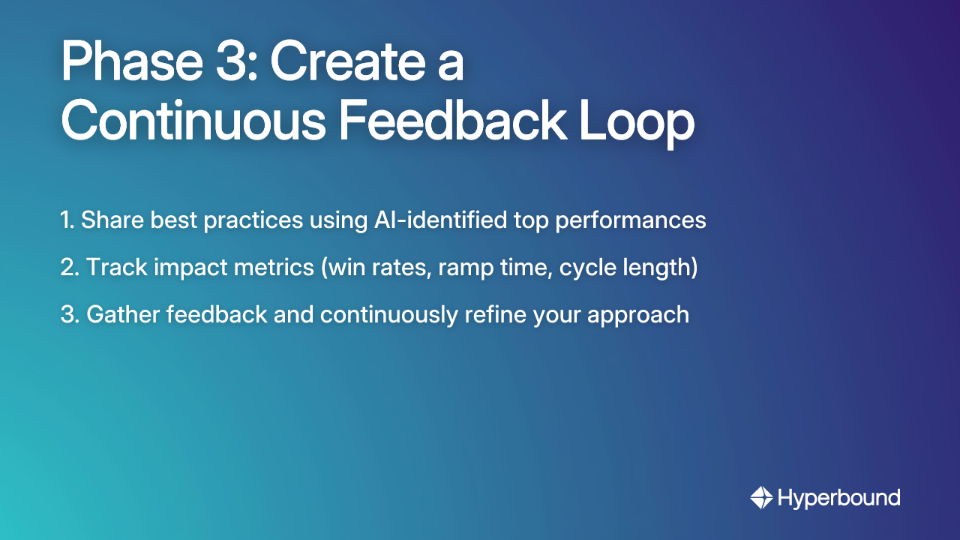
Goal: Embed coaching into the daily workflow and foster a culture of continuous improvement.
Action Steps:
Even with the best intentions, organizations can make critical mistakes when implementing a hybrid coaching approach:
Over-reliance on AI: Don't let AI replace human interaction completely. It's a tool to augment, not replace. Neglecting the human element leads to disengagement and fails to address complex emotional needs.
Forgetting to Train the Coaches: Managers need training on how to interpret AI-generated data and translate it into effective coaching conversations. Don't assume they'll naturally adapt to this new paradigm.
One-Size-Fits-All Coaching: Don't let the standardization of AI overlook individual differences. Human coaches must use the data to personalize their approach for each rep's unique strengths and weaknesses.
Poor Integration: Ensure your AI coaching platform integrates with your existing tech stack (CRM, call recorders) to create a seamless workflow and avoid data silos.
The most effective coaching strategy for modern hybrid teams is a synergistic blend of AI and human expertise. This approach drives higher win rates, accelerates remote productivity, reduces ramp time, and builds a more confident, consistent sales organization.
By leveraging AI to handle the scalable, data-intensive aspects of coaching, you empower your managers to focus on what they do best: strategic guidance, motivation, and human connection. Platforms like Hyperbound are built to create this exact synergy, turning coaching from a sporadic event into a continuous, data-driven engine for revenue growth.
The question is no longer whether to use AI or human coaching—it's how to combine them effectively to create a competitive advantage in today's hybrid sales environment.

Hybrid sales coaching is a modern approach that combines the power of AI-driven tools with the essential empathy and strategic insight of human coaches. This model uses technology to automate foundational training, analyze performance data at scale, and provide consistent feedback, which frees up human managers to focus on high-value activities like complex deal strategy, mentorship, and developing emotional intelligence.
Traditional sales coaching struggles in hybrid environments due to several key weaknesses exposed by remote work. These include manager overload from a lack of visibility, inconsistency in coaching delivery across different locations, significant blind spots in understanding remote sales conversations, and widening skill gaps as quarterly training fails to keep pace with market changes.
AI enhances sales coaching by providing data-driven, objective insights from analyzing 100% of sales calls, something human managers cannot do. It ensures every rep receives consistent coaching based on a proven methodology, offers a safe, on-demand environment for reps to practice risk-free, and delivers real-time feedback for immediate improvement, dramatically increasing scalability and effectiveness.
In an AI-augmented model, the human coach's role becomes more strategic and focused on areas where technology falls short. Human coaches are irreplaceable for providing empathy and emotional support, coaching on complex deal strategy and organizational politics, offering career mentorship to build trust and motivation, and interpreting the subtle nuances of human conversation that AI might miss.
The success of a hybrid coaching program can be measured by tracking key sales performance indicators. Look for improvements in metrics such as higher win rates, reduced new-hire ramp time, shorter sales cycle lengths, and increased playbook adherence across the team. Gathering qualitative feedback from both reps and managers is also crucial for gauging effectiveness and refining the program.
The most common mistakes include an over-reliance on AI that neglects essential human interaction, failing to properly train managers on how to interpret AI data for coaching, applying a one-size-fits-all approach that ignores individual needs, and poor integration of the AI platform with your existing tech stack, which can create data silos and inefficient workflows.








Use Cases
Legal