
You've been there. Staring at a blank document, trying to capture your entire sales process in a way that actually helps your team sell better. But you're overwhelmed, struggling to organize fragmented knowledge into something cohesive. The pressure mounts as you watch ramp times stretch longer and performance vary wildly across your team.
"Most of what I've seen on the bizdev side is just LinkedIn influencers peddling dribble," as one sales leader put it in a recent Reddit discussion. Meanwhile, you're "stuck in reworking our sales strategy and tweaking it/innovating it"—with little to show for the effort.
The problem isn't you. It's that traditional sales playbooks are fundamentally broken.
Static documents stored in shared drives quickly become outdated. Even when meticulously crafted, they're rarely referenced after onboarding. And most critically, they fail to bridge the gap between knowing what to do and actually doing it under pressure.
It's time for something different—not just another document, but a dynamic system that:
In this guide, I'll walk you through how to build your first truly repeatable sales playbook using AI, creating not just a reference document but a performance engine that drives consistent, scalable growth.
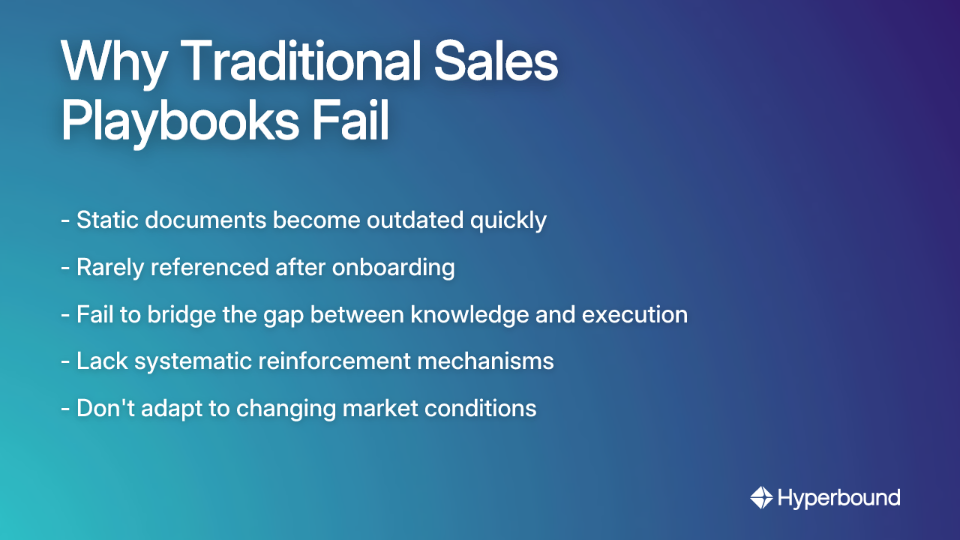
Before diving into the solution, let's understand why traditional sales playbooks so often fail to deliver results:
They're Static and Stale The moment you finish writing your playbook, it begins to age. New competitors emerge. Product features change. Market conditions shift. That carefully crafted document becomes increasingly irrelevant with each passing day.
They Face an Adoption Gap Simply documenting a process doesn't mean reps will use it, especially when they're under pressure to hit targets. Without practice and reinforcement, your perfectly crafted talk tracks remain theoretical rather than practical.
They Lack Data-Driven Insights Traditional playbooks are often built on assumptions or anecdotes from a handful of top performers. They lack a systematic way to analyze thousands of conversations to identify what truly drives wins across your entire team.
The consequences are costly: inconsistent performance, extended ramp times for new hires, and wasted effort on messaging that doesn't resonate. You're left wondering if you need to "tighten your copy/messaging, or rework your value" without clear data to guide those decisions.
.png)
Before we revolutionize the playbook with AI, let's establish what information should be included. Think of this as the essential "table of contents" for your playbook:
This framework is based on proven industry best practices, but the real magic happens when we transform how this information is gathered, maintained, and operationalized.
Let's start with the practical steps to gather and organize the essential information for your playbook:
Don't build your playbook in isolation. Create a small, focused committee that includes:
This cross-functional approach ensures you capture the entire customer journey and different perspectives on what drives success.
Choose a sales methodology that aligns with your business model and customer buying process. Whether you're using MEDDIC, Challenger Sale, Solution Selling, or a custom approach, your methodology provides the structural framework for your playbook.
This decision impacts everything from how you qualify prospects to how you present solutions and handle objections. Be explicit about your chosen methodology in the playbook itself.
Before optimizing, map out your current sales process, stages, and activities. This addresses the pain point of "fragmented documentation" that needs to be compiled "into a central repository."
Document:
Don't worry about perfection here. The goal is to get everything out of people's heads and into a central place so you can refine it in the next phase.
Collect all existing assets that support your sales process:
This initial collection will provide the raw ingredients for your playbook, which we'll refine using AI in the next section.
Now comes the transformative part: using AI to turn your static playbook into a living, breathing system that evolves with your business. Let's explore how to solve the key challenges of playbook creation and implementation with AI.
The AI Solution: Conversation Intelligence
Instead of relying on anecdotes or gut feeling, use AI to analyze thousands of your real sales calls to identify patterns that correlate with success.
How it works: AI can systematically identify the specific questions, talk tracks, and behaviors used by your top reps that lead to closed deals. This data-driven approach reveals insights that might otherwise remain hidden, such as:
Example in action: Hyperbound's AI analyzes your actual sales calls to uncover the specific techniques that make your top reps successful. These insights become the foundation of your playbook's "Best Practices" and "Sales Plays" sections, ensuring they are based on evidence, not assumptions.
Instead of generic advice like "ask open-ended questions," you can provide specific examples of questions that have proven effective: "When discussing implementation concerns, top performers ask 'What other initiatives would be competing for resources if you moved forward with our solution?' which uncovers hidden obstacles 73% of the time."
The AI Solution: AI-Powered Roleplays
Reading a script is not the same as executing it under pressure. Your reps need a safe, repeatable environment to practice the plays in your playbook until they become second nature.
How it works: Create hyper-realistic roleplay scenarios based on the plays in your playbook. Reps can practice with an AI buyer persona that responds dynamically to their approach, allowing them to:
Example in action: Once you've defined your plays, use Hyperbound's AI Sales Roleplays to let your team practice them. Whether it's a cold call, handling a specific objection, or navigating a competitive discussion, reps can get unlimited practice and instant feedback, dramatically reducing ramp time and ensuring they can deliver the message consistently.
The AI Solution: Automated Call Scoring & Coaching
Manually reviewing calls for playbook adherence is impossible at scale. Even the most diligent manager can only review a small fraction of conversations.
How it works:AI can listen to and score real customer conversations against your custom methodology, tracking if reps are:
This creates accountability and visibility into playbook adoption across the entire team.
Example in action:Hyperbound's AI Real Call Scoring automates this QA process, giving managers objective, data-driven insights into playbook adherence. This is followed by AI Coaching, which delivers personalized feedback to reps, highlighting exactly where they deviated from the play and how to improve.
According to Salesforce's State of Sales report, improving training is the #1 growth tactic for sales leaders. AI-powered coaching creates a powerful feedback loop that makes your training stick.
The most important thing to understand about a modern sales playbook is that it's never "finished." An effective playbook must be a "Living Document," not a one-and-done project.
Implement a continuous improvement loop:
Schedule quarterly reviews with your sales team and leadership to assess playbook performance using data from your AI platform. This maintains engagement with the playbook and shows its evolving value to the organization.
Building a modern sales playbook isn't about writing the perfect document. It's about building an AI-powered system that:
This approach solves the core problems that plague traditional playbooks: it keeps content fresh, ensures adoption, and provides data-driven insights that drive continuous improvement. It transforms your sales process from an art into a science.
Stop struggling with static documents and start building a performance engine. Platforms like Hyperbound are designed to power this entire lifecycle, from discovering what works to ensuring your team can deliver it every single time.
Ready to build a playbook that actually plays? The AI-powered approach is not just the future of sales enablement—it's the present for teams that want to scale effectively and consistently in today's competitive landscape.
A sales playbook is a comprehensive guide that outlines a company's sales process, strategies, and best practices to help sales representatives sell more effectively and consistently. It typically includes key components such as ideal customer profiles, sales methodologies, specific sales plays, messaging guides, objection handling techniques, and competitive analysis. The goal is to codify what works and make it repeatable across the entire team.
Most sales playbooks fail because they are static, quickly become outdated, and suffer from poor adoption by the sales team. Traditional playbooks are often created as documents that live in a shared drive, rarely referenced after onboarding. They fail to bridge the gap between knowing what to do and actually executing under pressure, and they lack a system for data-driven updates, causing them to become irrelevant as the market changes.
AI transforms a sales playbook from a static document into a dynamic performance system by discovering what actually works, training reps through practice, and reinforcing best practices on live calls. AI tools like conversation intelligence analyze thousands of real sales calls to identify the winning behaviors of top performers. AI-powered roleplays then allow reps to practice these behaviors, while automated call scoring and coaching ensure the playbook is being followed consistently in real customer interactions.
A good sales playbook should include your company and product overview, sales strategies, ideal customer profile (ICP), a defined sales process, specific sales plays and messaging, common objection rebuttals, competitive analysis, and key performance indicators (KPIs). These components work together to provide a complete framework for your sales team, from high-level strategy to on-the-ground tactics.
Ensuring playbook adoption requires moving beyond a static document and integrating it into the team's daily workflow through practice and reinforcement. The most effective way to drive adoption is with AI-powered tools. AI roleplays allow reps to practice plays until they become muscle memory, while AI call scoring automatically tracks adherence on live calls and provides personalized coaching. This creates a continuous feedback loop that makes the playbook an active part of their development.
A sales playbook should be treated as a "living document" and updated continuously, with formal reviews conducted at least quarterly. The market, your product, and your competitors are always changing. Using AI to constantly analyze sales conversations allows you to identify new winning patterns and areas where current plays are failing. This data should be used to refine the playbook regularly, ensuring your team is always equipped with the most effective strategies.
Looking to implement an AI-powered sales playbook for your team? Learn more about how Hyperbound can help you analyze winning behaviors, create realistic practice scenarios, and ensure consistent execution across your entire sales organization.










Use Cases
Legal