
You're sitting on a goldmine of untapped potential.
Every day, your sales team generates dozens, if not hundreds, of customer conversations. These calls contain the exact language that resonates with prospects, reveals objection-handling masterclasses, and showcases the subtle techniques that separate your top performers from everyone else.
Yet most sales organizations let this valuable data disappear into the ether, while simultaneously struggling with:
"Sales managers often feel like they're drowning in call recordings but starving for actionable insights," notes a sales leader on Reddit. "They see reps struggle but find it hard to pinpoint the common threads for strategic coaching."
The problem? Traditional sales training relies on static scripts and generic advice that don't prepare reps for the nuance of real conversations. These theoretical playbooks quickly become outdated and fail to capture what actually works with your specific customers.
The solution is hiding in plain sight: build a "living" training library sourced directly from your most valuable data asset—real customer conversations.
This isn't just a best practice; it's a strategic imperative. According to Salesforce's State of Sales report, sales leaders rank improving training and coaching as their #1 tactic for driving growth.
Let's explore how to transform your call recordings into a powerful training resource that continuously improves your team's performance.
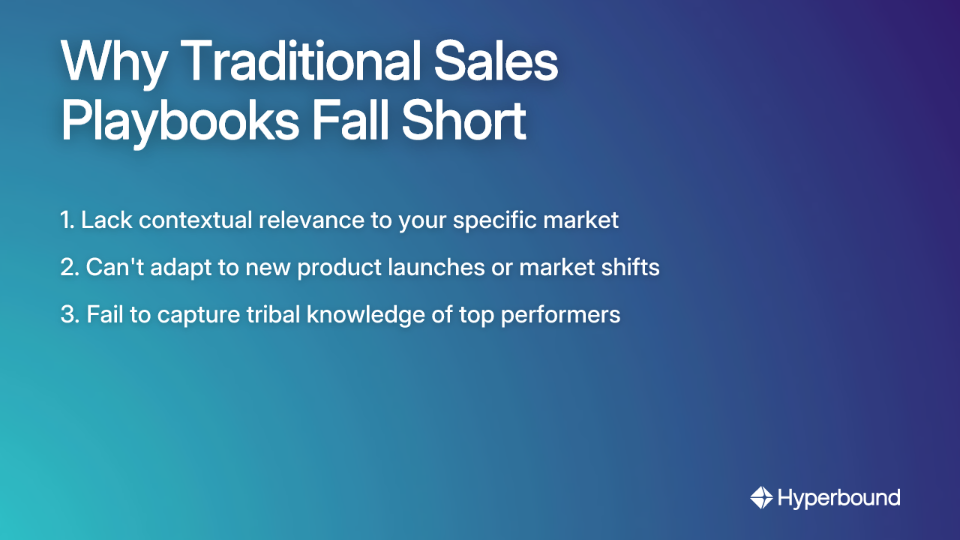
Generic sales playbooks fail for three key reasons:
Without data-driven insights, coaching becomes subjective and inconsistent. Managers can only review a fraction of calls, leading to incomplete feedback. As one sales leader put it: "The challenge is moving beyond flagging mistakes on a single call to identifying systemic skill gaps across the entire team."
The evidence-based alternative uses your own customer conversations as the single source of truth for what works. This approach transforms training from theoretical to practical, from static to dynamic, and from generic to highly specific.
Let's break down how to extract actionable insights from your raw call data.
First, you need a system to record, transcribe, and store all customer-facing conversations. This could be:
The goal is to create a single, searchable repository of all sales conversations that can be easily accessed by your team.
Now comes the crucial part—identifying what actually works. There are two approaches:
The Manual Way: Managers spend hours listening to calls, taking notes, and trying to spot trends. This is valuable but not scalable as your team grows.
The AI-Powered Way: Leverage AI technology to analyze thousands of hours of conversations to surface data-driven insights. Platforms like Hyperbound can automatically analyze your calls to uncover the specific techniques, talk tracks, and behaviors that make your top representatives successful.
When analyzing your calls, look for:
For example, instead of a generic script for handling price objections, you might find your top performer saying: "I know the recent 22% increase in component tariffs is impacting everyone, and that's led to a 14% increase in production costs for your systems. I want to walk through a few options to navigate this together."
That level of specific, contextual language is impossible to create in a vacuum—it can only come from real conversations.
The final step is transforming these insights into tangible assets. Instead of vague instructions like "build rapport," provide an annotated transcript of a top rep's first 60 seconds on a cold call.
This becomes the raw material for your library of best practices that can be shared, learned, and replicated across the team.
The most effective training libraries focus on bite-sized, on-demand, multi-format content.
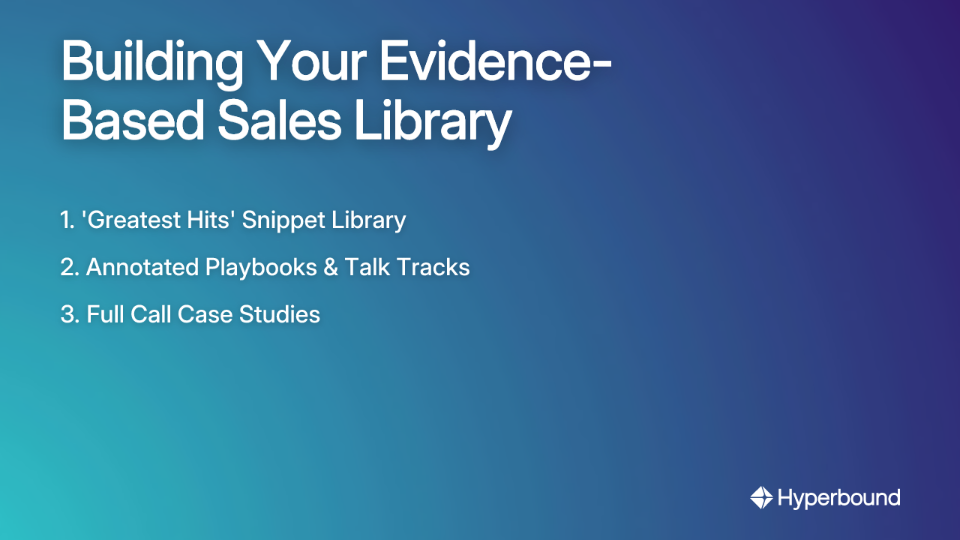
Here's how to organize your extracted content for maximum usability:
Create a searchable collection of short (30-90 second) audio/video clips tagged by topic:
These bite-sized examples are perfect for quick learning moments between calls.
These aren't rigid scripts but transcripts of real, successful conversations with commentary that explains why certain approaches work:
Customer: "Your solution looks great, but honestly, we're pretty happy with our current vendor."
Rep: "I appreciate your transparency. Many of our current customers were initially satisfied with their previous solution too. What I've found helpful is to understand what's working well for you now, so we can see if there are any gaps worth exploring. Would you mind sharing what you like most about your current setup?"
[Annotation: Notice how the rep acknowledges the customer's position instead of immediately trying to overcome the objection. This builds trust and opens the door to a more consultative conversation.]
Include full-length recordings of exemplary calls that serve as masterclasses for reps to study. Examples include:
Key Principle for Organization: Structure your library by skill, sales stage, and scenario. For example:
Prospecting > Cold Call > Objection Handling > "We already have a vendor"
This makes it easy for reps to quickly find relevant examples for their specific needs.
Knowledge without application is merely trivia. As one sales rep noted on Reddit, "Real calls offer invaluable experience. However, with the stakes so high, I'm cautious about using real prospects for practice."
This is where passive learning becomes active mastery. The scenarios, objections, and customer personas identified in your call analysis are the perfect ingredients for realistic practice drills.
Platforms like Hyperbound allow you to transform these real-world insights into AI Sales Roleplays. Your reps can practice handling the exact objections they'll face with an AI buyer that responds dynamically, providing a safe and infinitely repeatable training ground.
The problem with traditional role-play is subjective feedback. AI-powered platforms can automatically score both practice role-plays and real calls against your specific methodology. Hyperbound's AI Real Call Scoring provides an unbiased look at performance, tracking whether reps are hitting key talk tracks, asking the right questions, and adhering to best practices.
This approach creates a continuous improvement loop:
This frees up managers from tedious call reviews and empowers them to be strategic coaches. AI Coaching can provide reps with instant, personalized feedback after every call, accelerating their learning curve.
The old way is generic playbooks that gather digital dust. The new way is a dynamic, evidence-based training system fueled by your own customer conversations.
By building a library from real conversations, you create a scalable system that not only trains new hires faster but continuously upskills your entire team, turning your sales organization into a data-driven powerhouse.
To get started:
The result? A sales team that continuously improves, consistently delivers your message, and closes more deals—all based on evidence of what actually works with your customers.
A living sales training library is a dynamic collection of training materials sourced directly from your own team's real customer conversations. Unlike static playbooks, it continuously evolves with new call recordings, ensuring that reps are learning from the most current and contextually relevant examples of what works with your specific customers.
Traditional sales playbooks are often ineffective because they lack the context of your specific market, customers, and competitive landscape. They are static, unable to adapt to new products or market shifts, and they fail to capture the nuanced "tribal knowledge" and specific language that make your top performers successful.
You can start building a sales library by following a simple three-step process. First, capture and centralize all customer conversations in a single repository. Second, analyze these recordings to identify winning behaviors and patterns from your top performers. Finally, codify these findings into tangible assets like call snippets and annotated transcripts.
An effective sales library should include a variety of formats to support on-demand learning. The key components are a "Greatest Hits" library of short, topic-tagged video/audio clips; annotated playbooks and talk tracks that explain why certain phrasing works; and full-length call recordings that serve as "case studies" for masterclass-level learning.
AI significantly accelerates and scales the process of creating and using a sales training library. AI-powered tools can analyze thousands of calls to automatically surface winning patterns, saving managers hundreds of hours. Furthermore, AI can transform these insights into realistic practice simulations and provide objective, automated scoring and feedback on both practice and real calls.
Sales reps can practice safely and effectively using AI-powered sales simulations. These tools, like Hyperbound, use the scenarios, objections, and personas identified in your call library to create a realistic training ground. Reps can practice handling difficult conversations with a dynamic AI buyer, allowing them to make mistakes and refine their skills in a risk-free environment.
Want to see how Hyperbound can help you build a dynamic sales training library from your real customer conversations? Book a demo to learn how our AI-powered platform can accelerate your team's performance.










Use Cases
Legal