
You've invested heavily in Gong to capture your sales team's calls—but now you're drowning in recordings with no clear path to improvement. Your CRM holds the outcomes, Gong captures the conversations, but the critical link between insights and action remains broken.
Sound familiar?
"We have a massive library of call recordings but struggle to get actionable feedback and assess skill gaps beyond individual calls," shared one sales leader on Reddit. This represents a common frustration: fragmented tools create a disconnect between conversation intelligence and measurable performance improvement.
The problem is clear: Gong provides the "what" (what was said on calls), but without a structured process, it fails to drive the "so what" (how reps can improve) and the "now what" (the action plan for improvement). The connection between conversational insights and tangible performance improvement remains broken, leaving the feedback loop open.
This guide provides a practical, step-by-step framework for building a closed-loop sales coaching system by integrating Gong with your CRM. We'll cover the technical setup, how to activate the data for coaching, and how to use AI-powered tools to turn insights into measurable skill development and revenue impact.
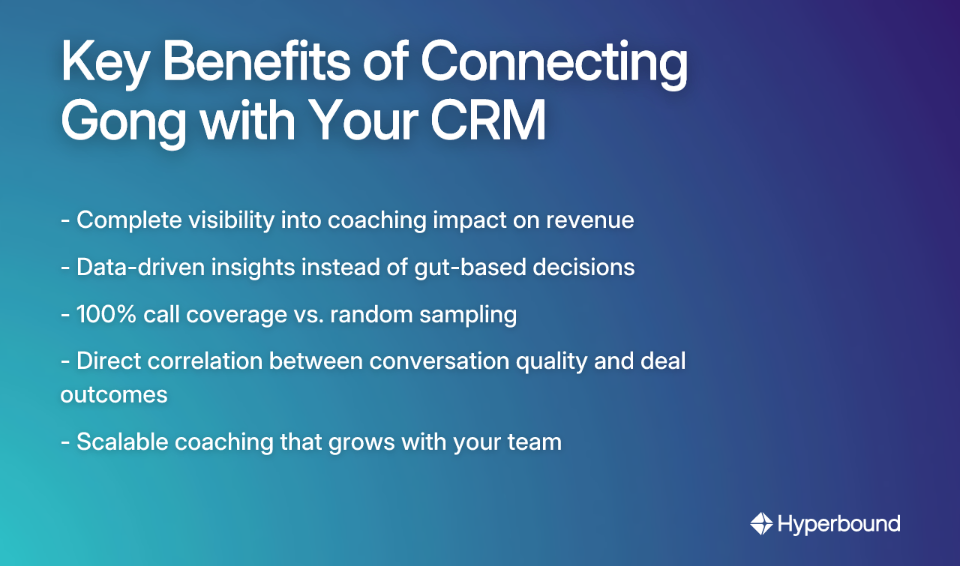
According to Forrester research, "Sales enablement efforts without visibility into specific sales coaching conversations and their impact on results will not succeed." This finding highlights a critical truth: without connecting coaching activities directly to sales outcomes, you're operating on hope rather than data.
Traditional sales coaching suffers from fundamental limitations:
In contrast, data-driven AI coaching provides:
Industry research confirms that this shift from sporadic, subjective coaching to continuous, data-driven feedback accelerates skill development and directly impacts win rates.
Connecting Gong with your CRM creates a powerful bidirectional data flow:
CRM to Gong: Syncing CRM data (accounts, opportunities, deal stage) into Gong provides crucial context for call analysis. You can understand a conversation in the context of the deal's health, allowing for more nuanced coaching.
Gong to CRM: Pushing conversation data (call topics, scores, key moments) into your CRM allows managers to see conversational performance alongside sales metrics like pipeline generated and quota attainment on a single contact or opportunity record.
This integration closes the loop, allowing you to answer critical questions like: "Do reps who follow our discovery call framework have higher win rates?" or "Which talk tracks are most effective in moving deals from proposal to closed-won?"
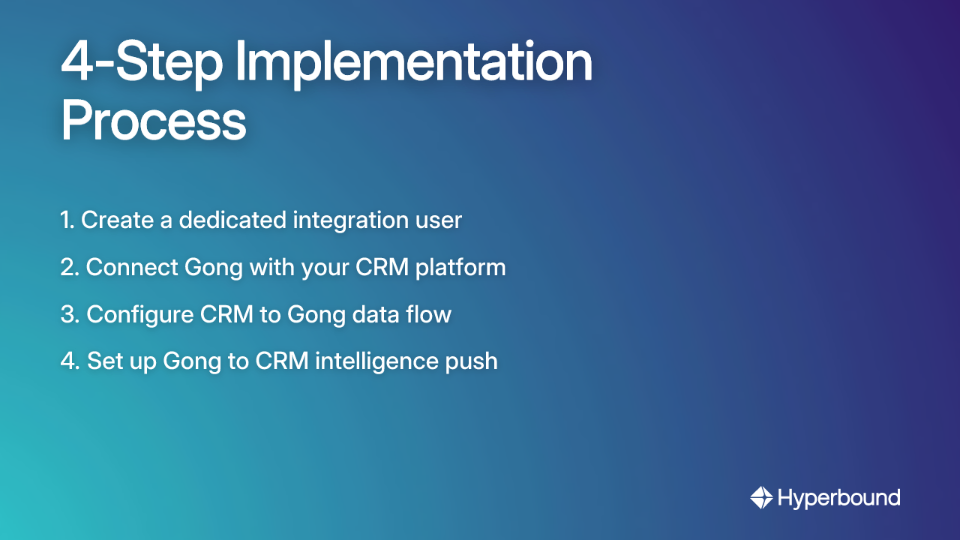
Let's move from strategy to execution with a step-by-step guide based on Gong's official documentation.
Before you start, create a dedicated user in your CRM (e.g., Salesforce, HubSpot) specifically for the Gong integration.
Why this is critical: This prevents the integration from breaking if the employee who set it up leaves the company or has their permissions changed. This dedicated user needs the necessary permissions to read and write data to the relevant objects (Accounts, Contacts, Opportunities, Activities).
Navigate to your company settings in Gong and select the CRM you use. Gong has native integrations for Salesforce, HubSpot, and Microsoft Dynamics.
For Salesforce:
What to Sync: Choose to import Accounts, Contacts, and Opportunities.
The Benefit: This unlocks powerful filtering within Gong. For example, you can easily find calls by CRM fields like:
Configuration Tips:
The Core of the Loop: Configure Gong to export call data back to your CRM.
How it Works: Calls, emails, and other activities captured in Gong are pushed to the CRM and associated with the correct contact, account, or opportunity record. Gong's algorithm automatically associates activities based on participants and deal ownership.
Configuration Options:
The Result: A manager can open an opportunity in Salesforce and see a full history of all Gong-recorded conversations related to that deal, including links to the recording, topics discussed, and any coaching feedback left.
The integration is complete, but now you have a firehose of data. This addresses the user pain of "difficulty in getting actionable feedback from call transcripts" that many sales leaders express on forums.
Your feedback loop is only as good as the criteria you measure against. Establish a clear coaching scorecard based on your sales methodology.
Key metrics to track could include:
Pro Tip: Align your scorecard with your sales methodology (e.g., MEDDIC, Challenger, SPIN) to reinforce your playbook consistently.
Gong can track keywords and topics. However, to scale coaching effectively, you need to automate scoring against your specific playbook.
This is where a tool like Hyperbound's AI Real Call Scoring adds a critical layer. It can automatically score 100% of your real calls from Gong against your custom methodology, addressing the widespread need for "customizable assessment tools" to evaluate rep performance.
Benefits include:
With automated scoring in place, you can now:
You've identified a skill gap—now what? Simply leaving a comment in Gong or the CRM is passive and ineffective. True improvement requires active practice.
This is the final, crucial step to close the loop. Once a skill gap is identified from Gong data in the CRM (e.g., poor objection handling), you must provide a way for the rep to practice and improve.
This is where Hyperbound's AI Sales Roleplays can transform insights into action. A manager can assign a specific practice scenario using AI-powered roleplays that target the exact skill gap identified in the coaching loop.
Example Workflow:
Traditional coaching suffers from delayed feedback—a rep might wait days for manager input on a call. Hyperbound's AI Coaching provides reps with immediate, personalized feedback after each roleplay or real call, dramatically accelerating the learning curve.
This empowers reps to self-correct and master skills on their own time, supporting the principle of "learning by doing" that's proven to be most effective for skill development. It also frees managers to focus on high-level strategy instead of repetitive skill correction.
Building a feedback loop from Gong to your CRM transforms your sales tech stack from a passive recording system into an active, continuous improvement engine. The process is straightforward:
The business impact is substantial. By closing the loop, you can directly correlate coaching activities to sales outcomes. You can finally answer questions like, "Does our coaching on discovery calls lead to shorter sales cycles?" This data-driven approach reduces ramp time, drives consistent execution of your playbook, and ultimately, increases revenue.
The best part? This system scales. As your team grows, your coaching infrastructure grows with it, ensuring consistent quality across all customer conversations.
Ready to close your coaching feedback loop and turn insights into performance? See how Hyperbound's AI coaching platform connects call analysis with automated scoring and deliberate practice to elevate your entire sales team.
A Gong-to-CRM feedback loop is a system where conversation intelligence from Gong is integrated with sales outcome data in your CRM. This creates a continuous cycle where call insights inform coaching, coaching impact is measured against performance metrics, and performance data highlights new areas for coaching.
Integrating Gong with your CRM is important because it directly connects coaching activities to sales outcomes. It moves your coaching from being based on gut feelings and random call samples to a data-driven process where you can see how specific conversational behaviors impact win rates, deal velocity, and revenue.
Connecting Gong to a CRM improves sales performance by creating a single source of truth for conversational and sales data. This allows managers to identify winning behaviors from top reps, pinpoint systemic skill gaps across the team, and provide targeted coaching that is directly tied to improving key sales metrics like quota attainment and sales cycle length.
You should establish a bidirectional data sync. From your CRM to Gong, sync objects like Accounts, Contacts, and Opportunities to provide context for call analysis. From Gong to your CRM, push call activities, links to recordings, conversation topics, talk ratios, and AI-generated call scores to view rep performance alongside deal progression.
You can automate call scoring from Gong by using an AI-powered coaching tool like Hyperbound. While Gong can track keywords, a dedicated AI tool can automatically evaluate 100% of your calls against your specific sales methodology and scorecard, providing objective, consistent, and scalable analysis without manual review.
The final step is to turn insights into action through deliberate practice. Once a skill gap is identified from Gong data (e.g., poor objection handling), the loop is closed when a manager assigns targeted practice, such as an AI-powered roleplay scenario, allowing the rep to master the skill in a risk-free environment before their next real call.
This integrated system helps new reps ramp up faster by providing a clear blueprint for success. They can review "gold standard" call examples from top performers in Gong, receive immediate, objective feedback on their own calls from AI scoring, and use AI roleplays to rapidly practice and master the core skills defined in your sales methodology.







Use Cases
Legal