
You've heard the skepticism. "AI sales simulations just aren't realistic." "Nothing can replace practice with real people." "These tools are too robotic to be useful." If you've been in sales for any length of time, you've likely encountered these sentiments or even expressed them yourself.
And let's be honest—in the early days of AI sales training, these criticisms weren't entirely off-base. Early iterations often felt mechanical and failed to capture the nuanced dance of a complex sales conversation.
But it's 2025 now, and things have changed dramatically.
The fundamental challenge in sales training has always been the "forgetting curve." According to Demand Gen Report, sales reps forget a staggering 70% of information within a week of a training session. This makes one-off workshops and quarterly training sessions largely ineffective, regardless of how engaging the trainer might be.
What teams need is continuous, accessible practice—and this is where today's AI roleplay technology truly shines.
Modern AI-driven roleplay is no longer about clunky chatbots reciting scripted responses. It's about creating a scalable, judgment-free, and data-driven practice environment that complements—not replaces—human coaching. The goal isn't to eliminate the human element from sales training but to enhance it by providing a consistent foundation of practice opportunities that weren't previously possible at scale.
Traditional sales roleplay has several critical limitations that become increasingly problematic as organizations grow:
It's physically impossible for managers to provide consistent, high-quality, 1-on-1 roleplay for large or distributed teams. One success story from Snowflake highlights how they reduced manager coaching time by 1,200+ hours per quarter using AI roleplay platforms like Hyperbound, allowing managers to focus on strategic coaching rather than basic skill drills.
Traditional roleplays are enormously time-intensive for both reps and managers. Coordinating schedules alone can be a logistical nightmare, especially for remote or global teams.
The quality of feedback varies dramatically from manager to manager, leading to inconsistent skill development across the organization. Some managers excel at coaching specific scenarios while struggling with others, creating knowledge gaps in their teams.
Many reps feel judged or embarrassed practicing in front of peers and managers, preventing them from taking risks and truly learning from mistakes. AI provides a judgment-free practice environment where reps can fail safely and experiment with different approaches.
The AI advantage addresses each of these pain points:
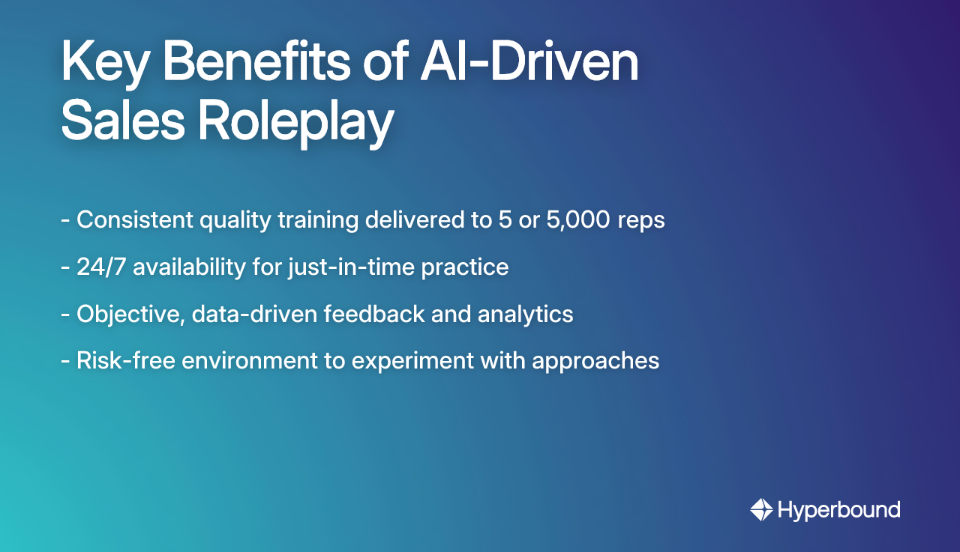
One of the most common objections to AI roleplay has been that "AI technology is still in its infancy and not yet ready for complex and nuanced interactions". This was a fair criticism in the past, but several technological breakthroughs have transformed what's possible:
Modern AI understands context, intent, and subtext—not just keywords. This allows for dynamic, unscripted conversations where the AI persona can ask intelligent follow-up questions and react realistically to unexpected turns in the conversation. The days of the AI breaking character or giving nonsensical responses are largely behind us.
You're no longer practicing with a generic "customer" but with a "Skeptical CFO of a mid-market tech firm who's been burned by similar solutions before" or a "Time-crunched IT Director facing pressure to reduce costs while improving security." Platforms can tailor these AI personas to match your actual Ideal Customer Profiles (ICPs), making practice sessions remarkably relevant to real-world scenarios.
Perhaps the biggest leap forward is training the AI on what works for your business specifically. Platforms like Hyperbound integrate with call recording tools to analyze thousands of your team's actual sales calls, identifying the talk tracks, questions, and behaviors used by your top performers on won deals.
This insight is then used to build roleplay scenarios and scoring models that ensure reps practice the exact methods proven successful within your organization. This makes the practice intensely relevant and effective—not generic "sales best practices" that may not apply to your specific market or solution.
Modern systems go beyond simple pass/fail evaluations. You can build scorecards that measure specific competencies based on your sales methodology (whether that's MEDDPICC, BANT, Challenger, or your own proprietary approach). Did the rep uncover budget authority? Did they identify the decision-maker? The AI provides instant, objective scoring against these custom metrics.
If you're convinced that AI roleplay deserves a place in your sales enablement strategy, here's how to get started:
Don't try to boil the ocean. Start with a clear, focused goal:
Use data to guide your decision. Analyze real call data to pinpoint where reps struggle most. This is where a tool like Hyperbound's AI Real Call Scoring can provide immediate, actionable insights by automatically flagging skill gaps across the team.
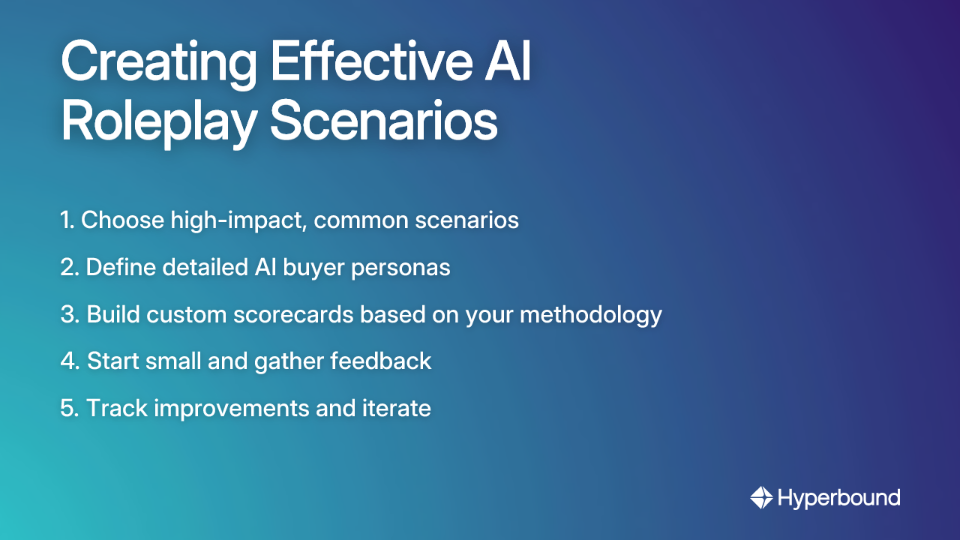
Choose a Scenario: Start with a high-impact, frequently occurring scenario (e.g., handling the "we have no budget" objection).
Create the AI Persona: Define the persona's role, industry, personality traits (e.g., impatient, inquisitive), and primary pain points.
Build the Scorecard: Define what "good" looks like. The AI scorecard should measure key behaviors, for example:
Price Objection Scorecard Example:
Start with a small pilot group of motivated reps to gather feedback and build success stories. According to exec.com, starting small allows you to refine your approach before scaling.
Gamify the experience: Use leaderboards to create friendly competition around roleplay scores and completion rates. This increases engagement and motivation.
Integrate roleplays into existing workflows: Make it a required step for new hire onboarding, a certification requirement for a new product launch, or encourage "warm-ups" before important calls.
Track both activity metrics (roleplays completed) and performance metrics (score improvements over time).
Correlate practice with performance. Look for connections between reps who actively use the AI roleplay tool and their real-world outcomes like meeting book rates, win rates, and deal size. Teams that implement structured AI roleplay programs often see significant increases in both performance and the number of opportunities booked.

Use insights from real calls to continuously refine and create new scenarios, keeping training fresh and relevant.
Automation isn't just for SDRs and AEs. Modern platforms can train any customer-facing role:
Drastically reduce ramp time by giving new reps unlimited, safe practice on core messaging and objection handling from day one. Hyperbound suggests teams can reduce ramp times by up to 50% with consistent AI-driven practice.
Prepare teams for high-stakes conversations with specialized scenarios for renewals, handling pricing objections, navigating difficult customer complaints, and identifying upsell opportunities. Hyperbound's AI Post-Sales Roleplays are specifically designed for these critical customer retention and expansion conversations.
Objectively assess a candidate's real-world selling skills, not just their interview answers. Use a standardized AI roleplay as part of the screening process to identify top talent faster and reduce mis-hires. Hyperbound's AI Roleplay Hiring Assessments provide a consistent way to evaluate sales talent at scale.
Managers can use AI to practice giving difficult feedback or conducting performance reviews, improving their own coaching skills.
AI-automated roleplay has evolved from a clumsy simulation to an essential, strategic tool for sales enablement. It solves the critical challenges of scalability, consistency, and data-driven feedback that traditional methods alone cannot address.
The true power lies in creating a feedback loop: analyze real calls to understand what works, use AI roleplays to practice those winning behaviors at scale, and measure the impact on real-world performance.
By embracing AI-driven practice, organizations aren't just training their teams; they're building a resilient, adaptable, and high-performing revenue engine. Advanced platforms like Hyperbound provide an end-to-end solution, from analyzing real calls to delivering personalized AI coaching, equipping sales teams to win any conversation in 2025 and beyond.
The skepticism around AI roleplay was once justified, but the technology has evolved dramatically. Today's AI roleplay tools don't aim to replace human coaching—they enhance it by providing the consistent, scalable practice environment that sales teams have always needed but never had. The result is more confident reps, more consistent messaging, and ultimately, more closed deals.
Are you ready to reimagine how your team practices and perfects their craft? The tools are here. The time is now.
AI sales roleplay is a training technology that uses artificial intelligence to simulate realistic sales conversations with virtual customers. It provides sales representatives with a scalable, on-demand platform to practice their skills, handle objections, and master sales methodologies in a safe, judgment-free environment. Unlike static chatbots, modern AI roleplay tools use advanced natural language processing to create dynamic and unscripted dialogues.
AI sales training solves the key limitations of traditional roleplay by offering superior scalability, consistency, and objective feedback. While traditional roleplay is valuable, it is time-consuming for managers, difficult to scale across large teams, and feedback can be subjective. AI provides 24/7 access to practice, delivers the exact same scenario and evaluation criteria to every rep, and offers data-driven insights on performance metrics like filler word usage and adherence to talk tracks.
Yes, modern AI roleplay is highly realistic thanks to advanced Natural Language Processing (NLP) and customizable AI personas. Today's AI can understand context, intent, and nuance, allowing for unscripted conversations. You can create hyper-realistic buyer personas (e.g., "a skeptical CFO") that mirror your Ideal Customer Profiles. Furthermore, the AI can be trained on your company's own successful sales calls, ensuring the practice scenarios are directly relevant to your specific market and solution.
No, AI roleplay is designed to complement and enhance human coaching, not replace it. The goal is to automate the repetitive, foundational practice drills, freeing up managers from spending hours on basic roleplays. This allows them to focus their valuable time on higher-level strategic coaching, deal reviews, and personalized mentorship. AI handles the scale, while managers provide the strategic wisdom.
The primary benefits of AI sales training are increased practice frequency, consistent and objective feedback, a safe-to-fail environment, and a significant reduction in manager coaching time. By providing unlimited, 24/7 practice, AI helps reps overcome the "forgetting curve" and build muscle memory. It eliminates performance anxiety by allowing reps to fail and experiment without judgment. This leads to more confident reps, faster ramp times for new hires, and improved performance on key metrics like meeting book rates and win rates.
Start by identifying a specific, high-impact training objective, design a focused roleplay scenario around it, and pilot it with a small group of reps. Begin by analyzing call data to find a common challenge, such as handling a specific objection. Create a detailed AI persona and a custom scorecard to measure success. Run a pilot program to gather feedback and build success stories before rolling it out to the entire team. To drive adoption, integrate the tool into your existing workflows, like new hire onboarding, and use gamification elements like leaderboards.










Use Cases
Legal