You've just launched a new service and your sales team is eager to start outbound calling campaigns. But there's a problem: with no historical data, you have zero conversion rate benchmarks to measure against. On top of that, you're dealing with variables you can't control, like fluctuating staff capacity and messy data quality. How can you possibly test different sales strategies across multiple segments without drawing inaccurate conclusions?
This is the data scientist's equivalent of flying blind. But fortunately, you don't need pre-existing baseline data to run effective A/B tests that yield actionable insights.
Even without historical data, A/B testing is crucial for moving away from intuition-based sales strategies. Rather than focusing on hitting specific benchmarks, your goal shifts to identifying the better-performing strategy through systematic comparison.
The beauty of starting from scratch is that your initial test results become the foundation for all future optimization. You're not just testing strategies—you're building your baseline data from the ground up.
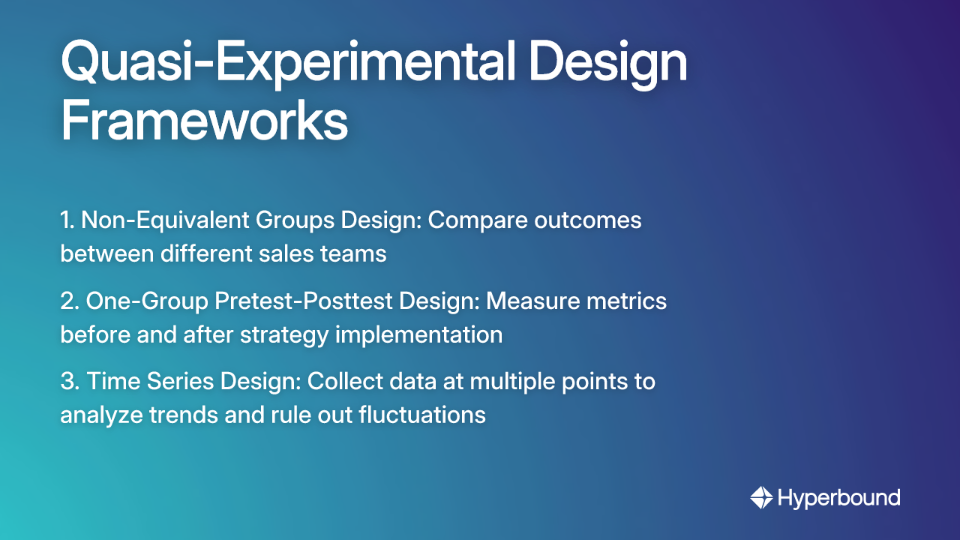
When true randomized experiments aren't possible—a common reality in real-world sales environments—Quasi-Experimental Design becomes your best friend.
Quasi-Experimental Design is a research methodology for studying cause-and-effect when full experimental control isn't practical. Unlike traditional experiments, quasi-experiments work with pre-existing groups or when random assignment isn't feasible—perfect for sales teams with varying capacities and data quality issues.
Here are three practical frameworks you can implement:
The cornerstone of any A/B test is a well-designed control group—a segment of your audience that doesn't receive the new sales strategy. This group serves as your anchor for comparison, allowing you to see what would have happened without the change.
Before creating groups, clearly define your objectives. Are you trying to improve call-to-demo conversion rates? Increase the number of follow-up conversations? Boost overall sales?
Once your objectives are clear, use these methods to create groups:
Without baseline data, focus on metrics that are directly tied to sales activities and can be compared relatively between your test and control groups:
Speaking of LTV (Lifetime Value), this can be particularly challenging for new services. When direct LTV is unknown, use proxies like "impactable healthcare spend" or known KPIs from similar customer segments in your existing products. Alternatively, focus on short-term, measurable conversion goals first—LTV models for new services are often speculative and can add noise to your A/B test results.
Let's apply these concepts to a real-world scenario: testing "calling as many prospects as possible" versus "prioritizing follow-up calls."
Real-world sales environments come with variables you can't control. Here's how to mitigate their impact:
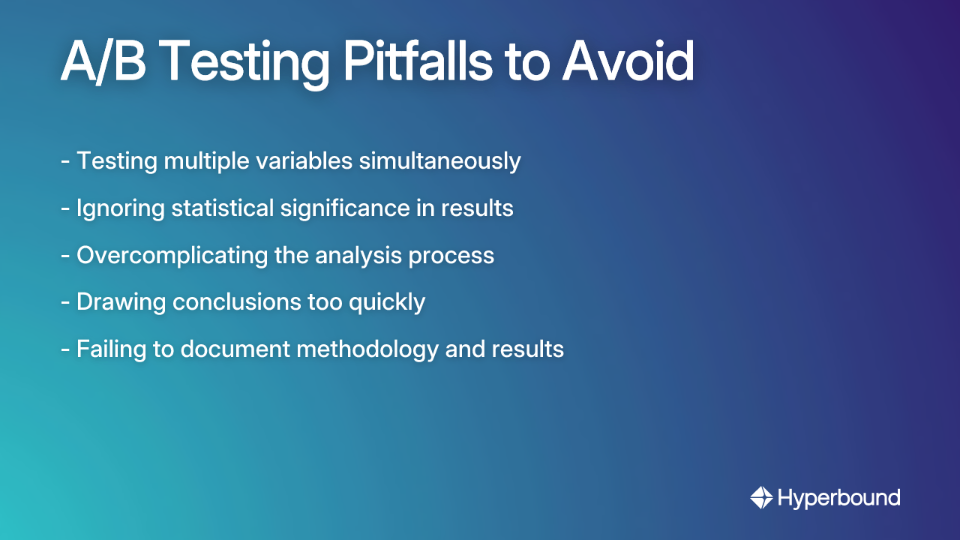
Even without baseline data, maintaining statistical validity is critical:
A/B testing without baseline data is not only possible but essential for new initiatives. By focusing on relative lift rather than absolute performance, using concurrent control groups as your comparison, and maintaining statistical rigor, you can transform your outbound sales approach from guesswork into a data-driven growth engine.
Start small—pick one clear hypothesis (like the follow-up vs. new prospect test), set up the experiment diligently, and use the results as the first building block for a data-driven sales culture.
And remember: Document Everything. Keep thorough records of your tests, hypotheses, and outcomes. This documentation will become your invaluable baseline for all future optimization efforts.
A/B testing in sales without baseline data is a method of comparing two different strategies (Strategy A vs. Strategy B) to see which one performs better, even when you have no historical performance metrics. Instead of measuring against a pre-existing benchmark, you focus on the relative lift or difference in performance between the two strategies being tested simultaneously.
A/B testing is crucial for a new product because it helps you move from intuition-based decisions to data-driven strategies right from the start. It allows you to systematically identify the more effective sales approach for a new market or service, and the results from your initial tests become the foundational data for all future optimization efforts.
You can run an effective A/B test using Quasi-Experimental Designs when true randomization isn't possible. This approach uses methodologies like the Non-Equivalent Groups Design, where you compare outcomes between pre-existing groups (like two different sales teams), or a Time Series Design, where you collect data at multiple points before and after a change to analyze trends.
The most important metrics to track are those directly tied to sales activities and can be compared relatively between your test and control groups. Key metrics include engagement rates (e.g., call response rates, call duration), funnel progression metrics (e.g., conversion rate from contact to demo), and revenue proxies (e.g., average deal size or impactable spend).
A sales A/B test should typically run for 2-4 weeks. This timeframe is usually long enough to collect sufficient data to achieve statistical significance and average out any daily or weekly fluctuations, but short enough to provide timely, actionable insights.
A common mistake is testing too many variables at once. To get clear and accurate results, you should only change one element at a time between your control and test groups. This ensures that you can confidently attribute any difference in performance to the specific change you made.
Success is measured by identifying the better-performing strategy through direct comparison, not by hitting a specific target. The group that shows a statistically significant improvement in your chosen KPIs (like a higher demo booking rate) is the winner. This "winning" strategy's performance then becomes your new benchmark for future tests.











Use Cases
Legal