
You're a financial services sales rep closing in on a promising deal. The conversation is flowing smoothly until your prospect asks about potential returns. You want to be persuasive, but you also know that making specific performance promises could violate regulations. In that split-second, what do you say?
This high-stakes balancing act plays out daily across the financial industry. Sales teams face the constant challenge of meeting aggressive targets while navigating one of the world's most heavily regulated sectors. One misstep in a client conversation can lead to substantial fines, legal action, and damaged reputations.
"Ultimately it's a role where your function is dominantly business protection - that frequently contradicts or at the very least curbs the easiest way for front office to generate a profit," notes one industry professional. This tension has traditionally positioned compliance as the "necessary evil" of financial sales.
But what if compliance could become a competitive advantage rather than a hindrance? This is where artificial intelligence is changing the game. According to EY research, 2023 marked a pivotal shift as AI transitioned from theoretical to practical applications in compliance, similar to early cryptocurrency developments.
Let's explore how AI-powered tools are transforming compliance conversations in financial services, enabling teams to move from a reactive, fear-based approach to a proactive, performance-enhancing one.
Financial institutions face relentless regulatory scrutiny with frameworks like the Anti-Money Laundering (AML) and Bank Secrecy Act (BSA) requiring robust systems for continuous monitoring and reporting. What makes this particularly challenging is that the regulatory landscape isn't static—it evolves constantly to address new threats.
Traditional compliance monitoring relies heavily on human oversight:
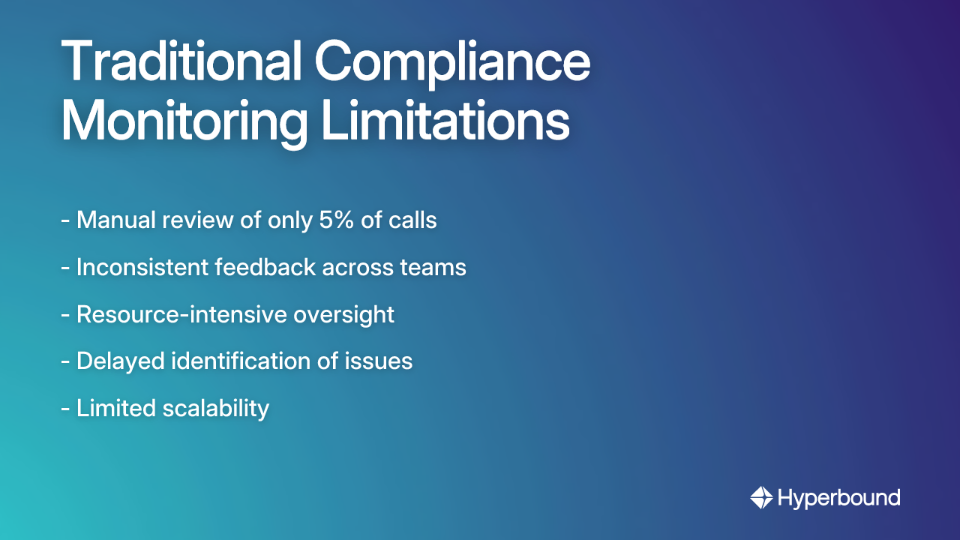
This approach is inefficient, inconsistent, and simply not scalable. Techniques like live call monitoring and post-call reviews, while valuable, are severely limited by manager bandwidth.
Meanwhile, the consequences of non-compliance continue to escalate:
For sales teams, this creates a chilling effect. Many reps become overly cautious, sacrificing effective selling techniques for fear of crossing compliance boundaries. Others may take dangerous risks, either through ignorance or in pursuit of commission targets.
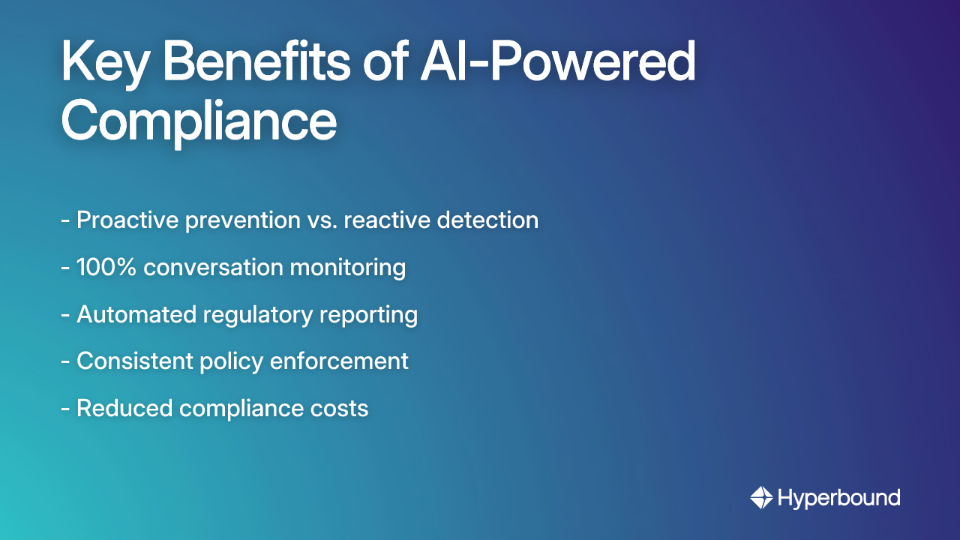
Artificial intelligence enables a fundamental shift from finding compliance breaches after they happen to preventing them in the first place. This proactive approach delivers several key advantages:
AI can scan regulatory updates and create summary documents, drastically reducing the time and cost needed to update internal policies and sales talk tracks. According to EY, this capability significantly reduces costs and time for compliance initiatives.
Generative AI and Large Language Models (LLMs) can automate the drafting of Suspicious Activity Reports (SARs) and other complex regulatory reports. This frees up investigators to focus on quality control and analysis rather than paperwork, leading to faster filing rates and cost reductions, as noted by both EY and IBM.
Perhaps most valuable for sales teams, AI can analyze 100% of customer conversations for specific keywords, phrases, and sentiment that may indicate compliance risk—a key application noted by EY. It builds comprehensive customer profiles that enhance risk tracking, moving from rigid schedules to agile monitoring.
While powerful, AI implementation requires careful governance. As noted by both EY and IBM, regulators are focused on key issues that firms must address:
Let's connect these high-level AI capabilities to the daily workflow of financial sales representatives.
The problem is clear: Financial services reps, especially new BDRs and SDRs, need to practice handling sensitive conversations without risking a live deal or a compliance breach. How do you learn to navigate complex disclosures or fee discussions without potentially making costly mistakes with real clients?
This is where AI simulation platforms provide a revolutionary solution. They create a safe space for practice that directly addresses the need for tools that help in "real life sales situations."
For example, Hyperbound's AI Sales Roleplays allow managers to create hyper-realistic scenarios tailored to specific financial products and compliance requirements. Reps can practice navigating tricky conversations, such as:
The AI provides instant, objective feedback via scorecards, allowing for unlimited practice and rapid skill development. This ensures training is sticky and measurable—a vast improvement over traditional role-playing exercises that depend on manager availability and subjective feedback.
Once reps are trained, how do you ensure every single person on a large team is consistently adhering to approved compliance talk tracks on every call? Manager spot-checks simply aren't enough.
Conversation intelligence tools with AI capabilities can analyze 100% of calls, providing a complete and objective view of team performance and compliance adherence. Hyperbound's AI Real Call Scoring automatically analyzes and scores real sales conversations against a custom methodology that includes key compliance criteria. It flags when required disclosures are missed or when risky language is used.
Furthermore, AI Coaching delivers immediate, personalized feedback. This addresses the challenge of AI being "awful at context based coaching" by providing feedback aligned with your specific playbooks. It identifies missed opportunities and off-track messaging in real-time.
The result is a form of holistic coaching—before the call (roleplay), and after the call (scoring and feedback)—that helps reps self-correct and continuously improve, scaling a manager's impact across the entire team.

There's understandable skepticism about AI coaching tools. Some industry professionals have expressed concerns that these tools are "a bit hyped up" or that they "get no value out of it," based on experiences with early-generation AI. These are valid points, so let's address some specific pain points:
Earlier AI coaching relied on simple keyword matching and generic advice. Modern AI has evolved substantially. Tools built on advanced LLMs understand nuance and can be tailored to a company's specific sales methodology and compliance requirements. The coaching isn't generic; it's aligned with your exact compliance playbook, providing highly relevant, contextual guidance.
The key is the combination of practice and feedback. AI Sales Roleplays allow reps to build muscle memory in a controlled environment. Then, AI Real Call Scoring validates if those skills are being applied on actual calls. This creates a tight feedback loop that accelerates learning far faster than traditional methods.
This is exactly the direction the technology is heading. The goal isn't to replace on-the-job learning but to supercharge it. By using AI to practice beforehand (roleplays) and get immediate feedback afterward (call scoring), reps learn faster from every single interaction. It allows managers to focus their limited 1:1 time on high-level strategy instead of repetitive corrections.
The regulatory pressures on financial services aren't decreasing. If anything, they're becoming more complex and demanding. AI provides a scalable, efficient, and proactive way to manage compliance in sales conversations.
Tools that combine AI-powered practice (roleplays) with real-world analysis (call scoring and coaching) create a powerful system for continuous improvement. They help financial services firms turn a traditional cost center—compliance—into a strategic advantage.
By embedding compliance into the daily workflow through AI, financial institutions can empower their sales teams to perform at their peak without fear. They can build trust with clients, protect the firm, and ultimately, drive sustainable growth. AI is the key to making compliance a competitive advantage, not just a cost of doing business.
AI-powered compliance uses artificial intelligence technology to automate, monitor, and enhance regulatory adherence within financial institutions. It moves beyond traditional manual checks by analyzing 100% of sales conversations, automating reports, and proactively identifying potential risks before they become serious issues.
AI helps sales teams stay compliant by providing tools for safe practice and real-time feedback. AI-powered role-playing simulations allow reps to practice navigating tricky compliance scenarios in a risk-free environment. On live calls, conversation intelligence tools can monitor for risky language and ensure required disclosures are made, offering immediate coaching to reinforce compliant behavior.
Traditional compliance monitoring is no longer sufficient because it is manual, resource-intensive, and not scalable. Typically, managers can only review a small fraction (less than 5%) of all sales calls, leading to inconsistent feedback and delayed identification of compliance issues in an ever-evolving regulatory landscape.
The primary benefits include a shift from reactive to proactive risk management, 100% monitoring of all customer conversations, and consistent policy enforcement across entire teams. AI also automates repetitive tasks like report drafting and helps reduce the significant costs associated with non-compliance fines and manual oversight.
Sales reps can practice compliant conversations using AI simulation platforms. These tools, like AI Sales Roleplays, create hyper-realistic scenarios tailored to specific financial products and regulations. This allows reps to build "muscle memory" for handling sensitive topics, like disclosing risks or discussing fees, and receive instant, objective feedback without jeopardizing a live client relationship.
Yes, modern AI coaching is highly effective because it provides personalized, contextual feedback aligned with a company's specific compliance playbooks. Unlike earlier versions that relied on simple keyword matching, today's advanced AI understands nuance and provides a tight feedback loop by combining risk-free practice (roleplays) with analysis of real-world performance (call scoring), accelerating skill development.
The key risks when implementing AI for compliance include potential AI bias, lack of explainability (the "black box" problem), and data privacy concerns. Financial firms must establish strong governance to ensure AI models are fair, that their decisions can be understood and justified to regulators, and that sensitive customer data is handled securely.











Use Cases
Legal