
You've rehearsed your product demo a dozen times. You know every feature inside and out. Yet somehow, when that crucial enterprise prospect joins the call, you freeze at their first challenging question. Your carefully planned flow derails, and you can feel the deal slipping away.
Sound familiar?
While some view AI sales coaching as "a bit hyped up" or "awful at context-based coaching," the reality is that the right technology is fundamentally changing how top-performing sales teams prepare for their most crucial conversations.
The product demo isn't just a feature walkthrough—it's a pivotal moment where deals are won or lost. In 2025, the teams consistently hitting quota are those leveraging AI-powered roleplays to ensure every rep can deliver a perfect demo, every time.
The limitations of conventional demo preparation methods have become increasingly apparent:
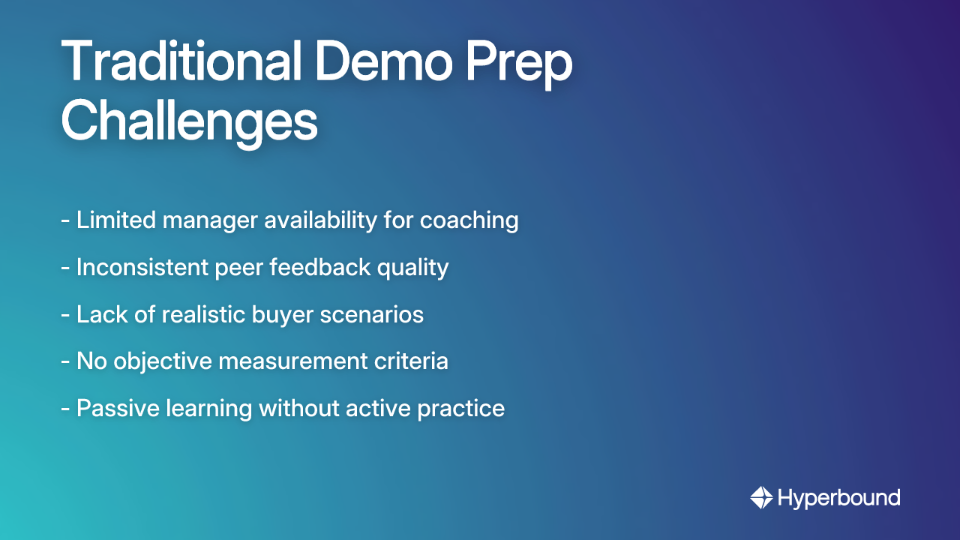
While valuable, reviewing recorded demos is merely a lagging indicator of performance. It shows what went wrong after the fact but doesn't provide a way to practice and correct behavior before the next high-stakes call.
This is the difference between watching game tape and actually running plays on the field. One builds knowledge; the other builds skill.
According to Salesforce research, sales leaders consistently identify improved training as a primary growth tactic. Yet managers are often too busy with forecasting and deal strategy to provide the repetitive, foundational call coaching each rep needs. This creates a gap where bad habits form and persist.
AI roleplay tools aren't just chatbots. They're sophisticated simulators that create realistic buyer personas reps can practice with 24/7.
The technology allows reps to engage in simulated conversations across the entire sales cycle. Platforms like Hyperbound offer scenarios specifically designed for demo practice, including product walkthroughs and slide deck presentations.
This provides a risk-free environment to practice new talk tracks, handle tough questions, and refine delivery without jeopardizing live deals. It enables real learning through active participation—something over 40% of sales professionals are already leveraging through various AI tools to boost their efficiency.
A great demo isn't a monologue; it's a conversation that connects insights from discovery to the solution's value. AI roleplays allow reps to practice this entire sequence:
The true value of AI roleplay comes from data-driven, instantaneous feedback that human managers can't provide at scale.
AI-Powered Scorecards analyze the rep's performance against pre-defined methodologies:
AI Coaching provides instant notifications about missed opportunities and weak responses. For example, Hyperbound's AI coaching identifies when a rep fails to tie a feature to a specific customer pain point, allowing for immediate self-correction. This accelerates the learning curve dramatically.
Demos are where the toughest objections surface:
AI roleplays can be programmed with libraries of the most common and difficult demo-related objections specific to your product. Reps can practice handling these objections dozens of times until their responses are sharp, confident, and aligned with the company playbook.
This moves training from theoretical knowledge to practical, applicable skill—building the muscle memory needed to perform under pressure in a live call.
Confidence is a key-yet-underrated factor in demo effectiveness. A confident rep leads the call, controls the narrative, and inspires trust.
Unlimited Practice: Reps can practice anytime, anywhere, building familiarity and reducing anxiety. New hires can ramp faster, and tenured reps can sharpen skills on new product releases.
Gamified Learning: To keep reps engaged, leading platforms incorporate game mechanics. Leaderboards create friendly competition, motivating reps to complete more roleplays and improve their scores, which accelerates overall skill development.
When you launch a new product, feature, or competitive talk track, how do you ensure the entire team can deliver the message effectively on day one?
AI roleplays solve this enablement challenge by allowing you to create new scenarios focused on specific messaging and roll them out to the entire team simultaneously.
Certification: Managers can use AI scorecards to certify that every rep has mastered new talk tracks before using them with customers. This ensures consistency and maximizes the impact of product launches.
According to Goconsensus, 80% of reps using AI solutions find it easier to get the customer insights needed to close deals—highlighting the tangible impact of these tools on sales outcomes.
Not all AI sales coaching platforms are created equal. Here's what to evaluate when selecting a solution that truly delivers on the promise of improved demo effectiveness:
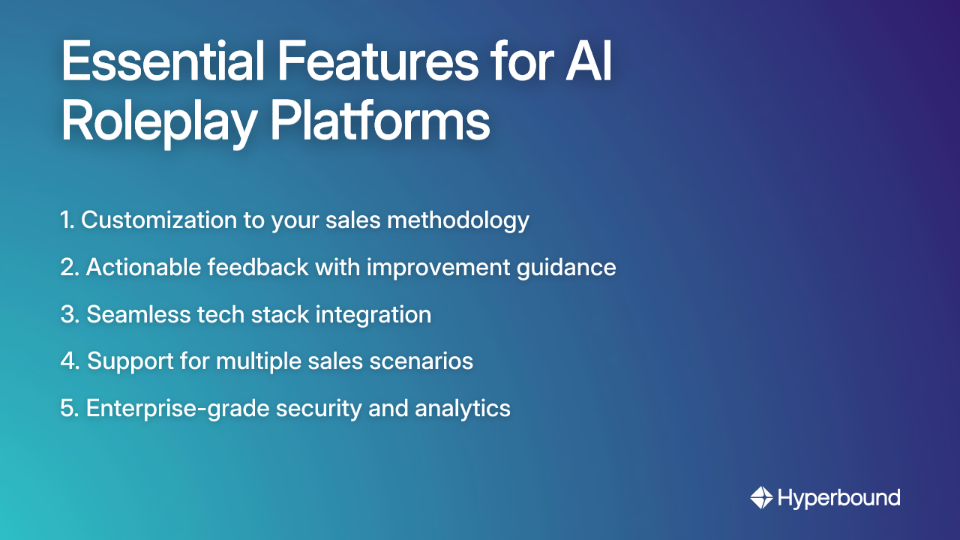
The platform should not be a one-size-fits-all solution. Can it be tailored to your specific ICPs, product, competitors, and sales methodology (e.g., MEDDICC, Challenger)?
Effective tools allow you to create scenarios that reflect your real sales environment. For example, Hyperbound enables tailored roleplays for any ICP and methodology, with setup possible in under 10 minutes for simple scenarios.
Don't just look for a score. Look for actionable insights. Does the AI provide specific feedback on why something was ineffective and how to improve it? This is the core of good context-based coaching.
The best tools offer holistic coaching by integrating with real call data to inform the practice scenarios, addressing the concern that "real learning happens on the job." By connecting actual customer interactions with practice sessions, these platforms create a virtuous learning cycle.
The tool should be intuitive for reps and managers. If it's cumbersome, it simply won't be adopted, regardless of its capabilities.
Look for platforms that integrate with your existing tech stack (your CRM, call recording, and conversation intelligence platforms) to create a seamless workflow that enhances rather than complicates your sales process.
While this article focuses on demos, a valuable platform supports the entire sales cycle, from cold calls to renewals. This provides a better ROI and a more comprehensive training solution.
The most robust platforms offer roleplay types for various sales activities, including:
For larger teams, look for features like multi-language support (some platforms like Hyperbound support over 25 languages), robust analytics for tracking team progress, and enterprise-grade security certifications.
While healthy skepticism around AI sales tools exists, the data and capabilities of modern AI roleplay platforms tell a compelling story. They solve the core challenges of traditional sales training: scalability, objectivity, and consistency.
Adopting AI roleplays isn't about replacing managers; it's about empowering them. It frees them from repetitive call coaching to focus on high-level strategy and deal-closing. It gives reps a powerful tool for self-improvement, leading directly to better performance metrics and more effective demos.
As one sales leader put it on a Reddit discussion: "we are super happy with the results so far." While not every tool will be the right fit for every organization, those that find the right match are seeing tangible improvements in demo effectiveness and overall sales outcomes.
Don't just read about it. Experience it. The best way to evaluate if AI roleplays can transform your demo effectiveness is to try an interactive demo yourself. Platforms like Hyperbound offer interactive experiences that showcase how these tools work in practice.
By embracing AI-powered sales roleplays today, you position your team to deliver more effective demos, close more deals, and stay ahead of the competition in 2025 and beyond.
An AI sales roleplay is a training simulation where a salesperson practices conversations with an AI-powered bot that acts as a realistic buyer persona. These platforms provide a safe, on-demand environment for reps to practice scenarios like product demos, objection handling, and discovery calls without risking live deals.
AI roleplays improve product demos by providing a platform for consistent, scalable practice with instant, objective feedback. Reps can master the flow from discovery to presentation, practice handling tough demo-specific objections until their responses are sharp, and build confidence through unlimited repetition in a risk-free environment.
AI roleplays offer significant advantages over traditional peer practice by solving issues of scale, subjectivity, and realism. Unlike peer roleplays, AI is available 24/7, provides consistent feedback based on your company's sales methodology (not a colleague's personal style), and can simulate the pressure and specific objections of a real buyer more effectively.
No, AI sales coaching is designed to empower sales managers, not replace them. By automating repetitive, foundational coaching for skills like demo delivery and objection handling, AI frees up managers to focus on higher-level strategy, complex deal coaching, and human-centric aspects of leadership. It acts as a force multiplier for the coaching team.
The most effective AI roleplay platforms offer deep customization to match your sales methodology and products, provide actionable, data-driven feedback (not just a score), are easy for reps to use, and integrate with your existing tech stack like your CRM. Look for platforms that support a wide breadth of scenarios beyond just demos and offer enterprise-grade security and analytics.
Implementation speed varies, but leading platforms are designed for rapid deployment. Simple scenarios can often be set up in under 10 minutes. The key is to choose a tool that is intuitive for both managers to create content and for reps to start practicing immediately, minimizing the time to value and driving quick adoption.
Yes, AI roleplays are beneficial for reps at all experience levels. For new hires, they accelerate ramp time by providing a safe space to master core messaging. For tenured reps, they offer an efficient way to practice new product talk tracks, refine skills, and adapt to changing market dynamics, ensuring the entire team maintains a high level of performance.










Use Cases
Legal