
Remember the awkward silence that fell over the conference room whenever your sales manager announced, "Today, we're doing roleplays"? That collective groan from your team wasn't just about performance anxiety—it stemmed from a universal truth: traditional roleplays felt painfully artificial.
"People hate roleplays, they feel very fake and unrealistic," as one sales professional put it in a Reddit discussion. Another lamented, "The problem with roleplay is that most people are following a set script with someone anticipating what the playee is going to say."
Early attempts to solve this with AI only reinforced skepticism. As one rep bluntly stated, "AI needs to get less robotic before it truly helps here." Another complained, "I found it a bit unrealistic for B2B sales role-playing. Prospects often ask unexpected questions... which it doesn't really handle well."
But that was then. This is 2026.
Today's AI roleplays aren't just marginally better—they've fundamentally transformed sales enablement. They're no longer clumsy substitutes for human interaction but powerful, scalable tools that are creating elite sales teams across industries. The technology has evolved from stilted, predictable simulations to dynamic, responsive conversations that feel remarkably real.
This article explores how modern AI roleplay systems are redefining sales readiness, the data-proven benefits they deliver, and how forward-thinking sales organizations are implementing them to drive measurable performance gains.
Before diving into the AI revolution, it's worth examining why traditional sales training methods consistently disappointed both reps and leaders.
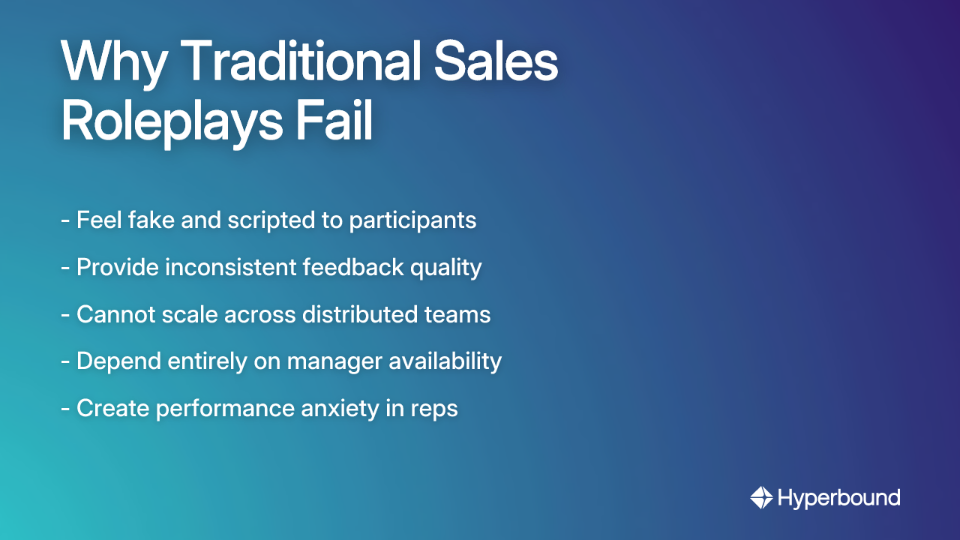
Traditional roleplays suffered from three critical flaws:
First-generation AI simulators attempted to solve these problems but created new ones:
Fast forward to 2026, and the technology has undergone a remarkable transformation. Today's AI roleplay systems aren't just marginally improved—they've been fundamentally reimagined.
Modern AI creates dynamic conversations, not static scripts. These systems:
These AI-driven simulations can mimic actual buyer personas, providing realistic practice for various sales situations, including cold calls, objection handling, and upselling.
This is perhaps the core innovation. Modern AI doesn't just simulate; it analyzes and teaches:
As highlighted in a Forbes article, "AI-driven platforms provide instant feedback to sales reps, helping them adjust their strategies during calls and improve their performance continuously."

Perhaps most revolutionary is the accessibility:
The benefits of modern AI roleplay systems aren't theoretical—they're measurable and significant:
Organizations implementing AI roleplays see up to a 30% decrease in ramp time for new hires. This translates directly to faster productivity and earlier quota attainment. Instead of waiting 6-9 months for a new hire to reach full productivity, companies are seeing results in as little as 4-6 months.
This acceleration occurs because AI role-play simulates real-life sales conversations and provides real-time feedback, enabling reps to practice multiple times before engaging with actual prospects.
Studies show an 11-28% increase in average win rates after implementing AI-driven sales training. This substantial improvement comes from reps mastering critical moments in the sales cycle through repeated practice.
Over 50% of high-performing sales teams are already using AI technology to standardize their processes and messaging, according to HubSpot data. This enables organizations to identify what works and scale those behaviors across the entire team.
Platforms like Hyperbound are designed to deliver these metrics by enabling sales teams to create a scalable coaching engine. By analyzing your best calls and turning those insights into AI roleplays, you can ensure every rep practices the specific behaviors that lead to closed deals, effectively reducing ramp time and driving playbook consistency.
While cold call practice remains popular, today's AI roleplay systems excel across the entire sales cycle:
Practice responding to the top objections your team faces in discovery calls:
The AI persona can be programmed with varying levels of resistance, helping reps develop multiple strategies for overcoming the same objection based on buyer signals.
This scenario is crucial for post-sales teams who need to master the art of expanding accounts and securing renewals. Practice identifying expansion opportunities or handling difficult renewal conversations with at-risk customers.
This is a key area where specialized tools like Hyperbound's AI Post-Sales Roleplays help Customer Success and Account Management teams master the conversations that drive net revenue retention.
When a new product or feature is released, AI roleplays can be used to certify that the entire go-to-market team can pitch it consistently and accurately. This ensures your messaging is delivered with precision across all customer touchpoints.
Forward-thinking organizations now use standardized AI roleplays as part of the interview process to objectively assess a candidate's practical selling skills, not just their interview charisma.
This is becoming a powerful strategy for hiring managers, using AI Roleplay Hiring Assessments to get a data-driven look at a candidate's aptitude, reducing mis-hires and improving quality of hire.
Ready to implement AI roleplays in your organization? Here's a straightforward approach to creating your first scenario:
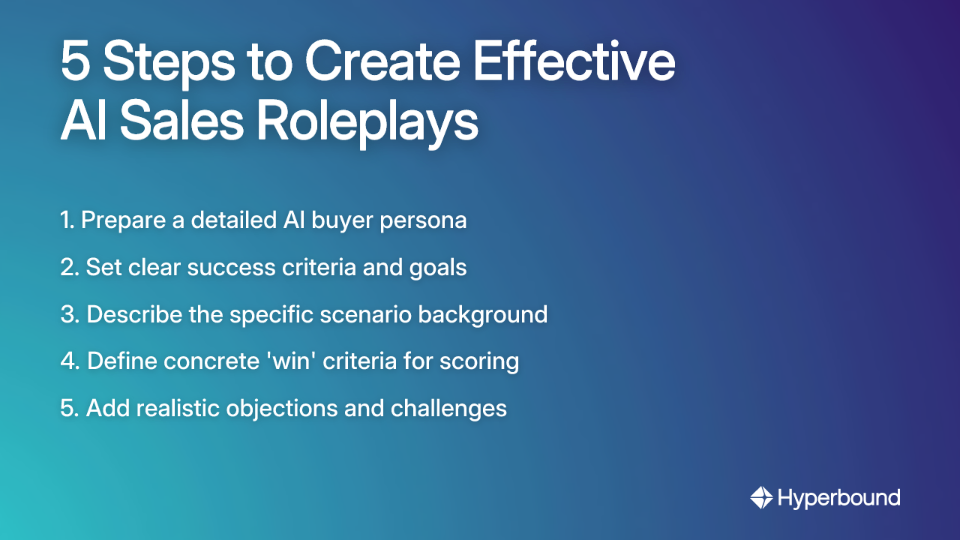
Go beyond a generic title. Define:
This must align with your real ICP to be effective. The more detailed the persona, the more realistic the interaction.
Define what success looks like for the rep in this simulation:
Having clear objectives helps both the AI and the rep understand what "winning" looks like.
Give context to both the AI and the rep:
Outline the key talking points, discovery questions, or value statements the rep must cover to succeed. This will form the basis of the AI's scoring. For example:
Pre-load the AI with the most common and difficult objections your team faces. Provide the AI with the ideal frameworks or responses you want reps to use when addressing these challenges.
While you can build basic versions of these with prompt engineering, advanced platforms like Hyperbound are built specifically for this purpose. They allow sales enablement leaders to easily create, deploy, and automatically score custom scenarios, tracking rep progress against their specific sales methodology.
Despite the compelling benefits, there are still challenges to successful implementation. Here's how to address them:
Solution: Start with a pilot program. Choose one high-impact scenario (e.g., handling your #1 competitor) and roll it out to a small group. Use the results and positive feedback to build internal buy-in.
Solution: Integrate the tool into your existing sales tech stack (CRM, conversation intelligence platforms, etc.). Make it part of the weekly workflow or pre-call prep, not a separate, clunky chore. Gamification features like leaderboards can also drive engagement.
Solution: Use the platform's analytics to connect practice to performance. Track metrics like talk-time ratio, frequency of objection handling, and scorecard improvements in roleplays. Then, correlate this with real-world outcomes like meeting book rates and win rates.
This is where features like Hyperbound's AI Real Call Scoring become invaluable. You can score both practice roleplays and actual customer calls against the same scorecard to objectively measure if the skills learned in practice are being applied in the field.
AI roleplays have evolved far beyond the scripted bots of the past. In 2026, they are an essential component of a modern sales enablement strategy, offering a scalable, data-driven, and realistic way to prepare teams for any conversation.
The ultimate goal is to give every rep the skills and confidence of your #1 performer. AI roleplays make this possible by decoding what works in your specific market and turning it into unlimited, personalized practice opportunities.
For sales leaders looking to elevate team performance, it's time to stop thinking of roleplay as a dreaded training exercise and start seeing it as a strategic performance tool that can transform good reps into great ones—and great teams into market leaders.
AI sales roleplay is a training technology where sales representatives practice conversations with an AI-powered bot that simulates a real customer. Unlike traditional roleplays with peers, modern AI systems create dynamic, unscripted conversations. The AI can adapt to the rep's approach, raise realistic objections, and mimic specific buyer personas, providing a safe and scalable environment to practice any sales scenario.
Modern AI roleplay is hyper-realistic and adaptive, whereas older versions were robotic and followed predictable scripts. Today's AI leverages advanced language models to understand nuance, tone, and context. It can handle unexpected questions and create unique conversations every time. Furthermore, it integrates a data-driven coaching loop, analyzing performance and providing instant, objective feedback—a feature early AI simulators lacked.
The main benefits are accelerated new hire ramp time, increased team-wide win rates, and the scalable adoption of winning sales behaviors. Data shows organizations can decrease ramp time by up to 30% and increase win rates by 11-28%. AI provides a consistent coaching experience for every rep, allowing them to practice anytime, anywhere, and master the specific talk tracks that are proven to work for your top performers.
Yes, a key feature of modern AI roleplay platforms is their deep customizability. You can create specific buyer personas that match your Ideal Customer Profile, including their job title, industry, pain points, and even personality traits. Scenarios can be tailored to new product launches, competitive messaging, or industry-specific objections, ensuring the practice is highly relevant to your team's daily challenges.
The AI provides instant, data-driven feedback based on pre-defined success criteria and analysis of the conversation flow. After a roleplay session, the platform generates a scorecard that can measure metrics like talk-time ratio, the number of key discovery questions asked, how effectively objections were handled, and adherence to your sales methodology. This objective feedback helps reps pinpoint specific areas for improvement without waiting for a manager's review.
Yes, adoption is high when the tool is integrated into the existing workflow and provides a safe, non-judgmental space to practice. Unlike peer roleplays which can cause performance anxiety, AI provides a private environment where reps can fail and experiment without fear. When platforms are easy to use and integrated with tools like CRMs, they become a go-to resource for pre-call preparation. Gamification features like leaderboards also help drive consistent engagement.
AI roleplay is effective across the entire customer lifecycle, including objection handling, price negotiations, upsell conversations, and customer renewals. You can simulate a procurement negotiation with a budget-conscious buyer, practice navigating a renewal conversation with an at-risk customer, or certify your team on new product messaging. It can even be used in the hiring process to assess a candidate's practical selling skills.
Is your team ready to experience the next generation of sales training? Learn more about how AI-powered roleplay can transform your sales organization by visiting Hyperbound.









Use Cases
Legal