
You've been there before. You ask a thoughtful question, trying to connect with someone, and the response you get is a lackluster "yep," "cool," or the dreaded "not much." The conversation immediately grinds to a halt, and suddenly the pressure falls entirely on your shoulders to resuscitate a dying interaction.
It's frustrating and often leaves you questioning your own social skills. Are you asking the wrong questions? Is it something about you? Or is the other person just not interested in talking?
This article is a practical guide for those moments when you're faced with one-word responses and seeming disinterest. We'll move beyond generic advice like "just ask open-ended questions" and provide a multi-layered toolkit of strategies—from foundational conversation techniques to observational methods, from last-resort efforts to the art of gracefully exiting a stalled conversation.
Before diving into strategies, it's essential to reframe the situation. A one-word answer is not necessarily a personal rejection.
The other person might be shy, distracted, having a bad day, socially anxious, or simply not interested in talking at that moment. According to social skills experts, it's crucial to accept that not every interaction will blossom into a meaningful conversation, regardless of your conversational prowess.
The mindset shift here is important: recognize that a conversation requires effort from both parties. If one person is unwilling to engage, it's not solely your fault or responsibility to salvage it. This perspective helps protect your self-respect in unfulfilling interactions and removes some of the pressure.
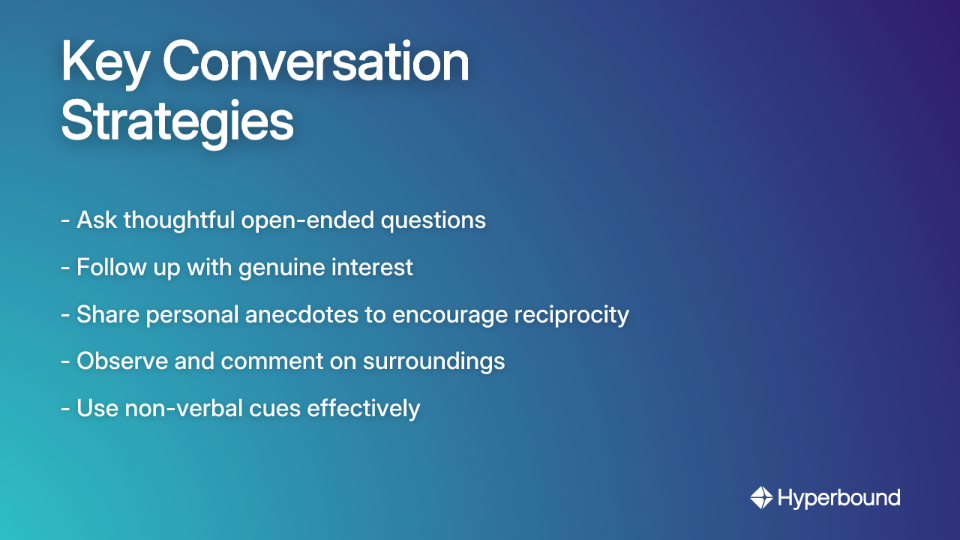
While you've likely heard this advice before, it bears repeating with specificity. The goal is to move beyond questions that can be answered with a simple "yes" or "no" and instead ask questions that invite elaboration.
Instead of: "Did you have a good vacation?" Ask: "What was the highlight of your vacation?"
Instead of: "How are you?" Ask: "What has been a surprise in your week so far?" or "How have you been adapting to [current relevant situation]?"
These questions require more thought and naturally lead to more detailed responses, creating better opportunities for Small Talk to evolve into something more substantial.
When you do get a brief response, gently probe for specifics to find a Conversational Trail you can follow.
For example, if they say, "I went to a concert," you might ask, "Oh cool! What was your favorite song they played?" or "How does this show compare to others you've seen?"
The key is balance—you want to show genuine interest without creating an interrogative atmosphere. If they continue giving curt answers after a few thoughtful follow-ups, it might be time to try a different approach or recognize they may not be in a chatty mood.
If the other person seems shy or reserved, take the lead by doing more of the talking initially. This can make them feel more at ease and demonstrate the level of sharing you're hoping for.
Share a related personal anecdote to encourage reciprocal sharing—something that research on conversation dynamics shows often leads to more balanced exchanges.
For example: "I recently tried that new coffee shop downtown and was surprised by their unique brewing method. Have you ever had a similar experience with something you expected to be ordinary?"
This technique, sometimes called "vulnerability matching," invites the other person to meet your level of disclosure, potentially opening up more meaningful Big Talk rather than remaining stuck in superficial exchanges.
When standard questions fall flat, it's time to employ more sophisticated approaches that leverage your environment and non-verbal communication skills.
Your body language can either invite conversation or shut it down. When trying to engage someone:
This last point is particularly important. After asking a question, give them time to think and expand on their answer. Don't rush to fill the silence—sometimes people need a moment to formulate their thoughts, and jumping in too quickly can cut off potential engagement.

These are bold, last-ditch efforts for when you're in a situation you can't easily leave and the conversation is completely stagnant. Use with caution.
Sometimes the solution is to temporarily dominate the speaking role by sharing your own stories and opinions. Occasionally check in with them ("What do you think about that?") to create an opportunity for them to join in.
This approach can work particularly well with shy individuals who may appreciate someone else taking the conversational lead, according to resources on stalled conversations.
When more nuanced approaches fail, abandon smooth transitions. Try various topics until something resonates: "Completely changing subjects, have you seen that new sci-fi show everyone's talking about?" or "Random question, but do you have any travel plans coming up?"
This directness acknowledges the conversational struggle while offering new pathways.
Introduce quirky or hypothetical questions that break away from conventional Small Talk. These Conversation Sparkers often elicit more interesting responses:
Sometimes, calling out the elephant in the room can lighten the mood. With the right tone—confident and light, not accusatory—you might say, "It seems like we're having trouble finding our conversational rhythm today." This meta-commentary can often reset the interaction and lead to more authentic exchanges.
.png)
One of the most important aspects of Social Nuance is knowing when to stop trying and how to end a conversation without awkwardness or offense. This is an act of self-respect.
It's probably time to wrap things up when:
The Quick Wrap-Up: Direct and simple. "Well, I should get going. It was nice talking with you!"
The Transition Statement: Puts the focus on them. "I'll let you get back to your friends/work/shopping."
The Reason to Leave: Provides a clear, brief reason. "I need to catch up with my friend, but it was great meeting you."
The Professional Nudge: Acknowledges their potential busyness. "It sounds like I might have caught you at a busy moment. Would it be better to chat another time?"
The Summary Statement: Wraps up the last topic before leaving. "That book recommendation sounds interesting. I should get going, but thanks for the suggestion!"
According to experts on conversation endings, these approaches allow you to exit with dignity while keeping the door open for future interactions if appropriate.
People give one-word answers for many reasons, and it's often not a personal rejection. The other person might be distracted, shy, socially anxious, having a bad day, or simply not in the mood to talk at that moment. It's important to remember that a successful conversation requires effort from both sides, so you shouldn't always assume it's your fault if the interaction doesn't take off.
The most effective way to avoid one-word answers is to ask thoughtful, open-ended questions that invite elaboration. Instead of asking questions that can be answered with a simple "yes" or "no," try questions that start with "what," "how," or "tell me about." For example, instead of "Did you have a good weekend?" ask, "What was the most interesting part of your weekend?"
If someone is reserved, try leading by example using the "sharing-reciprocity loop." Share a short, related personal story or opinion first. This can make the other person feel more comfortable and demonstrate the level of detail you're hoping for in the conversation. This technique, sometimes called "vulnerability matching," encourages them to open up and share in return.
If open-ended questions aren't enough, it's time to try other strategies. Use observational openers by commenting on something in your shared environment, like their phone case or a drink they're holding. You can also gently probe for more details with a follow-up question or, as a last resort, try a bold topic transition by saying, "Completely changing the subject..." to see if a new topic sparks their interest.
You should consider ending a conversation when you've tried multiple strategies without success and the interaction feels forced. Key signs include consistently receiving one-word answers with no reciprocal questions, closed-off body language (like crossed arms or avoiding eye contact), and a general sense that the other person is distracted or disinterested.
To exit a conversation gracefully, use a clear and polite exit line. You can use a simple wrap-up like, "Well, it was great chatting with you, I should get going." Another effective method is to provide a brief reason, such as, "I need to go find my friend, but it was nice meeting you." The goal is to end the interaction respectfully without placing blame or creating awkwardness.











Use Cases
Legal