
You've done your homework. You've shortlisted Hyperbound, Gong, and Second Nature as potential platforms for AI sales roleplay practice — and you're right to look closely at all three. These are genuinely the names that come up most often in sales enablement circles, and each has a legitimate claim to a spot in your tech stack.
But here's the thing: most comparisons stop at pricing tiers and feature checklists. They won't tell you that the biggest complaint from real sales reps using AI roleplay tools is that the AI "just agrees and tells me why I'm right" — making objection handling practice essentially useless. Or that teams who've tried generic AI tools often find them "a bit unrealistic for B2B sales role-playing," especially when prospects take conversations in unexpected directions.
That's the real challenge. Not picking the tool with the most features — picking the one that actually builds skills that transfer to live calls. This comparison goes deeper across five decision dimensions that distinguish tools worth paying for from ones that become shelfware within 90 days.
The foundation of effective AI sales roleplay practice is whether the AI actually behaves like a real buyer. A persona that caves on every objection or follows a predictable script doesn't prepare reps for the messy, unpredictable reality of B2B sales.
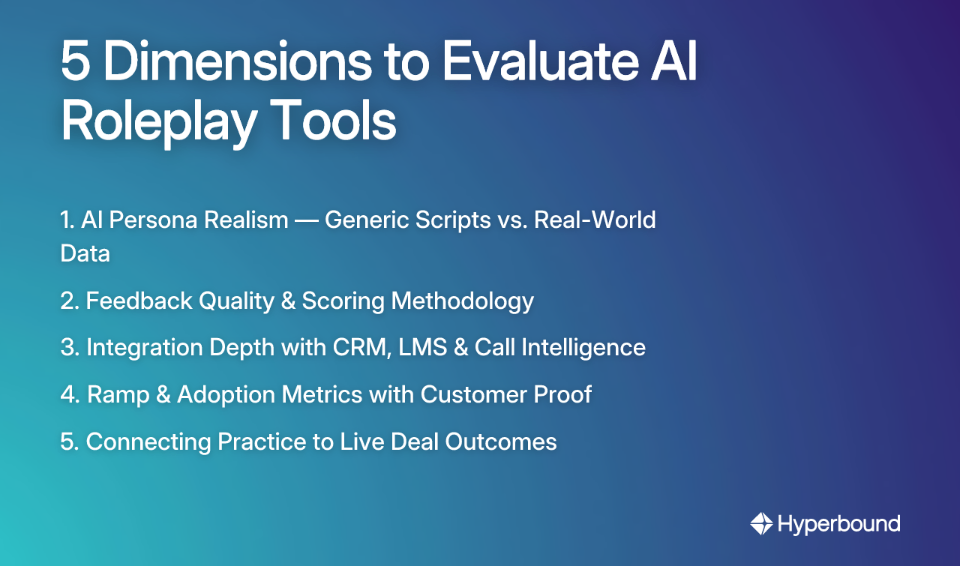
Hyperbound solves this at the data layer. Hyperbound Practice builds its AI buyer personas from analysis of 2M+ hours of real B2B sales conversations — not scripts written in a conference room. The result is an AI that handles unexpected pivots, pushes back on weak value props, and mirrors the behavior of actual buyers in your industry. As one Reddit user pointed out, the fix for unrealistic AI is "training the model with call recording data" — which is precisely Hyperbound's approach. Reps can practice cold calls, discovery, demos, objection handling, renewals, and upsells against personas that don't let them off easy.
Second Nature is an established AI roleplay platform with customizable personas and voice interaction. It works well for structured practice scenarios and has a solid reputation in the market. However, its AI can lean more scripted in execution, which limits how well it handles truly dynamic conversations — a known gap for B2B sales environments where buyers rarely follow the expected path.
Gong is a conversation intelligence platform — and an outstanding one — but it is not an AI roleplay tool. It analyzes calls that have already happened. It gives you rich insight into past conversations but doesn't give reps a single additional at-bat to practice before the next one.
Practice without structured feedback is just repetition. The question isn't whether reps are going through the motions — it's whether the tool tells them why a discovery call went sideways and what to do differently. As one practitioner put it, the test of a good tool is whether it "makes it feel like I'm actually improving."
Hyperbound delivers instant, objective feedback through AI Scorecards and AI Coaching aligned to your specific sales methodology — whether that's MEDDPICC, BANT, Challenger, or a custom framework. After every roleplay, reps receive a detailed breakdown covering talk ratios, key selling moments, methodology adherence, missed opportunities, and off-track messaging. For sales enablement leaders who are often supporting 50–100 reps without enough bandwidth to coach each one personally, this automated feedback loop is a multiplier — not a replacement for managers, but a way to ensure every rep gets timely, consistent guidance.
Second Nature offers performance reports and manager dashboards to track rep progress over time. The feedback is valuable for high-level progress tracking but tends to be less granular at the methodology-specific level. It's more suited to tracking completion and general improvement than diagnosing exactly where in a sales conversation a rep is losing momentum.
Gong provides some of the most sophisticated AI-driven analysis of real sales calls available — surfacing patterns, talk ratios, sentiment shifts, and competitive mentions. The catch: that feedback is retroactive. It tells you what went wrong on a call that already happened, rather than helping reps build the muscle before the next one.
A tool that doesn't fit into existing workflows creates adoption resistance from day one. RevOps teams, in particular, are wary of anything that adds to tool sprawl without clear value — and they'll ask hard questions about security, SSO, and data governance before signing off.
Hyperbound is built to embed within your existing tech stack rather than replace it. Its named integrations include:
Critically, Hyperbound integrates with Gong — meaning teams that already use Gong for conversation intelligence can pipe those insights directly into Hyperbound's coaching and practice workflows. It's a complementary layer, not a competing one.
Second Nature has solid LMS integration and works well within structured learning programs. Its connectivity to CRMs and call intelligence tools is more limited, which can restrict how seamlessly it fits into a modern, data-driven revenue workflow.
Gong is the industry standard for integrating call intelligence across the revenue stack. Its value is as a data source and system of record for customer conversations — it pipes insights out to other tools. It's not designed to be a destination for practice.
Every vendor will tell you their platform accelerates ramp time. The question is: who can prove it with named customers, specific metrics, and verifiable outcomes?
.png)
Hyperbound has a growing body of public, quantifiable proof:
Across the platform: 50% faster ramp, 2x faster time to first won deal, and 150% increase in DM → demo conversion rate are validated proof points. Hyperbound has delivered 1.1M+ minutes of simulated calls and 3.7M+ AI coaching insights to 45,000+ active users across 7,000+ companies.
Second Nature has an established customer base and genuine adoption in the market, particularly among mid-market teams. However, it has fewer publicly available, hard-quantified metrics on ramp acceleration or conversion rate impact — making it harder to build an internal business case with specific numbers.
Gong drives measurable impact through better deal visibility and rep performance insights, but its value is concentrated in the analyze-and-inspect layer. It's not positioned as a ramp acceleration tool in the way a dedicated practice platform is.
This is the dimension that separates the platforms. Practice in isolation is better than no practice — but if a tool can't connect what a rep does in simulation to what they do on live deals, its impact will always be hard to measure and easy to deprioritize.
Hyperbound is the only platform in this comparison built around this loop. The Revenue Activation model works like this:
The result is a continuous improvement cycle: Score Real Calls → Identify Skill Gaps → Practice Targeted Roleplays → Score Real Calls again. Training stops being a one-time event and becomes embedded in the rhythm of how your team sells. This is what aligning sales enablement with execution actually looks like in practice.
Second Nature is primarily focused on the practice layer. It's a solid tool for getting reps comfortable in simulated conversations, but it lacks native functionality to score live calls and automatically close the loop back into recommended practice based on real-world performance data.
Gong identifies the problems — deal risk signals, skill gaps, underperforming reps. But it doesn't provide the mechanism to fix them. It tells you what is broken. A platform like Hyperbound is designed to be the layer that fixes it.
.png)
Choose Hyperbound if your goal is to measurably improve revenue outcomes — not just practice volume. If you want a platform that scores live calls, identifies exactly where reps are losing deals, and automatically closes the loop back into targeted AI sales roleplay practice, Hyperbound is the only platform in this comparison built to do that end-to-end. It's the right fit for revenue teams that want practice tied to real call data, deal performance, and a continuous coaching cycle — and for leaders who are tired of being unable to draw a straight line between enablement spend and pipeline results. If you're already using Gong, Hyperbound integrates with it and turns those insights into action.
Choose Second Nature if your primary need is a straightforward, self-contained AI roleplay tool — and deeper integration with your CRM, call intelligence stack, or deal data isn't a near-term priority. It's a solid option for teams looking to get reps comfortable in conversations without requiring a full Revenue Activation workflow.
Keep using Gong for exactly what it's built for: best-in-class conversation intelligence. Gong is the system of record for your customer conversations and provides invaluable insight into what's happening across your pipeline. The gap it doesn't close — and was never designed to close — is giving reps a practice repetition before the next call. Pairing Gong with Hyperbound gives you both sides of the equation: the analysis and the activation.
The main difference is that Hyperbound is an AI platform for practicing sales conversations, while Gong is a conversation intelligence tool for analyzing sales conversations that have already happened. Hyperbound gives reps a safe environment to practice skills before a live call, whereas Gong provides insights on what went well or poorly after a call. Hyperbound is designed to be the "activation" layer that helps reps fix the skill gaps that Gong identifies.
AI persona realism is crucial because it prepares sales reps for the unpredictable and challenging nature of real-world B2B conversations. If the AI is too easy or follows a predictable script, reps don't build the skills needed to handle tough objections from actual buyers. Tools like Hyperbound train their AI on millions of hours of real sales calls to ensure practice is realistic and the skills learned are transferable to live deals.
Hyperbound provides instant, objective feedback after every roleplay session through AI Scorecards and AI Coaching. This feedback is aligned with your specific sales methodology (e.g., MEDDPICC, BANT) and offers a detailed breakdown of performance, covering talk ratios, methodology adherence, key selling moments, and missed opportunities. This gives reps actionable guidance to improve immediately.
Hyperbound's AI personas are more realistic because they are built from the analysis of over 2 million hours of real-world B2B sales conversations, not from pre-written scripts. This data-driven approach means the AI can handle unexpected conversational turns, push back on weak value propositions, and mirror the complex behaviors of actual buyers, preparing reps for the dynamic nature of live sales calls.
Hyperbound connects practice to performance through its Revenue Activation model, which scores 100% of real calls to identify skill gaps and then recommends targeted AI roleplay practice to fix them. This creates a continuous improvement loop where insights from live deal conversations directly inform training priorities, ensuring practice is always relevant and focused on improving revenue outcomes.
Yes, Hyperbound is designed to integrate seamlessly with your existing tech stack, including CRM (Salesforce, HubSpot), LMS (Seismic, Highspot), and call intelligence platforms like Gong. Its ability to integrate with Gong allows you to use insights from real calls to inform and personalize the practice scenarios within Hyperbound, creating a powerful, closed-loop system for skill development.
Data alone doesn't change outcomes. Knowing your reps are losing deals on pricing objections doesn't fix it — systematic, realistic AI sales roleplay practice built from real call data does.
Hyperbound's Revenue Activation Platform is used by sales teams at Autodesk, LinkedIn, Vanta, Monday.com, and 7,000+ other companies to turn call insights into measurable improvements in ramp time, conversion rates, and win rates.
Book a personalized demo today and see what it looks like when practice is connected to performance.









Use Cases
Legal