
Gong is exceptional at call intelligence. Mindtickle is a mature enablement platform. But neither closes the loop between what reps are doing wrong and what they should practice next.
That's the uncomfortable truth enterprise sales leaders are running into. You've invested in the category-leading tools. Your dashboards are full of data. And yet, reps are still struggling on calls, ramp times are still painfully long, and coaching still depends on whether a manager happens to have a free hour on Thursday.
According to Hyperbound's Revenue Activation Report 2026, 84% of sales reps missed quota last year, and the average new hire takes 381 days to become productive — costing over $130,000 per mis-hire. You don't have an insights problem. You have an activation problem.
The tools you're using were built to analyze and deliver training. What they weren't built to do is connect those two worlds — taking the specific moment a rep stumbled on an objection in a live deal and turning it into a targeted, realistic practice session that actually changes behavior before the next call.
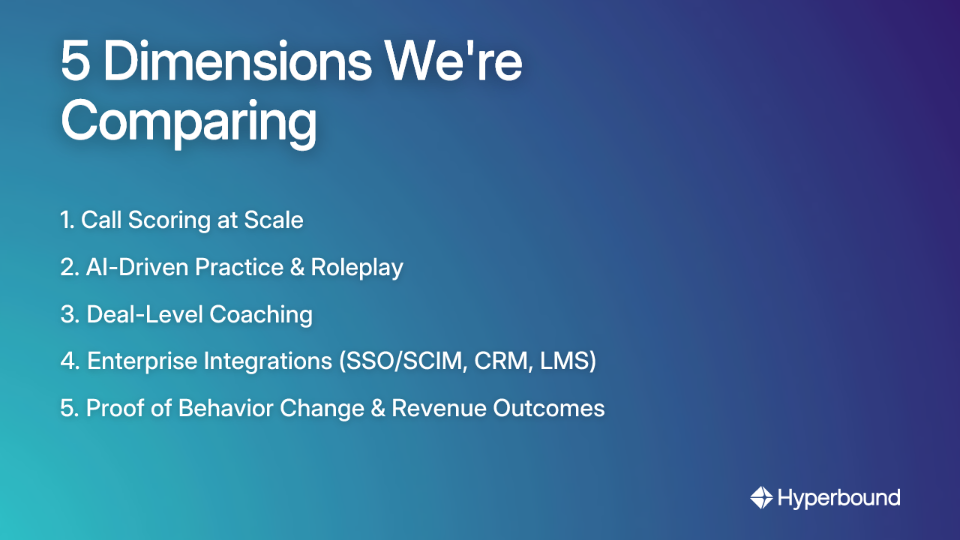
This article compares Hyperbound, Gong, and Mindtickle across five enterprise-critical dimensions:
The goal isn't to pick a winner in isolation — it's to help you understand which combination of tools (or which single platform) actually scales enterprise sales coaching end-to-end.
Hyperbound Perform deploys AI scorecards directly on real customer calls, automatically scoring 100% of conversations against your specific sales methodology. It integrates with Gong, Outreach, Salesloft, and other call recording systems — so you're not replacing your call intelligence infrastructure, you're scoring behaviors on top of it.
More importantly, those scores feed directly into the practice engine. A rep who consistently under-indexes on multi-threading gets assigned targeted practice scenarios — automatically.
Gong is the undisputed gold standard here. It captures and analyzes the vast majority of customer interactions, surfacing talk ratios, keyword mentions, sentiment shifts, and deal risk signals. For any enterprise sales team that wants to know what happened on a call, Gong is the answer.
The gap? It's diagnostic, not prescriptive. Gong will tell you a rep is struggling with pricing objections. It won't give that rep a place to practice handling a CFO who pushes back on cost. The insight stops at the dashboard.
Mindtickle offers 100+ out-of-the-box analytics reports for tracking training adoption, content engagement, and quiz completions. Its role-based dashboards make it easy to see who's completed what in a learning path.
The gap? Scoring lives inside the training environment. It measures whether a rep watched a module or passed a certification — not whether those skills are showing up in real, unstructured customer conversations.
This is where the gap between the legacy platforms and modern AI-native tools becomes starkest — and where enterprise sales leaders are feeling the most pain.
Sales teams on Reddit have flagged the exact problem: "I found it a bit unrealistic for B2B sales role-playing. Prospects often ask unexpected questions or take the conversation in different directions, which it doesn't really handle well." Others using ChatGPT for practice noted: "It just agrees and tells me why I'm right" — the AI failing to provide any real challenge.
Hyperbound Practice is built specifically for this problem. AI buyer personas are trained on 2M+ hours of real B2B sales conversations — meaning the AI pushes back, goes off-script, and responds the way actual buyers do. That's the difference between a simulation that challenges and one reps can game in two sessions.
Key features for enterprise scale sales coaching:
This is the practice layer that Gong doesn't offer and Mindtickle doesn't match in depth.
Gong doesn't offer a dedicated, scalable practice or roleplay layer. Its coaching mechanism relies on managers manually reviewing calls and scheduling 1:1s — which, as any enterprise enablement leader knows, means coaching only happens for the reps whose managers prioritize it. That's not scale; that's luck.
Mindtickle includes roleplay functionality as part of its broader enablement suite, and it's well-suited for structured onboarding and certification programs. But the simulation fidelity isn't tied to real call data. Scenarios tend to be built from templates, and reps quickly learn to game them — going through the motions of a mock call without actually improving the underlying skill.
Most enterprise coaching conversations happen in a vacuum — a training module assigned to everyone, regardless of what deals they're actively working. The result? Coaching that's disconnected from the specific situations where reps actually need help.
This is where Hyperbound's closed-loop model becomes most powerful for enterprise teams.
Hyperbound Perform analyzes all touchpoints across a deal's lifecycle — not just the last call — to surface deal-level coaching insights. It identifies what's helping or hurting an opportunity and recommends specific actions.
Kota Activate, Hyperbound's AI assistant, then orchestrates the next step. A rep that mentions a competitor in a late-stage deal without a strong counter-narrative gets a Bitesized Roleplay assigned at the right moment — before the next call, not at the next QBR.
The operational loop looks like this:
Score real calls → Identify skill gap in active deal → Assign targeted practice → Measure behavior on next call
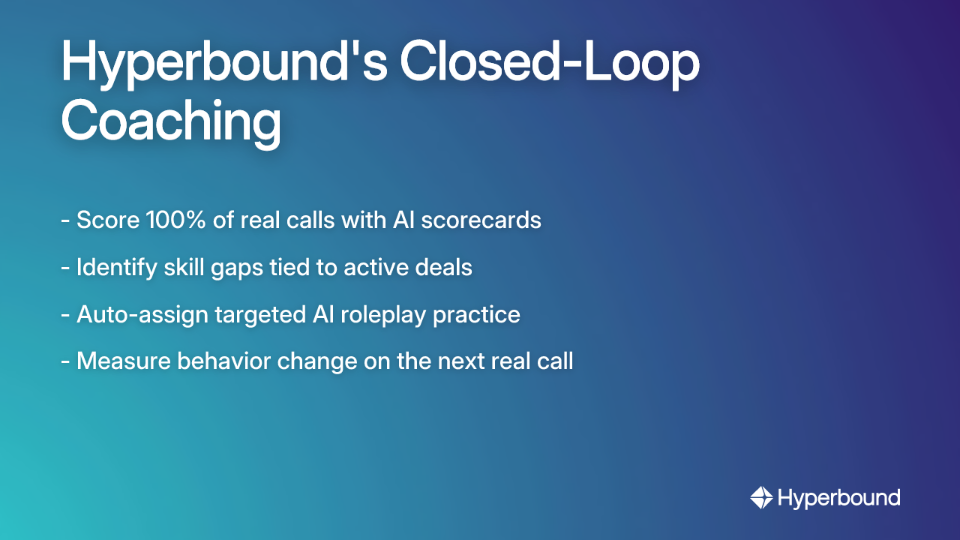
That's deal-level coaching at enterprise scale. Not manager-dependent, not calendar-driven — behavior-driven.
Gong does surface deal risk well — it can flag when a champion has gone quiet, when budget hasn't been discussed, or when competitive mentions are increasing. The gap is in what happens next. It tells the manager the deal is at risk. It doesn't tell the rep what to do differently, or provide a mechanism to practice the exact conversation they need to have.
As one enterprise revenue ops leader put it in a community thread: "We're not huge fans of Gong's pipeline management and 1:1 coaching tools." The analysis is excellent; the actioning of that analysis is where it falls short.
Mindtickle enables programmatic coaching — managers can assign a competitive positioning module to a rep. But that assignment is driven by a manager's intuition or a training calendar, not by what just happened in a live deal. It's coaching by schedule, not by situation.
For enterprise buyers, a coaching platform is only as valuable as its ability to slot into an existing tech stack without creating data governance headaches or tool sprawl.
Hyperbound is purpose-built to integrate across the enterprise sales tech stack without adding friction:
Notably, Hyperbound's Gong integration means enterprise teams don't have to choose. Gong captures and analyzes the call; Hyperbound scores behaviors, surfaces gaps, and assigns practice. The tools work together.
Gong has strong enterprise-grade integrations, particularly with Salesforce. Its security posture is mature. The limitation is on the LMS and enablement side — Gong isn't designed to plug into the learning infrastructure that enablement teams rely on.
As an enablement-first platform, Mindtickle has deep LMS and content integrations, and its security posture is well-established. The challenge is operational — large enterprise deployments can become complex to manage, and the current tool friction issue is real: "The current system takes 7-20 clicks just to find info, engagement is abysmal, and they're already overloaded with emails, Teams messages, CRM tasks."
Ultimately, every enterprise sales leader wants the same thing: evidence that a coaching investment is making reps better and moving revenue. This is where the three platforms diverge most sharply.
Hyperbound closes the loop between practice behavior and revenue outcomes — and has enterprise-scale proof points to back it:
These aren't training completion metrics. They're direct revenue outcomes — faster ramp, more pipeline, higher conversion rates — tied to a coaching and practice model that connects real call behavior to targeted skill development.
Gong can correlate behaviors with outcomes — teams that ask more discovery questions have higher win rates, for example. The gap is that this insight is indirect. It requires a manager to interpret the data, deliver coaching, and then monitor performance over time. The behavior change isn't facilitated by the tool; it depends on the humans using it.
Mindtickle can demonstrate ROI by correlating training completion rates with quota attainment. That's meaningful, but it proves the impact of completing training — not the application of specific behaviors in live deals that drives pipeline.
.png)
Enterprise sales teams don't have an insights problem. They have an activation problem. The data is there. The analysis is there. What's missing is the closed loop that takes a specific skill gap — identified in a real deal, on a real call — and turns it into a practice moment that actually changes what a rep does next time.
Gong identifies the problem. Mindtickle delivers training. But neither completes the loop.
Hyperbound's Revenue Activation platform is built around that loop: Perform scores real calls and surfaces what's putting deals at risk. Practice gives reps a realistic, AI-driven environment to fix the specific gaps identified. Kota orchestrates the entire system — recommending the right coaching intervention for the right rep at the right moment in their deals.
For enterprise sales leaders ready to move beyond dashboards and toward measurable behavior change, the question isn't whether to replace your call intelligence tool. It's whether your current stack can actually scale enterprise sales coaching all the way to closed-won.
Teams at LinkedIn, Vanta, and Autodesk have already found their answer. See how Hyperbound closes the loop →
The primary difference lies in their core function: Gong excels at analyzing what happened on past calls, Mindtickle focuses on delivering structured training content, while Hyperbound connects call analysis with AI-driven practice to actively change future call behavior. Gong provides the insights, Mindtickle provides the learning modules, but Hyperbound creates a closed loop where a rep's specific struggles on a real call trigger targeted, realistic practice to fix the issue before the next conversation.
Hyperbound is designed to complement and enhance your existing sales tech stack, not necessarily replace it. It integrates directly with call intelligence tools like Gong, using their recordings to score rep behaviors and identify skill gaps. While it offers a more advanced, AI-driven practice and coaching layer than Mindtickle's roleplay features, its unique value is in activating the data from your other systems to drive measurable performance improvements.
Hyperbound's AI roleplay is more effective because its AI buyer personas are trained on over 2 million hours of real B2B sales conversations, not generic language models. This allows the AI to behave like a real prospect—pushing back on pricing, asking unexpected questions, and going off-script. Unlike basic AI that might just agree with a rep, Hyperbound's AI provides a challenging and realistic simulation, ensuring reps are prepared for the dynamics of actual sales calls.
Revenue Activation is the process of turning sales call insights into measurable behavior change that directly impacts revenue. It solves the common "activation problem," where companies have plenty of data on what reps are doing wrong (from tools like Gong) but struggle to translate those insights into effective action. Hyperbound facilitates this by automatically identifying skill gaps from real calls and assigning targeted AI practice, closing the loop between analysis and performance.
Hyperbound provides scalable, deal-level coaching by automating the connection between call performance and practice. Its platform analyzes all touchpoints in a live deal to flag a rep's specific struggle (e.g., handling a competitor mention). It then automatically assigns a short, targeted AI roleplay to practice that exact scenario. This ensures coaching is timely, relevant to active deals, and not dependent on a manager's limited availability, allowing for consistent coaching across the entire team.
Customers typically see significant, measurable improvements in key revenue metrics. For example, Hyperbound helped Vanta reduce new hire ramp time by 60% (from 210 to 72 days) and drive 5x more pipeline. Other results include scaling coaching to thousands of sellers, as with LinkedIn, and achieving a 150% increase in demo conversion rates. The platform is designed to tie coaching activities directly to tangible business outcomes.
Yes, Hyperbound is built for enterprise-grade security, scalability, and integration. The platform is SOC 2 Type II compliant and supports SSO/SCIM for secure user management. It integrates seamlessly with enterprise systems like Salesforce, Gong, and major LMS platforms. Furthermore, with support for over 25 languages and proven success in scaling to over 3,000 sellers at companies like LinkedIn, it is well-equipped to handle the needs of complex, global sales organizations.








Use Cases
Legal