
When sales reps first start out, the struggle to find a good practice partner is real. One Reddit user summed it up perfectly: "When I was starting out I used to practice with my brother. We'd run through objection handling and stuff but it was always awkward because he didn't know how to act like a real prospect." Sound familiar?
The traditional answer is to find a sales buddy or manager willing to roleplay with you, but as most reps quickly discover, that's inconsistent at best. Most people flake. And even when they show up, they rarely push back the way a real prospect would. ChatGPT can handle basic objection handling if you prompt it well, but it tends to be too agreeable and can't maintain a consistent buyer persona across a full discovery call.
So when Gong announced AI roleplay included in its platform, it sounded like a genuine solution. No extra cost, already sitting inside a platform thousands of sales teams use every day. Why wouldn't you use it?
Here's why: included does not mean effective. Gong sales roleplay is a feature addition to a Conversation Intelligence (CI) platform. Hyperbound is a purpose-built coaching and practice platform trained on over 2 million hours of real B2B calls. Those are not the same thing, and this article will show you exactly where the gap shows up in practice.
The most important thing to understand about Gong's roleplay is what it is structurally: a feature. It lives inside a CI platform whose core job is recording, transcribing, and analyzing sales calls. Roleplay was added on top. That architectural decision has downstream consequences for everything from scenario depth to coaching integration.
When a product is designed around a secondary use case, it tends to get secondary investment, secondary design thinking, and secondary depth.
Hyperbound is built differently. Roleplay and practice are the entire product. Everything on the platform, from the Bot Builder to the scorecard system to the feedback loop, exists to make sales reps better at live conversations. The platform is trained on over 2 million hours of actual B2B calls, giving it a fundamentally deeper model of how real sales conversations unfold, including the messy, non-linear parts that generic simulations miss entirely.
The difference is not a matter of polish. It's a difference in what the product is fundamentally designed to do.
Practicing objection handling with a generic "skeptical CFO" persona is better than nothing. But it does not prepare you for a conversation with the actual CFO at the account you're trying to close next Tuesday.
This is where Gong's free roleplay falls short in a way that matters. The majority of its scenarios are generic, lacking the specificity needed for effective training. You can rehearse your pitch, but you're rehearsing it against a placeholder, not against a buyer persona that reflects the actual priorities, objections, and context of a real deal in motion.
Hyperbound's Bot Builder takes a different approach. Reps and managers can create custom digital twins that reflect actual LinkedIn profiles, complete with job title, company background, and likely concerns. That means before a rep walks into a discovery call with a champion at a mid-market SaaS company, they can practice specifically against a persona built to mirror that person's role and context.
This is deal-contextual practice. It's not about running through a script. It's about simulating the real conversation so that when the real call happens, the rep has already navigated the hardest parts. As one sales professional put it: "The combo of deliberate practice + real-world feedback is what actually moves the needle." Generic mock calls give you neither.
Here's the core problem with disconnected practice: you can spend an hour in a roleplay session, get a score, and walk away with no idea whether any of it translated to your actual calls.
Gong sales roleplay has no mechanism to link practice performance to real call data. You practice in one place, you perform in another, and there's no system connecting them. That means managers have no visibility into whether a rep's mock call performance is actually translating to better discovery calls or stronger objection handling in live deals. The practice exists in a vacuum.
Hyperbound Practice, part of the Hyperbound Revenue Activation Platform, is built around closing exactly that loop, using a four-step process integrated with Hyperbound Perform:
This is what reps mean when they say deliberate practice matters. Recording your cold calls and listening back is painful, but "you catch verbal tics and weak transitions fast." Hyperbound automates that process, routes reps to the right practice based on what real calls reveal, and then measures whether it worked. Gong offers none of that integration. You get a simulation. You do not get a coaching engine.
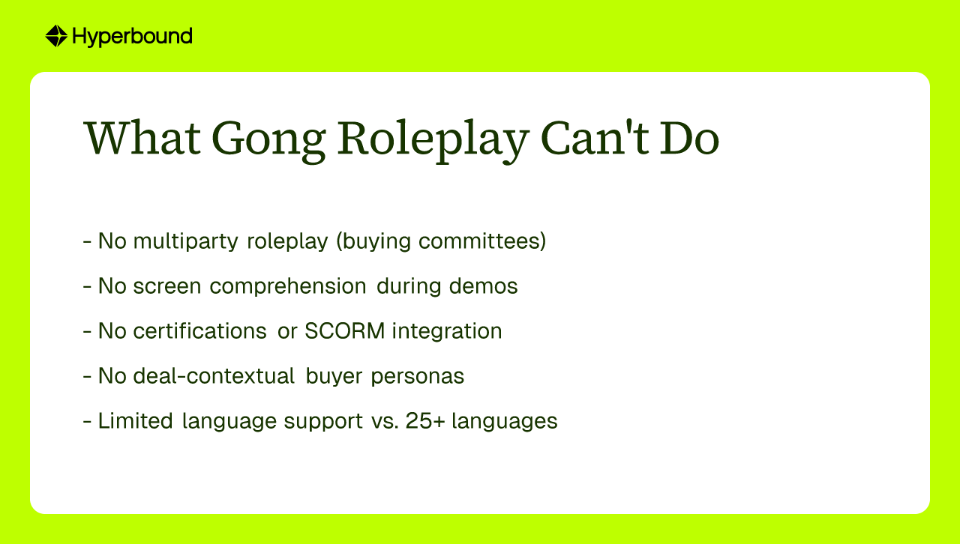
Beyond the structural differences, there's a direct set of capabilities that Gong's free roleplay simply does not offer. These are not edge cases. They are table stakes for enterprise sales teams running structured enablement programs.
Multiparty Roleplays
Most significant B2B deals do not close in a single 1:1 conversation. They involve a champion, a decision maker, a procurement lead, sometimes an IT stakeholder, and occasionally legal. Gong cannot handle multiparty interactions. That means you can't practice navigating a buying committee, managing competing priorities in a single call, or holding the room when the CFO pushes back while your champion stays quiet.
Hyperbound supports multiparty roleplays that let reps practice with a full project team simultaneously. The AI plays multiple personas at once, each with distinct roles, objections, and levels of enthusiasm. That's the kind of simulation that actually prepares reps for complex enterprise deals.
Screen Comprehension
Demo calls involve more than talking. Reps navigate pricing pages, slide decks, and product interfaces while managing the conversation. Gong's roleplay cannot see or react to what a rep is showing on screen. Hyperbound's Screen Comprehension feature allows the AI to respond to whatever is being presented, giving reps feedback on both their verbal delivery and how they handle the visual components of a pitch.
Certifications and SCORM Integration
If you're running a structured enablement program, you need to be able to certify that reps have completed and passed specific training modules. Gong lacks features for certifications or SCORM integration, which makes it unsuitable for companies that need to plug roleplay into an existing Learning Management System (LMS) or run formal readiness programs before product launches or new hire onboarding.
Hyperbound offers full certification workflows and SCORM compliance, meaning it integrates cleanly into enterprise L&D infrastructure.
Language Support
Gong's roleplay tool does not specify its language support. Hyperbound supports 25+ languages, making it a viable option for global sales teams that need consistent training across regions, not just English-speaking markets.
Gong sales roleplay is a free feature inside a platform built for something else. It can give reps a place to run through a script. What it cannot do is simulate a realistic buyer persona, connect practice to real call performance, support multiparty selling scenarios, enforce methodology, or scale into an enterprise enablement program.
Hyperbound was built from the ground up to solve the actual problem: getting sales reps to perform better on real calls, consistently, across different deal types, buyer personas, and geographies. It connects practice to performance through a continuous improvement loop. It builds digital twins from real LinkedIn profiles. It handles multiparty simulations, screen comprehension, certifications, SCORM, and 25+ languages. And critically, it ties everything back to what reps are actually doing on live calls.
When you're evaluating sales training technology, the right question is not "Is it free?" It's "Does it work?" Because ineffective practice does not just fail to help. It wastes time, reinforces habits that don't get corrected, and lets managers feel like they've done something when nothing has actually changed.
If your team's roleplay program is a checkbox, your win rates will reflect that. The reps who improve fastest are the ones who get deliberate practice tied to real-world feedback. That combination does not come from a free feature tacked onto a CI platform. It comes from a platform built for exactly that purpose.
The main difference is that Gong's roleplay is a free, supplementary feature within a Conversation Intelligence platform, while Hyperbound is a dedicated, purpose-built platform designed specifically for AI sales practice and coaching. This fundamental distinction impacts everything from the depth of scenarios to integration with coaching workflows. Hyperbound is built around a closed-loop system that connects practice to real-world performance, a capability not present in Gong's feature.
Built-in tools like Gong's roleplay are often ineffective because they lack the depth, customization, and coaching integration needed to drive real behavioral change in sales reps. They provide generic scenarios that don't mirror real deals and offer no mechanism to connect practice performance to on-the-job results. This creates "checkbox training," where activity happens but skills don't improve, leading to wasted time and stagnant win rates.
Hyperbound creates highly realistic buyer personas by building "digital twins" based on actual LinkedIn profiles of prospects. Instead of practicing with a generic "CFO" persona like in Gong, sales reps can simulate conversations with an AI that mirrors the specific job title, company background, and likely concerns of a real person they are about to meet. This deal-contextual practice prepares reps for the actual conversations they will have.
Hyperbound measures impact through an integrated, four-step coaching loop that connects practice directly to performance on real calls. The platform first analyzes a rep's actual sales calls to identify specific skill gaps. Then, managers assign targeted practice simulations to address those weaknesses. Finally, Hyperbound scores subsequent real calls to measure improvement, providing clear ROI on the training investment. Gong's roleplay feature is disconnected from real call data.
Hyperbound can simulate complex, realistic scenarios that Gong's tool cannot handle, such as multiparty roleplays with a buying committee and demo calls that require screen comprehension. With Hyperbound, reps can practice navigating conversations with multiple stakeholders (e.g., a CFO, champion, and IT lead) in a single call. The AI can also see and react to what's on the rep's screen during a demo, providing feedback on both verbal and visual presentation skills.
Yes, Hyperbound is designed for enterprise teams and integrates seamlessly into formal training programs through features like full certification workflows and SCORM compliance. Unlike Gong's feature, Hyperbound can plug directly into a company's Learning Management System (LMS). This allows enablement leaders to run structured readiness programs, certify reps on new products or methodologies, and track completion at scale, making it a true enterprise-grade solution.








Use Cases
Legal