
Gong deserves its flowers. When it launched, it did something genuinely transformative: it industrialized call recording and made rep execution visible for the first time. Before Gong, what happened on a sales call was essentially a black box. Managers coached based on ride-alongs and gut feel. Gong changed that. It gave revenue teams a searchable library of every call, meeting, and email. For the first time, leaders could actually see what their reps were doing.
That was real progress.
But here's the tension that no one in the market wants to say out loud: visibility is not the same as improvement. By the time a call ends up in a summary, the moment to change that outcome is already gone. Knowing a rep fumbled the discovery call last Tuesday doesn't help them win the deal this Thursday.
This is the core question the article is built around: if your goal is to actually scale sales coaching, not just record it, which platform gets you there?
To answer that fairly, we'll compare Gong and Hyperbound across five dimensions that define ai sales coaching scalability: deal-level coaching, a practice layer, proactive intervention, manager time required, and measurable ramp impact. Where Gong wins, we'll say so. Where the gap is real, we'll walk through it.
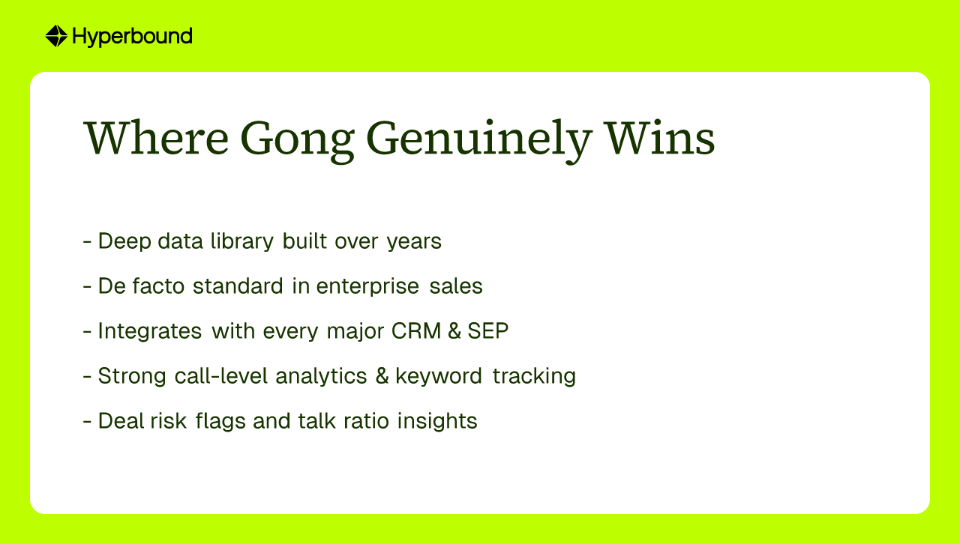
Gong built the category of Conversation Intelligence, and it earned its market position. The product captures every call, meeting, and email to give managers an unbiased view of rep behavior. It tracks metrics like talk-to-listen ratios, question rates, and objection handling patterns, and it links those behaviors to outcomes like win rates and deal velocity.
The integrations are deep. Gong connects with Salesforce, HubSpot, Slack, and dozens of other tools. Its data library is enormous. And for larger organizations with the budget for it (which can run six figures per year), it remains the gold standard for call intelligence.
Where Gong genuinely wins:
Gong has published data showing that new reps with access to its call insights ramp faster, though specific time-to-quota improvements vary by team and sales motion.
The question isn't whether Gong provides value. It clearly does. The question is whether that value, rooted in recording, transcription, and analysis, is enough to scale your coaching program as your team grows.
Here's the problem with a visibility-only model: it shifts the entire burden of analysis, interpretation, and action back onto the manager.
And managers are already stretched. According to Hyperbound's buyer research, frontline managers spend just 5-8% of their time on coaching. It's one of the first things cut when the calendar gets busy. According to Hyperbound's own buyer research, managers are listening to less than 1% of recorded conversations. That means the vast majority of coachable moments in a Gong instance are never actually acted on.
What fills the gap? The common workaround is manual and messy: pull a transcript, plug it into ChatGPT, and ask for feedback. As one sales leader described it, "this is a scrappy and cheap way of doing it." That's not a coaching program. That's duct tape.
The deeper issue is structural. A library of past calls, no matter how well-organized, doesn't coach anyone. It only coaches when a human reviews it, interprets it, and then delivers feedback to the right rep at the right time. That's a bottleneck that doesn't get better as your team grows; it gets worse.
Sales teams are increasingly asking a different question: "How do I improve rep skill gaps not just on a deal or call, and find the common threads across all my reps so I can coach more strategically?" That's the shift from visibility to Revenue Activation, and it's the gap that Hyperbound is built to close.
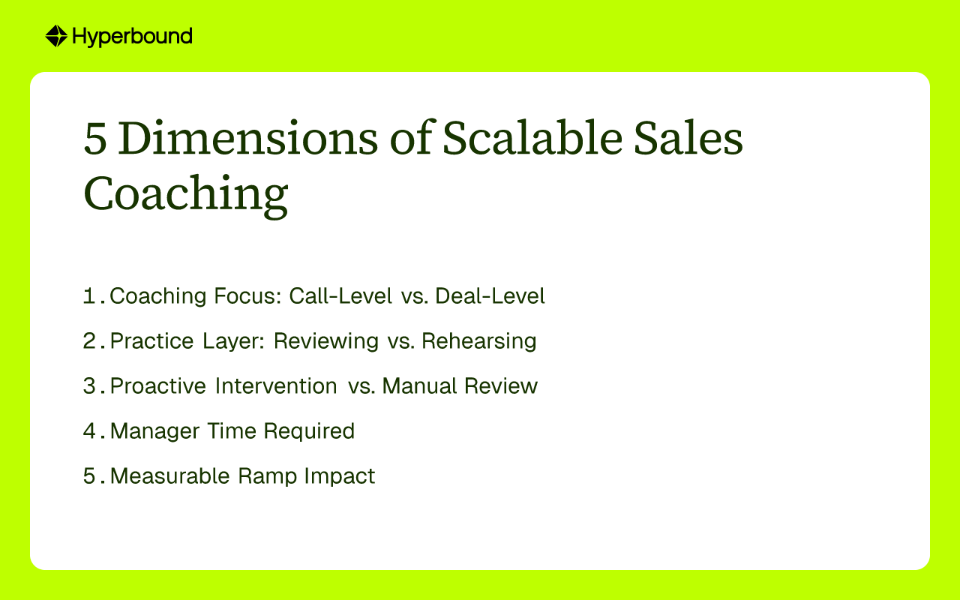
Gong analyzes conversations on a per-call basis. It surfaces what happened in a single interaction: how the rep handled an objection, whether they talked too much, what topics came up. That's valuable for reviewing individual moments.
What it misses is the larger arc. A deal doesn't live in one call. It lives across a discovery call, a demo, a follow-up, a multi-stakeholder negotiation. The coaching insight that matters is often not "what happened on Tuesday's call," but "what pattern across four calls is stalling this deal."
Hyperbound addresses this with Hyperbound Perform, its deal-level coaching product. Perform looks across all calls in a deal, stitching together behavior across the entire deal lifecycle to surface what's helping or hurting the opportunity. It tracks stakeholder engagement, email interactions, and conversation patterns to recommend deal-winning actions before deals are lost. It's not analyzing a call in isolation; it's analyzing a deal in motion.
This is the starkest gap between the two platforms. Gong has no structured practice layer. Coaching is reactive and backward-looking. You review what went wrong and hope the rep applies the feedback next time. There's no safe environment to actually rehearse the new behavior before the next live call.
Hyperbound is built on a foundation of proactive practice with Hyperbound Practice. Reps can run AI roleplays for cold calls, discovery, demos, objection handling, renewals, and more, before they ever talk to a real buyer.
These aren't generic chatbots. The AI buyer personas are trained on over 2 million hours of real B2B sales conversations. They handle unexpected questions, push back on weak responses, and replicate the kind of friction real buyers create. This directly addresses a common complaint from practitioners: that most AI role-playing tools are "unrealistic for B2B sales" or feel robotic. When the training data is grounded in real conversations, the simulation feels real.
Features like AI Scorecards, Bitesized Roleplays for tenured reps who won't sit through a 45-minute certification, Multiparty Roleplays for complex enterprise deals, and Screen Comprehension for demo practice make this a genuine skill-development environment, not a checkbox exercise.
In Gong's model, the intervention mechanism is a human manager. They review a call, spot a gap, and decide what to do about it. That's reactive, delayed, and doesn't scale.
Hyperbound's answer is Kota Activate: an AI assistant that sits above both Practice and Perform, acting as an AI Revenue Analyst for the entire team. Kota analyzes all deals simultaneously, references historical patterns from past closed-won and closed-lost deals, and proactively recommends personalized coaching interventions.
Critically, Kota doesn't just report; it acts. It can identify a skill gap in a rep's live deal through Perform, generate a targeted roleplay in Practice to address that exact gap, and surface it to the rep in Slack or Teams. The loop from insight to action closes automatically, without requiring a manager to manually connect the dots.
That's the difference between a tool that shows you problems and a platform that helps you solve them.
Gong is a high-effort tool for managers who want to actually coach from it. Reviewing calls, building scorecards, flagging moments, and delivering feedback all require time that most managers don't have.
Hyperbound is designed to significantly reduce that load. By automating call analysis, surfacing the highest-priority coaching moments, and delivering feedback directly to reps, it shifts managers from low-value review work to high-impact coaching conversations. Customers report saving 3.5 workweeks of coaching time, not because coaching happens less, but because the manual search-and-summarize work is handled automatically.
Gong has published data showing that new reps with access to its call insights ramp faster, particularly for onboarding and call review efficiency.
Hyperbound delivers more direct, quantifiable impact tied to the full coaching cycle. Vanta cut ramp time by 60%, from 210 days down to 72, while growing their BDR team 4x. Nivoda saw a 50% ramp reduction and doubled revenue year-over-year. Across customers, Hyperbound has also delivered a 150% increase in DM to demo conversion rates and 2x faster time to first won deal.
The distinction matters: Gong provides data that can lead to improvement when a human acts on it. Hyperbound closes the loop from data to practice to behavior change to revenue outcome, and measures it.
DimensionGongHyperboundData Library & Market PenetrationIndustry-leadingGrowing fast (45,000+ active users)IntegrationsExtensive (CRM, SEP, meetings)Strong (incl. native Gong integration)Coaching FocusCall-level insightsDeal-level coaching across full lifecyclePractice LayerNoneAI roleplays, scorecards, certificationsIntervention MechanismManual manager reviewProactive, Kota-orchestrated actionsManager Time RequiredHighLow (3.5 workweeks saved)Measurable Ramp ImpactCall-level visibility benefits for onboarding50-60% ramp reduction (customer-validated)
Gong laid the foundation for modern sales execution. It built the system of record for customer conversations and gave revenue leaders, for the first time, a way to see what was actually happening on the frontline. For organizations that need deep call analytics, CRM integration, and a mature enterprise platform, Gong remains genuinely powerful.
But the market has moved. The challenge in B2B sales today isn't visibility. Most teams have more call data, pipeline analytics, and dashboards than they can act on. The challenge is activation: closing the gap between knowing what happened and actually changing what happens next.
That's the category Hyperbound calls Revenue Activation. It's not about replacing your call intelligence layer. Hyperbound integrates directly with Gong and other tools in your sales stack. It's about adding the two layers that Gong was never built to provide: a proactive practice environment that prepares reps before the call, and a deal-level coaching system that intervenes while outcomes are still yours to change.
The result is a continuous improvement cycle that scales without adding headcount: Score real calls → Identify skill gaps → Practice roleplays → Score real calls again. That loop is what separates organizations with strong win rates from those still relying on hope and hindsight.
Gong records the call. Revenue Activation changes it.
Ready to close the gap between insight and action? See how Hyperbound works.
The primary difference is that Gong provides visibility into past sales conversations, while Hyperbound focuses on proactive practice and deal-level coaching to actively improve future outcomes. Gong is a leader in Conversation Intelligence, recording and analyzing calls to show you what happened. Hyperbound is a Revenue Activation platform that adds a practice layer for reps to rehearse before live calls and uses AI to recommend deal-winning actions across the entire sales cycle, not just on a single call.
No, Hyperbound does not replace Gong; it enhances it. Hyperbound is designed to integrate directly with Gong. It pulls call data from Gong to identify skill gaps and then uses its practice and deal-coaching layers to actively close those gaps. You can use both platforms together to create a complete cycle: record calls with Gong, then use Hyperbound to practice and improve before the next one.
Hyperbound provides AI buyer personas that reps can practice with in simulated sales scenarios like discovery calls, demos, and objection handling. These AI simulations are trained on over 2 million hours of real B2B sales conversations, making them highly realistic. The AI pushes back, asks tough questions, and provides instant feedback and scoring, allowing reps to build skills in a safe environment before engaging with actual prospects.
Deal-level coaching is more effective because it analyzes patterns and behaviors across the entire sales cycle, not just isolated moments in a single call. A deal's success depends on a series of interactions—discovery, demo, follow-ups, negotiations. Gong focuses on individual calls. Hyperbound's Perform product stitches together insights from all calls and emails within a deal to identify critical patterns and recommend actions that can save a deal before it stalls.
No, Hyperbound is designed for sales reps at all experience levels. While it's highly effective for reducing ramp time for new hires, it also offers tools for tenured reps. Features like "Bitesized Roleplays" allow experienced reps to quickly sharpen specific skills without sitting through lengthy certifications. The deal-level insights from Hyperbound Perform are valuable for reps at any stage of their career.
Teams using Hyperbound typically see a significant reduction in ramp time, increased conversion rates, and faster time to first deal. Customer case studies show results like a 50-60% reduction in new hire ramp time, a 150% increase in decision-maker to demo conversion rates, and a 2x faster time to the first won deal. It also saves managers an average of 3.5 workweeks in manual coaching time per year.







Use Cases
Legal