
If your team is already on Gong, you've made a smart investment. Gong is a leading call intelligence (CI) platform for a reason — it captures customer interactions, surfaces talk-to-listen ratios, flags competitor mentions, and gives managers a window into what's happening across their pipeline. As one sales ops professional put it: "Most helpful feature by far is the call recording and transcript."
The call recording is reliable, the deal visibility is solid, and its market presence means many reps and managers already know how to use it.
But here's the tension that thousands of sales managers run into after they've been on Gong for six months: Gong tells you exactly what went wrong on a call. It doesn't give your reps a structured way to fix it before the next one.
You can see that your newest AE paused at pricing, fumbled an objection, or never asked for the next step. You have the transcript. You have the recording. You have the data. What you don't have is a batting cage — a place where that rep can practice the same scenario five times with a realistic AI buyer until the response becomes instinct, not improvisation.
That's the insight-to-practice gap. And it's where the comparison between Gong and Hyperbound gets interesting.
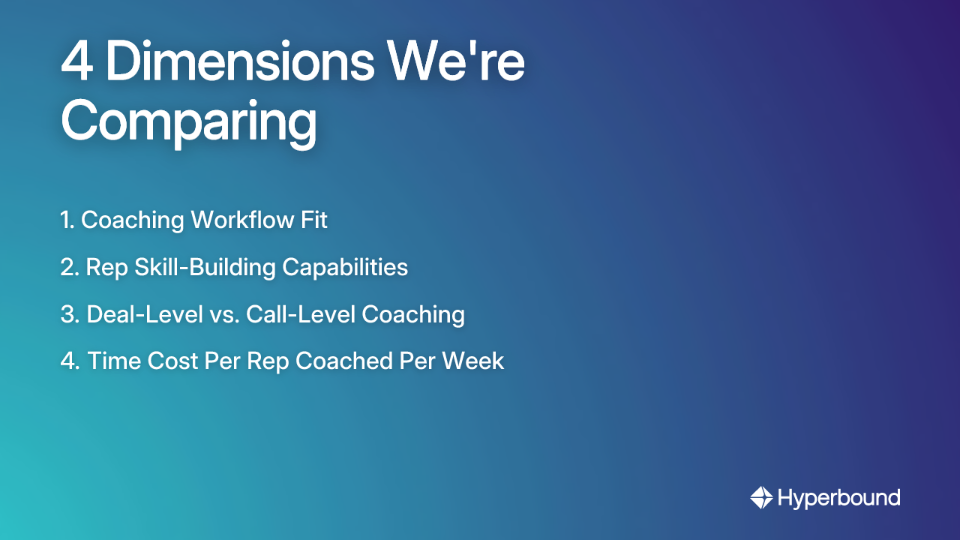
This article breaks down both platforms across four dimensions that matter most to frontline sales managers looking for the right sales coaching software for managers on their team:
Before getting into the comparison, it's worth naming the underlying problem. Sales managers spend only 5–8% of their time on actual coaching — and it's usually the first thing cut when their calendar fills up.
Even with Gong running on every call, a manager can realistically review maybe 5% of recorded calls in a given week. The rest? They sit in a library that no one has time to visit. The coaching that does happen is reactive, manual, and entirely dependent on the manager's bandwidth.
This is the environment both tools are operating in. Let's see how they stack up.
Gong: Reactive Review
Gong's workflow is built around what happened after a call. A rep finishes a discovery call, Gong transcribes it, maybe flags a few moments for review, and — if the manager has time — they leave a comment or schedule a debrief. The coaching only happens if the manager initiates it.
This is valuable. But it's inherently lagged. The rep is already on their next call before feedback lands.
Hyperbound: Proactive Practice Loop
Hyperbound Practice is designed to embed skill-building directly into the weekly workflow — not as a one-off event but as a continuous loop. Here's what that looks like in practice:
That's a fundamentally different coaching motion — one that's proactive instead of reactive, and rep-driven instead of manager-dependent.
Gong: Passive Learning
Gong's skill-building model is based on consumption: listening to your own calls, reviewing transcripts, or watching a curated call library. There's real value here, especially for new reps learning what "good" sounds like.
But there's a ceiling. Watching someone else handle an objection and being able to handle it yourself are two very different things. Learning to swim by watching videos only gets you so far.
Hyperbound: Active Skill Development
Hyperbound flips the model from passive to active. Reps get real at-bats in a safe environment, with AI buyer personas trained on 2M+ hours of real B2B sales conversations — not generic chatbot responses. This directly addresses a common frustration sales reps mention about generic AI tools: "The main difference is that it's a lot more realistic than ChatGPT because it doesn't give generic answers."
Key capabilities that separate Hyperbound on this dimension:
The result is a practice environment that scales with your team without adding to the manager's workload.
Gong: Call-Centric Analysis
Gong's primary unit of analysis is the individual call. This is where it shines — it gives you a precise breakdown of what happened in a single conversation. But deals aren't single conversations. They're a sequence of touchpoints that span weeks or months, and the risk in a deal is often visible only when you look across all of them together.
A manager might review a great discovery call, mark it "good," and move on — not realizing the deal has quietly stalled because the rep never surfaced the economic buyer in any of the three follow-up calls.
Hyperbound Perform: Deal-Level Coaching
Hyperbound Perform is built to address exactly this gap. Instead of analyzing individual calls in isolation, it connects behavior across the entire deal lifecycle — from the first cold call through the final negotiation.
The result is deal health intelligence grounded in what's actually being said in buyer conversations, not just what's logged in CRM fields:
This is what separates call inspection from genuine deal-level coaching as a manager practice.
Gong: Manager-Intensive
In a Gong-only coaching model, the time cost falls on the manager. They have to find the coachable moment in the recording, prepare the feedback, and schedule time to deliver it. Multiply this by a team of eight reps and you have a coaching operation that's fundamentally unscalable.
That's not a knock on Gong — it's a structural limitation of any post-call analysis tool. The insight is only as useful as the manager's capacity to act on it.
Hyperbound: Scaled and Automated
Hyperbound reduces the coaching time burden in two ways: it empowers reps to self-coach through AI-scored roleplays, and it tells managers exactly where to focus when they do step in.
The numbers back this up. Teams using Hyperbound save an estimated 3.5 workweeks of coaching time per manager per year. That's not time that disappears — it's time that gets redirected toward strategic conversations instead of manual call review.
The downstream business impact is where it gets compelling:
The common thread: when reps can practice efficiently and managers focus their limited coaching time on the highest-leverage moments, the output compounds fast.
Here's where a lot of these comparison articles go wrong — they frame it as an either/or decision. Replace Gong with something new, or stay the course.
That's not the right question. The right question is: what does your coaching stack need to do that it currently can't?
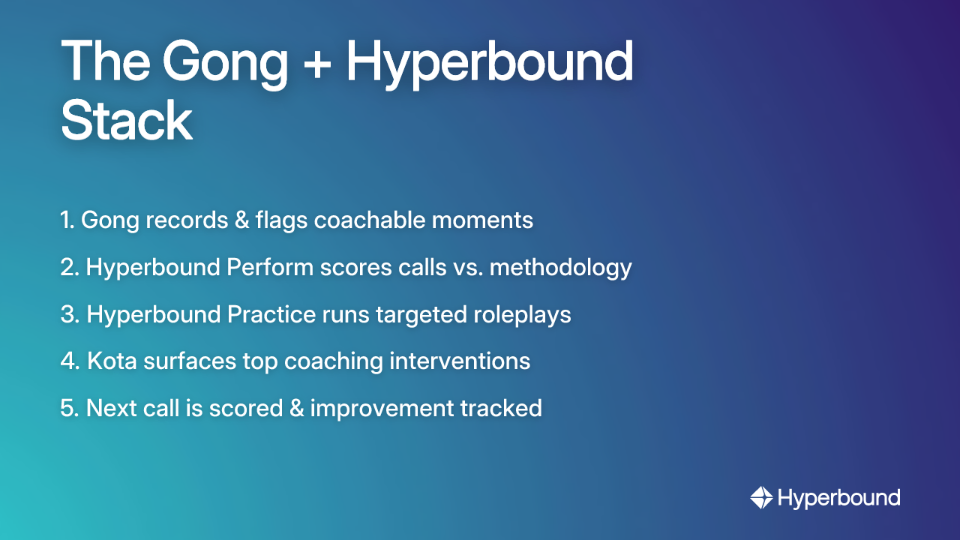
If you already use Gong, you have a strong call intelligence foundation. What Gong can't do is turn those insights into rep-level skill development at scale. That's the gap Hyperbound is built to close — not by replacing Gong, but by completing the stack.
The workflow looks like this:
.png)
And critically: Hyperbound has a native integration with Gong. This isn't a workaround or a CSV export. Gong recordings feed directly into Hyperbound's scoring and coaching pipeline, powering more realistic AI personas and sharper deal-level analysis. For RevOps teams already fielding questions about tool sprawl, this is a meaningful answer: these two tools are designed to work together.
Gong is the right tool for call intelligence. It remains one of the best investments a revenue team can make for visibility, recording, and deal inspection.
But visibility isn't the same as a behavior change. Knowing that your rep fumbles the pricing conversation is only useful if they have a structured way to practice it, get scored on it, and walk into their next call more prepared.
That's the difference between Call Intelligence and what Hyperbound calls Revenue Activation — the process of turning what you observe in sales conversations into the behaviors that actually close deals.
If your team is already on Gong and coaching is still inconsistent, ramp is still long, or managers are still stretched thin — the answer probably isn't a new call recording tool. It's adding the practice layer that turns your existing Gong data into measurable rep improvement.
See how Hyperbound integrates with Gong →
The main difference is that Gong analyzes past calls to tell you what happened, while Hyperbound provides a platform for reps to actively practice and improve before their next call. Gong excels at call intelligence, offering recordings, transcripts, and insights into completed conversations (a reactive approach). Hyperbound focuses on revenue activation, turning those insights into a proactive practice loop with AI-powered roleplays, allowing reps to build skills in a safe environment.
You need Hyperbound because Gong identifies skill gaps but doesn't provide a scalable way for your reps to fix them. Hyperbound closes this "insight-to-practice" gap. While Gong gives managers visibility into what went wrong, they often lack the time to manually coach every rep on every issue. Hyperbound automates and scales the practice component, allowing reps to self-coach with AI simulations based on the very issues Gong uncovers.
Hyperbound uses a sophisticated AI buyer, trained on over 2 million hours of real B2B sales calls, to simulate realistic sales scenarios. Reps practice conversations, and the AI provides instant, objective feedback on their performance. Unlike generic chatbots, Hyperbound's AI understands context, handles objections, and mimics the behavior of different buyer personas. After each roleplay, the rep receives an AI-generated scorecard analyzing their talk ratio, adherence to methodology, and missed opportunities.
No, Hyperbound is designed to complement and enhance Gong, not replace it. The two tools serve different, but connected, purposes in a modern sales coaching stack. Gong is the system of record for customer interactions (call intelligence), while Hyperbound is the system of practice for rep improvement (revenue activation). By integrating the two, you can feed insights from Gong directly into Hyperbound to create targeted, effective practice for your team.
The native integration allows Gong call recordings to be automatically analyzed by Hyperbound's AI. This process identifies skill gaps and deal-level risks, which then powers targeted AI roleplay recommendations for reps. This creates a closed-loop coaching system: a real call happens in Gong, Hyperbound analyzes it and recommends practice, the rep completes the AI roleplay to improve, and their performance on the next real call is tracked back in Gong.
Teams using Hyperbound can save an average of 3.5 workweeks of coaching time per manager, per year. This time is saved because reps can self-coach on demand with AI roleplays, reducing the need for managers to manually review every call and conduct one-on-one sessions for every minor issue. This frees up managers to focus on high-level strategic coaching and deal support.










Use Cases
Legal