
Conversation intelligence tools like Gong are known for analyzing what happens on sales calls. They can tell you about talk-to-listen ratios, track keywords, and even gauge a rep's energy. For many teams, they've become a standard for recording and transcribing conversations.
But that call-level data can't answer the most critical question for sales leaders: What should my rep do before the next call to save this deal?
That's a different question. And it requires a different kind of tool.
As sales teams grow more sophisticated, a pattern keeps emerging in discussions across RevOps forums and sales communities: teams want tools that analyze patterns across multiple calls for effective coaching — not just transcribe and score individual conversations in isolation. A good call doesn't guarantee a healthy deal. And one rough call doesn't mean the deal is lost. What matters is the full arc of buyer engagement across every touchpoint.
This is where the conversation shifts from conversation intelligence to AI deal coaching software — and it's why comparing Gong and Hyperbound Perform on the same rubric matters.
This breakdown isn't about which tool is "better" in a vacuum. It's about which tool answers the questions you're actually asking — and how the two can work together.
Traditional call intelligence tools were built around one core value: visibility into what happened on a call. That's still valuable. But modern sales teams — especially those managing complex, multi-touch B2B deals — need more. The evaluation criteria that matter for AI deal coaching software aren't about recording quality or search functionality. They're about:
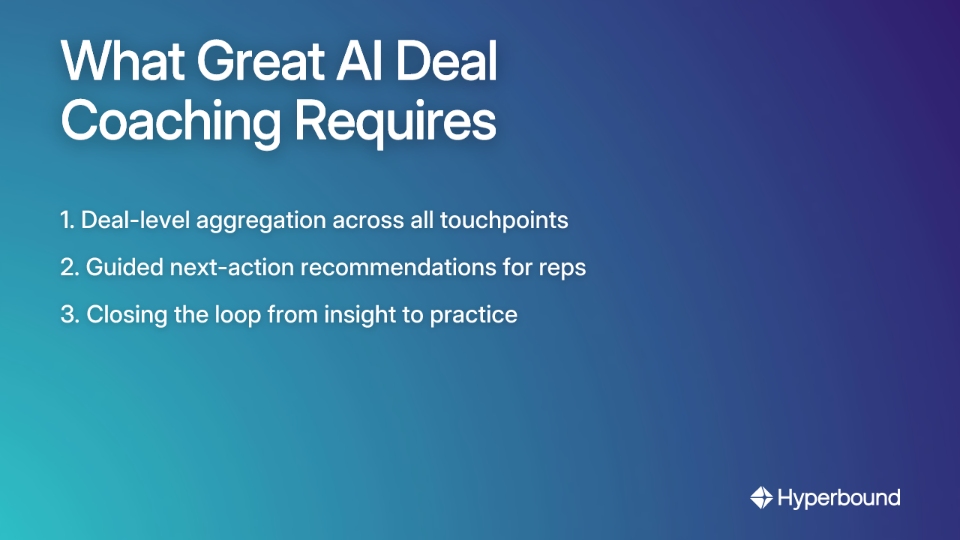
Gong was built for the first generation of this problem. Hyperbound Perform was built for the next one.
.png)
.png)
Conversation intelligence tools like Gong are effective at answering the question: "What happened on that call?"
They provide accurate transcriptions and have a large market presence, meaning they often integrate with other tools in your tech stack. For teams whose primary goal is to record calls for call-level visibility and manual review, these tools are a foundational part of the sales tech stack.
The gap isn't in the raw data they provide. It's in what call-level data alone can accomplish for coaching and deal execution.
Hyperbound Perform is built around a fundamentally different premise: a deal is not a call. It's a sequence of conversations, emails, silences, and signals that together tell a story about whether the opportunity is moving forward or quietly dying.
While Gong can show you that a rep's talk ratio was off on Tuesday's discovery call, Perform can tell you that the champion has gone quiet across the last three interactions — and flag that as an early risk signal before the deal slips out of the quarter.
Perform looks across all calls in a deal to surface what's helping or hurting the opportunity, and what to work on next to keep it moving. That's a categorically different output than a call scorecard. It's deal health intelligence — the kind that sales teams have been asking for when they talk about needing "holistic conversation intelligence that coaches people before, during, and after the call."
One of the most persistent frustrations in sales coaching is the gap between insight and action. A manager reviews a call in Gong, identifies that the rep missed a multithreading opportunity, writes a note — and then life happens. The rep goes into the next call without any structured preparation. The deal stalls.
Hyperbound Perform is designed to close that gap. After scoring a real call against a custom methodology scorecard, Perform generates guided, prescriptive next steps: specific actions the rep should take before the next touchpoint based on the deal's actual status. Not generic advice. Deal-specific direction grounded in real buyer conversation data.
This directly addresses the desire for real-time support that sales professionals keep raising — tools that don't just surface what went wrong, but tell you what to do about it.
This is where Hyperbound Perform does something no call intelligence tool offers: it closes the loop between what's happening on live deals and what reps practice.
Here's the workflow in practice: a rep struggles with a pricing objection on a real call. That call is scored by Perform. Perform flags a gap in objection handling around commercial conversations. Based on that specific weakness, it automatically recommends a Bitesized Roleplay — a short, focused practice session targeting that exact objection type, with an AI buyer persona that sounds like a real prospect, not a script.
The rep practices. The skill sharpens. The next call goes differently.
That's the Revenue Activation loop in action: Score Real Calls → Identify Skill Gaps → Practice Targeted Roleplays → Score Real Calls again. A continuous improvement cycle, automated, grounded in the actual deals your team is working right now.
This is the right question to ask, and it deserves a direct answer.
For RevOps leaders facing pressure to consolidate the tech stack and reduce tool sprawl, adding another platform requires a clear justification. The good news: Hyperbound Perform is not a Gong replacement. It's a layer that makes your Gong investment more actionable.
Hyperbound integrates directly with Gong. Here's what that looks like in practice:
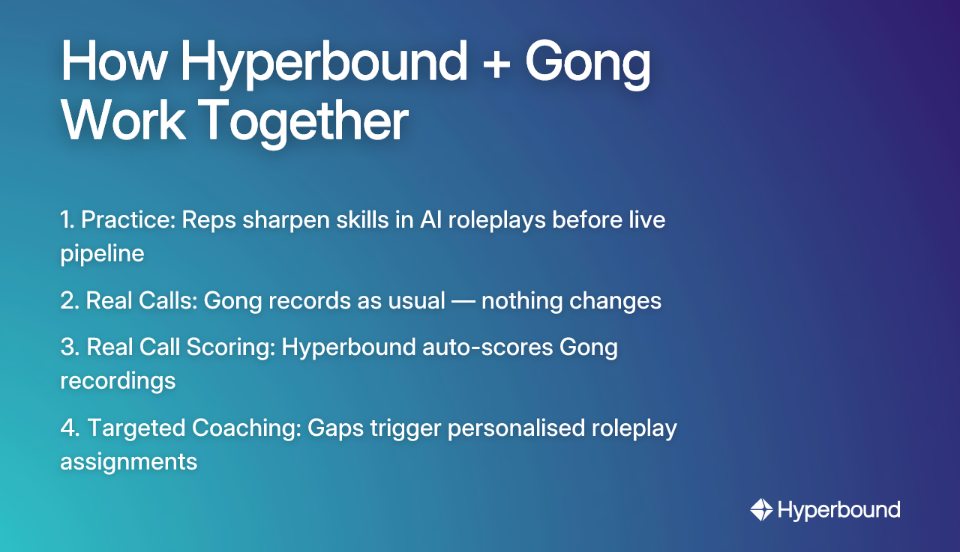
Gong remains your system of record for conversations. Hyperbound Perform becomes your system of action for AI deal coaching — translating what Gong captures into decisions that change deal outcomes.
This resolves the integration anxiety that slows adoption of new AI tools. You're not ripping and replacing. You're stacking a deal-level coaching layer on top of the call intelligence infrastructure you've already built.
Conversation intelligence tools like Gong are a fit when your primary question is: "What happened on that call?" They are useful for call-level visibility, manual coaching review, and building a library of recorded sales conversations.
Choose Hyperbound Perform when your question becomes: "What should my rep do before the next call to save this deal?" It's purpose-built for deal-level coaching — aggregating signals across all touchpoints, surfacing early risk indicators, generating guided next actions, and closing the loop between real-world performance and targeted practice. It's AI deal coaching software designed not to describe the past, but to change the future of your pipeline.
Use both when you want the full picture. Gong tells you what's happening. Hyperbound Perform tells you what to do about it. Teams running both don't have to choose between call intelligence and deal activation — they get both, connected, in a single coaching workflow.
Customers like Vanta saw a 60% reduction in ramp time (210 days down to 72) and 5x pipeline growth. Nivoda doubled revenue year-over-year and saw a 150% increase in demo conversion rates. Those outcomes aren't from analyzing calls. They come from acting on what the analysis reveals.
If your team is already using Gong and getting value from call-level intelligence, you're halfway there. The next step is layering in deal-level coaching that turns those insights into won deals.
See how Hyperbound Perform works alongside your existing Gong setup — and what it looks like to close the loop from call insight to rep practice to deal momentum. Request a demo and find out what your pipeline looks like when your reps know exactly what to do before every critical call.
The primary difference is the focus: conversation intelligence tools analyze individual calls to tell you what happened, while AI deal coaching software analyzes entire deals to tell you what to do next. Conversation intelligence, like Gong, excels at recording, transcribing, and scoring single interactions. AI deal coaching, like Hyperbound Perform, aggregates data across all touchpoints (calls, emails, etc.) to understand deal health and provide reps with prescriptive, guided actions to move the opportunity forward.
No, Hyperbound Perform is not designed to replace Gong. Instead, it integrates with Gong to make your call data more actionable. Gong serves as the system of record for your conversations, capturing the raw data. Hyperbound Perform acts as a system of action, analyzing that data at the deal level to generate coaching insights, next-step recommendations, and targeted practice for reps. They work together to create a complete coaching workflow.
Hyperbound's AI coaching helps reps win more deals by providing clear, prescriptive actions before every critical call, closing skill gaps with targeted practice, and surfacing deal risks early. Instead of just getting a score on a past call, reps receive guided recommendations on what to say and do in their next interaction to advance the deal. When the platform identifies a skill gap (like handling a pricing objection), it automatically triggers a "Bitesized Roleplay" so the rep can practice and improve before it's too late, directly impacting deal outcomes.
AI deal coaching software is designed for modern B2B sales teams, particularly for sales leaders, enablement managers, and RevOps professionals who manage complex, multi-touch sales cycles. It's most valuable for teams who want to move beyond simple call recording and implement a scalable, data-driven coaching program. It helps managers coach more effectively, enables reps to self-correct, and provides RevOps with a clear connection between sales activities and revenue outcomes.
Hyperbound connects performance to training by automatically scoring real customer calls against a custom methodology and using identified skill gaps to trigger targeted practice sessions. This creates a continuous improvement loop. For example, if a rep consistently struggles with articulating value propositions on discovery calls, Hyperbound flags this gap from their real Gong recordings. It then automatically assigns a specific AI roleplay scenario focused on that exact skill, allowing the rep to practice and get feedback before their next live call.
The integration is seamless: Hyperbound automatically imports call recordings from Gong for analysis, requiring no change to your reps' existing workflow. Your team continues to use Gong to record calls as they always have. In the background, Hyperbound ingests those recordings, scores them, analyzes them in the context of the entire deal, and pushes coaching insights and practice recommendations to managers and reps. Gong remains your recording infrastructure, while Hyperbound becomes your coaching and activation layer on top.










Use Cases
Legal