
You've invested in Gong. Your team's calls are recorded, transcribed, and scored. Dashboards are humming. And yet — win rates are flat, ramp times are still painful, and your managers are buried in call reviews they barely have time to act on.
Sound familiar? You're not alone.
The promise of conversation intelligence was that more data would lead to better reps. But data doesn't change behavior. Practice does. And that's the gap nobody talks about when they're evaluating ai call scoring software.
This article is an honest comparison of Gong — the undisputed market leader in call recording and conversation intelligence — and Hyperbound, a Revenue Activation Platform purpose-built to turn call insights into rep behavior change. The goal isn't to trash Gong. It's to show you exactly what Gong does brilliantly, where it stops, and who fills the gap.
Gong earned its place at the top of the sales tech stack. If you want to know what's happening on your team's calls — and in your pipeline — Gong is the gold standard.
Here's what it does exceptionally well:
Gong tells you what happened. It's the system of record for customer reality. Every serious sales org needs it — or something like it.
But here's the catch.
Gong is a passive tool. It captures the game tape. It doesn't run the drills.
According to Hyperbound's research on AI call scoring tools, sales managers hear only 2–5% of their team's calls — even with a tool like Gong recording everything. That means even with rich analytics, most coaching decisions are made on incomplete information, and most reps never get meaningful feedback on the calls that didn't get reviewed.
The downstream effects compound across the org:
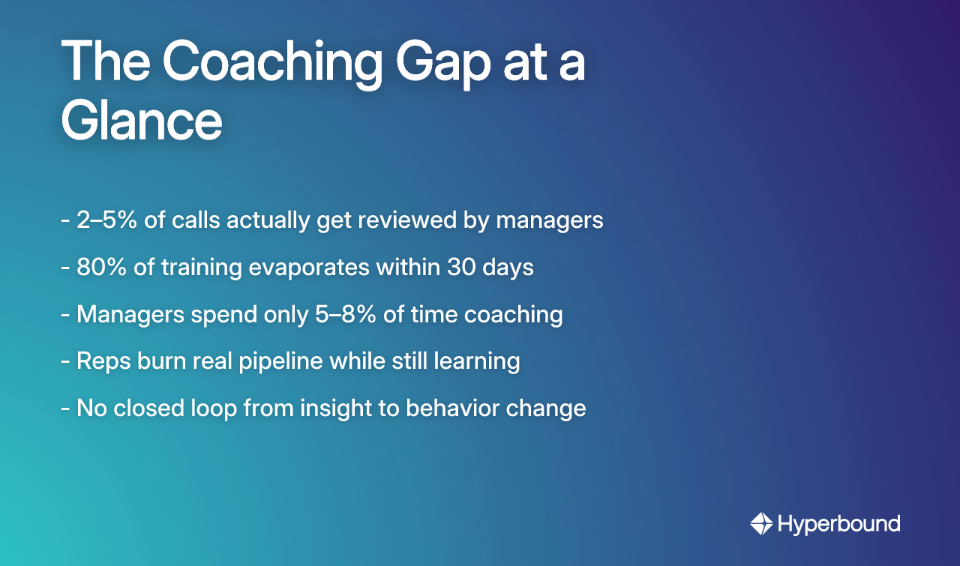
The problem isn't the data. The problem is that nobody has closed the loop between call insight → skill identification → deliberate practice → improved performance.
That loop is what Hyperbound was built to close.
Hyperbound coined the term Revenue Activation to describe what happens when teams stop just analyzing call data and start using it to change outcomes. Founded by Sriharsha Guduguntla (ex-Salesforce Einstein) and Atul Raghunathan (ex-Meta Ads ML), backed by Y Combinator and Peak XV Partners, the platform has 45,000+ active users across 7,000+ companies — including Vanta, LinkedIn, Autodesk, and Nivoda.
The model works in three connected layers:
The results are measurable. Vanta achieved a 60% ramp reduction (from 210 to 72 days). Nivoda saw a 50% ramp reduction, 2x revenue YoY, and a 150% increase in demo conversion rate. These aren't soft metrics — they're the direct result of turning call data into reps who actually practice.
.png)
Scores 100% of real calls | AI Deal Coaching | Full AI Roleplay suite
.png)
The table makes the split clear: Gong wins on call data. Hyperbound wins on behavior change.
This is the most common pushback — and it's a fair one. RevOps teams are under real pressure to consolidate their tech stacks, not expand them. As is often said, "Organizations can overwhelm themselves with too many tools, distracting from optimizing existing workflows."
Here's the straight answer: Hyperbound doesn't replace Gong. It makes your Gong investment work harder.
The integration workflow looks like this:
Without Hyperbound, that Gong data sits in a dashboard. A manager might catch it in a weekly review, leave a comment, and hope the rep absorbs it. With Hyperbound, the same data triggers a practice loop that actually changes what the rep does on their next call.
Gong becomes the fuel. Hyperbound is the engine.
Stick with Gong (or start there) if:
Add Hyperbound if:
In short: if you want call data, Gong wins. If you want call data and behavior change — faster ramp, higher win rates, consistent execution — Hyperbound Perform + Practice is the only option.
The main difference is that Gong is a conversation intelligence tool that records and analyzes what happened on past calls, while Hyperbound is a Revenue Activation Platform that uses those insights to actively change future sales behavior through AI-powered practice. Gong provides the "game tape," but Hyperbound runs the drills, turning call data into targeted AI roleplays that improve rep performance.
Teams need Hyperbound to activate the data that Gong collects. Gong identifies what happened on calls, but it relies on managers to manually review and coach, which rarely happens at scale. Hyperbound integrates with Gong to score 100% of calls and automatically assign practice where reps need it most, ensuring your investment in conversation intelligence leads to tangible behavior change and better outcomes.
Hyperbound improves sales coaching by automating skill gap identification and providing a platform for deliberate practice. Its AI scores every call against your methodology, pinpoints weaknesses, and assigns targeted AI roleplays. This allows every rep to get personalized coaching on demand and practice without risking live deals, freeing up managers to focus on high-level strategy.
AI Sales Roleplay allows reps to practice any sales scenario—from cold calls to closing—with a realistic AI buyer. Trained on millions of real B2B conversations, the AI provides a safe, scalable environment for reps to get unlimited "at-bats." It delivers instant, objective feedback based on your scorecards, helping reps build muscle memory and confidence before talking to real prospects.
Hyperbound reduces ramp time by enabling new hires to practice and master core skills before they ever speak to a customer. Instead of burning through live leads, reps can use AI Roleplays to get certified on messaging, objection handling, and your sales methodology. This data-driven approach ensures reps are truly ready for the field, with customers like Vanta reducing ramp time by 60%.
A Revenue Activation Platform is a system built to translate sales insights into improved sales execution. While conversation intelligence tools tell you what's happening in your deals, a Revenue Activation Platform like Hyperbound closes the loop by using that data to drive behavior change through automated coaching and deliberate practice, directly impacting revenue goals like win rates and ramp speed.
In 2026, having call data is table stakes. Every competitive sales org is recording calls, scoring them, and building dashboards. The teams pulling ahead aren't the ones with better data — they're the ones who've turned AI call scores into coaching plans that stick.
Gong tells you what happened. Hyperbound ensures your team gets better for the next one.
If you're already using Gong and want to close the gap between insight and outcome, see how Hyperbound's Revenue Activation Platform turns your existing call data into your most powerful coaching tool.







Use Cases
Legal