
You've invested in the stack. You have Gong recording every call, Clari modeling your pipeline, and dashboards everywhere showing you exactly what's happening.
So why aren't your reps getting better?
That's the question frustrating sales leaders right now. Gong tells you what was said. Clari tells you the mathematical probability that a deal closes. But neither platform explicitly tells a rep what to do differently on their next call. The loop between insight and skill development is broken — and the gap between "we see the problem" and "we fixed it" keeps costing deals.
As one Sales Ops professional put it plainly in a recent Reddit thread: "We're not huge fans of Gong's 1:1 coaching tools." The frustration isn't with the data itself — it's that data alone doesn't change outcomes. And that worldview is becoming a consensus across RevOps and enablement teams everywhere.
This article breaks down the three platforms honestly: what Gong and Clari genuinely do well, where they structurally fall short on coaching, and which deal intelligence platform is built for the sales org that wants to turn insights into actual behavior change.
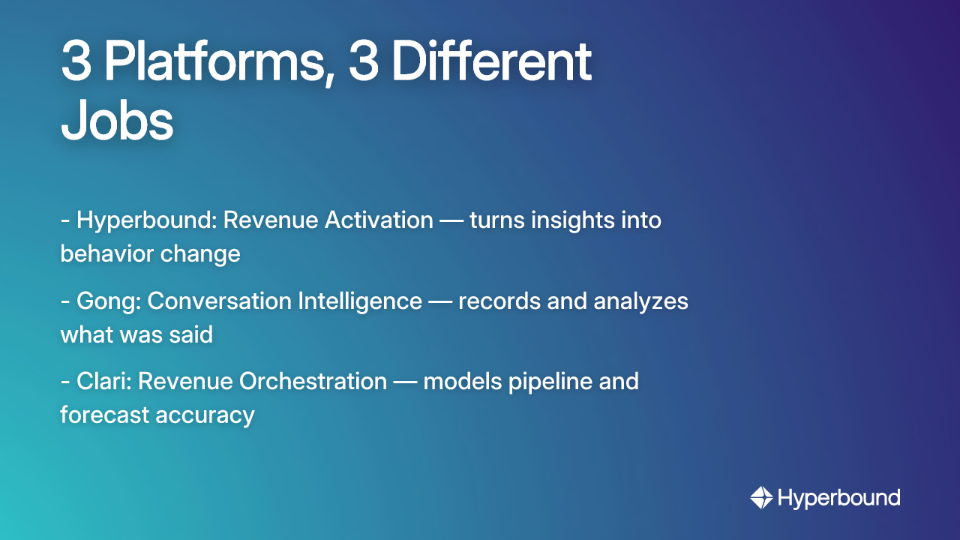
Hyperbound founded the Revenue Activation category — a new category built on the premise that analysis alone is not enough. Activation is what happens when teams use deal data to change outcomes: faster ramp, more consistent execution, higher win rates.
Gong pioneered the Conversation Intelligence category. It's the gold standard for capturing and analyzing customer-facing interactions — calls, emails, web conferencing — and surfacing patterns that correlate to deal outcomes.
Clari leads the Revenue Orchestration space. It unifies CRM signals, engagement data, and AI-driven health scores to give RevOps and leadership a predictable, auditable forecast.
.png)
.png)
Sources:
Gong built something genuinely valuable. Its deal intelligence capabilities are best-in-class for capturing what happens on customer calls, tracking competitor mentions, monitoring messaging adherence, and surfacing engagement patterns across a deal timeline. If your primary need is visibility — knowing what your reps are saying and how buyers are responding — Gong is exceptional at providing that foundation.
The problem is that visibility is not coaching. Gong gives managers raw material. What they do with it — how they translate call analytics into behavior change at scale — is entirely manual. For teams with experienced, high-bandwidth managers coaching small groups, that works. For everyone else, there's a massive gap between the insight on the screen and the improvement on the next call.
Clari's strength is in pipeline math. It unifies revenue-critical signals from the CRM to give RevOps and leadership a rigorous, AI-modeled forecast. Its opportunity management and pipeline inspection tools are purpose-built for the business that runs on numbers — quarterly review cycles, board-level forecasting, and pipeline coverage ratios.
If your CRM data is clean and your primary stakeholder is a VP of Finance asking "are we going to hit the number?", Clari answers that question well.
But Clari's insights are fundamentally about deals, not reps. It can tell you a deal is at risk. It cannot tell you the rep lacks the skills to save it — and it offers no mechanism to help them build those skills before the next touchpoint. As one Clari user noted on Reddit: "Not a fan for the $, unless you use all the features." When the forecasting layer is strong but the coaching layer doesn't exist, you're paying for half a solution.
Both platforms produce intelligence. Neither platform closes the loop. Knowing a deal is at risk is not the same as equipping the rep to handle the next conversation differently. That gap — between seeing the problem and solving it — is where deals are lost and where rep development stagnates.
The question isn't whether Gong and Clari are useful. They are. The question is: after you've run the analysis and flagged the risk, what happens next?
Hyperbound was built to answer that exact question. Its three-product model — Practice, Perform, and Kota Activate — creates a continuous improvement flywheel that connects deal data to rep development in a way neither Gong nor Clari is designed to do.
Hyperbound Perform isn't a call recorder. It's an AI Deal Coaching layer that looks across all touchpoints in a deal — from first cold call to closing conversation — to identify where momentum is stalling and why. Unlike call-level platforms that analyze conversations in isolation, Perform surfaces behavioral patterns that span the entire deal lifecycle.
Key capabilities include:
Hyperbound Practice is where the insight becomes skill. When Perform identifies that a rep is struggling with economic buyer objections in the second half of deals, Practice provides the environment to fix it — before the next live call.
One common concern about AI roleplay tools is that they feel generic or fail to push back realistically. That frustration is well-documented — "I found it a bit unrealistic for B2B sales role-playing. Prospects often ask unexpected questions or take the conversation in different directions." Hyperbound's AI personas are trained on 2M+ hours of real B2B sales conversations, not scripted scenarios. They handle tangents. They counter objections. They don't just agree with the rep and tell them they're right.
Key capabilities include:
Kota is the AI Revenue Analyst that sits above Perform and Practice — connecting the two into a coherent coaching system. Kota analyzes combined roleplay performance and real call data, then recommends personalized coaching interventions at the right moment. A rep finishes a difficult call. Perform scores it. Kota surfaces the gap and queues a targeted practice session — before the next opportunity slips.
The results of this flywheel are measurable. Teams using Hyperbound have seen 50% faster ramp times, 150% increases in DM-to-demo conversion rates, and 2x faster time to first won deal. Vanta's CRO, Stevie Case, reported reducing rep ramp time from 210 to 72 days — a 60% reduction — while scaling the BDR team 4x.
The honest answer is that these platforms serve different organizational priorities. Here's how to self-identify.
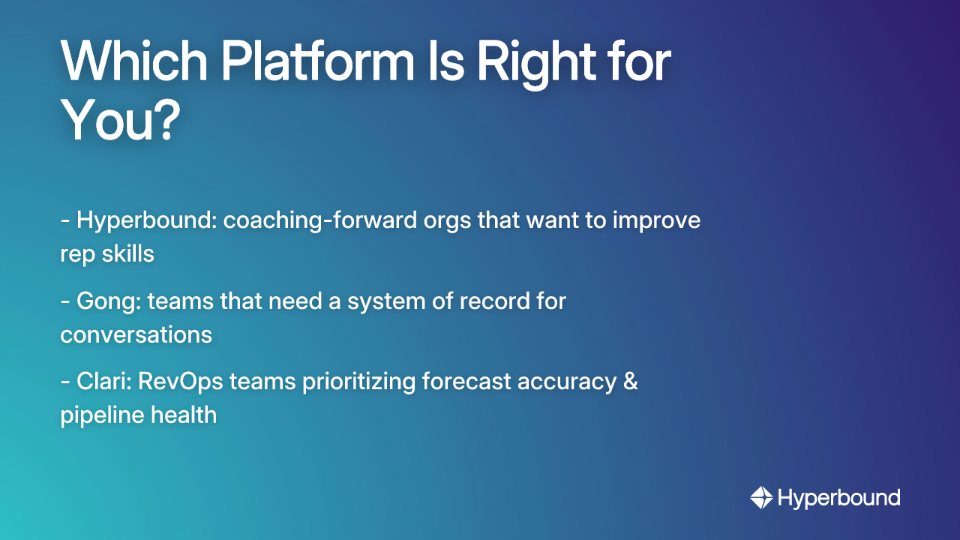
Gong and Clari are powerful for understanding what has already happened. They're the right tools for sales organizations that need a system of record and a forecasting engine. If that's your primary need, they deliver.
But if your goal is to change what happens next — on the next call, in the next deal, for the rep who almost had it — then you need more than analytics. You need activation.
The most effective sales organizations in 2025 aren't choosing between data and coaching. They're building systems where every deal insight automatically connects to rep development. That's not a feature Gong or Clari offers. It's the core of what Hyperbound was built to do.
The difference between a team that knows why it lost a deal and a team that knows how to win the next one isn't more dashboards. It's a closed loop between insight and action — and that loop starts with the right deal intelligence platform.
The main difference lies in their core function: Gong records and analyzes past conversations, Clari forecasts future pipeline based on CRM data, and Hyperbound actively improves rep skills to change future outcomes. Gong provides visibility, Clari provides predictability, and Hyperbound provides activation—the mechanism to turn insights into measurable behavior change.
Gong is not sufficient for sales coaching because it provides raw data and insights but lacks an integrated system for reps to practice and apply that feedback. While it's an excellent system of record for conversations, it leaves the translation of insights into skill development as a manual, often inconsistent, process for managers.
Hyperbound accelerates new rep ramp time by providing a safe, AI-powered environment where they can practice real-world sales scenarios. Instead of learning on live calls, reps use Hyperbound's AI roleplays to master your sales methodology and handle objections, receiving immediate, objective feedback. This targeted practice has been shown to reduce ramp time by over 50%.
Revenue Activation is a category of sales technology focused on turning deal insights into measurable changes in rep behavior to directly impact revenue. While other tools focus on analysis (what happened) or forecasting (what might happen), Revenue Activation provides the "how" by creating a closed loop between call analysis, skill gap identification, and targeted practice.
Hyperbound is a powerful standalone platform that can also complement an existing tech stack. It provides its own deal intelligence and call analysis, but its primary function is the coaching and activation layer that other tools lack. Many teams use Hyperbound to close the critical performance gap left by their conversation intelligence and forecasting platforms.
Hyperbound's AI buyer personas are trained on over 2 million hours of real B2B sales conversations, not generic scripts. This allows the AI to handle tangents, push back with unexpected objections, and mirror the unpredictability of a real buyer, ensuring reps are preparing for actual sales scenarios, not just a scripted test.








Use Cases
Legal