
Let's start with an honest statement: Conversation intelligence is a powerful, established category. Platforms like Gong have fundamentally changed how revenue teams capture, analyze, and learn from sales conversations. Nobody serious disputes that.
But here's what sales leaders are quietly frustrated about: their call libraries keep growing, their pipeline dashboards keep refreshing, and their win rates aren't moving.
Sound familiar? As one sales ops leader put it on Reddit: "Tools like Clari or Gong can be powerful, but they often overwhelm you with data." Another chimed in: "I need to spot weak deals early and see where the pipeline is going to miss before leadership asks why the number is off."
That's the real problem. And it's not just a conversation intelligence problem — it's a category-level gap that no amount of data can fix on its own. Data doesn't change rep behavior. Practice does.
This article breaks down exactly what conversation intelligence platforms do brilliantly, where the gap is, and how the emerging Revenue Activation layer — platforms like Hyperbound — closes the loop from insight to outcome.
Conversation intelligence (CI) platforms were built to answer a specific question: "What is actually happening on our sales calls?"
They answer that question remarkably well. A CI engine automatically records and transcribes every sales interaction, applies AI analysis to surface patterns — competitor mentions, objection frequency, talk ratios, deal risk signals — and feeds all of it into forecasting inputs and pipeline reviews. Different platforms offer similar capabilities, with unique strengths in areas like transcription accuracy.
The value of this is real. Before CI tools, managers were flying blind. They'd sit in on 1–2% of recorded calls and guess at rep performance from there. Now they have signal — lots of it.
The problem isn't the data. It's what happens (or doesn't happen) after the data is collected.
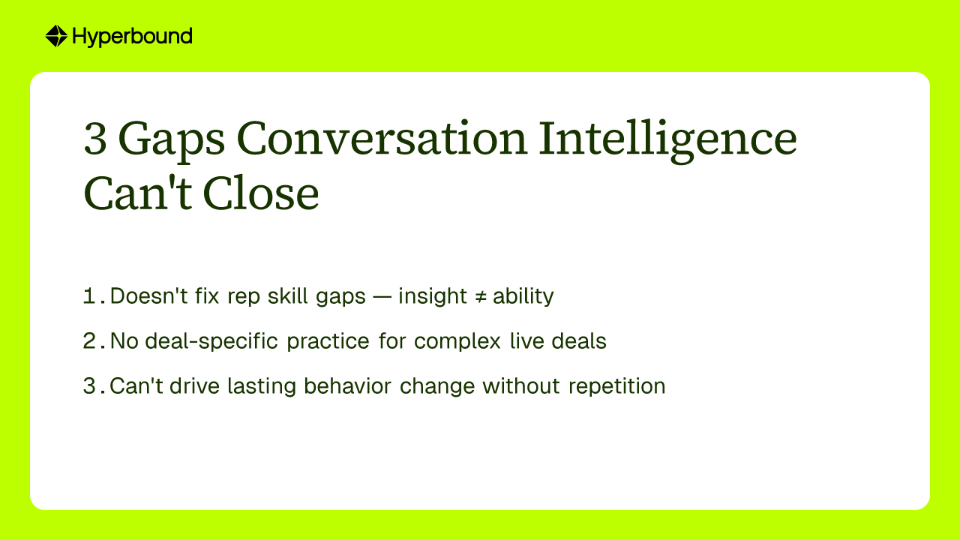
CI platforms are diagnostic, not prescriptive. They can tell you that a rep consistently loses deals after the pricing conversation. They cannot give that rep the 50 reps at a pricing objection before their next call. They surface the "what" but leave teams on their own for the "now what."
Three specific gaps stand out:
1. They don't fix rep skill gaps. Watching a top performer's recorded call is not the same as being able to replicate their behavior under pressure. There's a reason athletes don't just watch game film — they practice. Sales reps are no different. Knowing what good looks like and being able to do it are entirely separate skills.
2. They lack deal-specific practice. Most CI platforms analyze calls in isolation. A rep heading into their third call on a complex enterprise deal — where the champion is shaky, procurement just got involved, and a competitor was just brought in — needs practice calibrated to that exact situation, not a generic objection handling module.
3. They struggle to drive lasting behavior change. Sales enablement leaders know this acutely: 80% of training is forgotten within 30 days without reinforcement. A library of recorded calls, even an excellent one, doesn't create the repetition loops required for behavior to actually stick.
That skepticism is legitimate — and it points directly to the gap these platforms leave open.
Hyperbound coined the term Revenue Activation to describe exactly what the CI category leaves behind: the proactive use of sales data to actually change rep behavior and deal outcomes — not just report on them.
The operational loop looks like this: Score Real Calls → Identify Skill Gaps → Practice in AI Roleplays → Perform Better on Real Calls. Continuously. On every deal. For every rep.
Here's how Hyperbound's three-product platform makes that loop real.
Hyperbound Practice is where reps go to earn their reps — before high-stakes conversations happen. The AI buyer personas aren't built from generic scripts. They're trained on 2M+ hours of real B2B sales conversations, which means the objections feel real because they're derived from actual buyer behavior.
Reps can practice cold calls, discovery conversations, demos, objection handling, renewals, and upsells. They can build a digital twin of a specific buyer from a LinkedIn profile. Voice cloning makes the simulations feel remarkably authentic.
After every session, AI Scorecards deliver instant, objective feedback — talk ratio, methodology adherence, missed opportunities, off-track messaging. No waiting for a manager to find an hour. No subjective impressions.
A few things worth calling out for tenured reps specifically: Bitesized Roleplays are short, focused sessions targeting one skill or scenario. Senior reps who will never sit through a 45-minute generic certification module will do a 5-minute deal-specific prep session before a tough renewal call. That's a meaningful distinction.
The platform also integrates directly into the tools reps already use — embedded in Slack, your CRM, your calendar, and leading LMS platforms via SCORM.
Hyperbound Perform is where the rubber meets the road. While most CI tools analyze individual calls, Perform looks across the entire deal lifecycle — all calls, all stakeholders, all email interactions — and surfaces what's actually helping or hurting an opportunity.
This is deal-level intelligence, not call-level reporting. The difference matters enormously when you're managing a six-month enterprise deal with five stakeholders and a dozen touchpoints.
A few things Perform does that deserve specific mention:
One important clarification the Hyperbound team is direct about: Perform is not a forecasting tool. It's a deal execution platform. Better deal execution may improve forecast accuracy as a downstream result, but that's not the value prop — cleaner deal behavior is.
Hyperbound's own sales team used Perform internally before its customer release. The result, per co-founder Atul Raghunathan: their strongest quarter ever.
Kota sits above Practice and Perform, connecting them into a unified coaching system. Think of it as an AI Revenue Analyst that lives in Slack or Teams.
A manager can ask Kota: "Which reps are struggling with pricing objections this quarter?" or "Show me deals where we don't have a confirmed champion." Kota pulls from real call data, roleplay performance, and deal intelligence simultaneously — then doesn't just answer the question, it recommends a specific action: assign a roleplay, schedule a coaching session, flag a deal for review.
That's the distinction between a reporting layer and an activation layer. Kota doesn't surface insights. It closes the loop on them.

Skepticism about AI sales tools is healthy. So let's look at what actually happened when teams put this loop into practice.
Vanta reduced rep ramp time by 60% — from 210 days to 72 days — after implementing Hyperbound. Their BDR team grew 4x and pipeline grew 5x. Read the full case study here.
Nivoda cut ramp time by 50% and doubled revenue year-over-year. Their demo conversion rate increased 150% — a direct downstream result of reps practicing the right conversations before live calls. Full story here.
These aren't coincidental improvements in lagging metrics. They're the direct result of closing the gap between what CI tools tell you and what reps are actually equipped to do.
This is where we want to be direct: this is not a "replace your CI platform" argument.
If you're running a conversation intelligence platform, you already have something valuable — a rich, searchable library of what's actually happening in your sales conversations. That data is an asset. The question is whether you're extracting the full value from it.
Here's the most useful framing we've found:
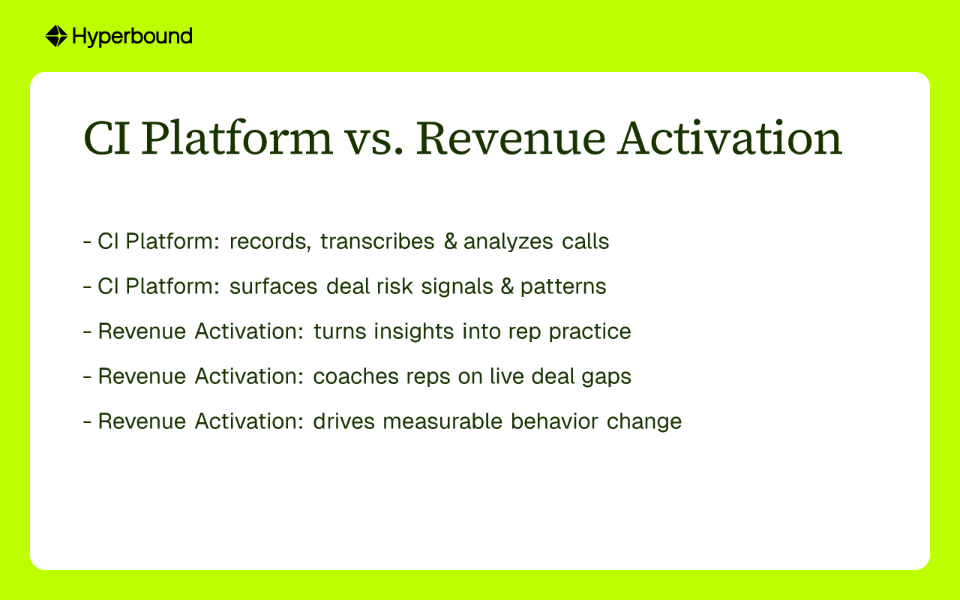
Your CI platform is the library. Hyperbound is the gym.
Your CI platform tells you what happened — which conversations went well, which objections came up, which deals are showing risk signals. That diagnostic layer is genuinely useful. But reading about how to lift weights doesn't build muscle. At some point, you have to do the reps.
Hyperbound takes what your CI platform surfaces and turns it into action:
The integration is also literal: Hyperbound connects directly with platforms like Gong, Chorus, and other recording tools, pulling real call data into Perform's deal coaching layer. You're not ripping anything out. You're adding the layer that converts your existing data investment into changed behavior and closed revenue.
Revenue intelligence software has matured rapidly. Conversation intelligence software gave revenue teams something genuinely valuable: visibility. You know what's happening on calls. You can review, analyze, forecast, and coach from a much richer data set than was available five years ago.
But visibility is a starting point, not an endpoint. The teams posting outsized win rates aren't just the ones with the best dashboards — they're the ones whose reps are better prepared for the next conversation than the competition's reps are.
If your team has conversation intelligence but no structured practice loop, you're leaving the most important part of the equation unaddressed. You have the library. The question is whether your reps are putting in the gym time.
That's the gap Revenue Activation was built to close — and it's worth asking honestly whether your current stack closes it.
The primary difference is that Conversation Intelligence platforms diagnose what is happening on sales calls, while Revenue Activation platforms prescribe actions to change future outcomes. CI tools are like a library of game film, providing data and insights. Revenue Activation is like the gym, providing the structured practice and coaching needed to turn those insights into improved skills and rep behavior.
Hyperbound improves performance by creating a continuous loop of practice, feedback, and real-world application. It uses AI-powered role-plays to let reps practice specific scenarios (like objection handling) before a live call, provides instant, objective feedback on their performance, and uses data from real deals to recommend targeted coaching. This focus on repetition and reinforcement drives lasting behavior change that diagnostic tools alone cannot.
Yes, the two platforms are designed to be complementary, not competitive. Your CI platform like Gong is excellent at recording and analyzing calls to tell you what happened. A Revenue Activation platform like Hyperbound takes that data and helps you act on it by creating deal-specific practice sessions and coaching workflows to fix the skill gaps your CI tool identifies.
Yes, especially when the practice is relevant and efficient. While senior reps may resist generic training, they embrace tools that help them prepare for specific, high-stakes deals. Hyperbound offers "Bitesized Roleplays" that are short, focused, and can be customized to an exact deal scenario, making it a valuable prep tool rather than a tedious training module.
Deal-specific practice is a training simulation tailored to the unique context of a live, in-progress deal. It's important because complex enterprise sales are not generic. A rep facing a shaky champion and a new competitor needs to practice for that exact situation, not a standard objection. Hyperbound's Perform product analyzes the entire deal lifecycle to surface these specific risks and can generate targeted role-plays to prepare the rep for their very next call.
Hyperbound is designed to connect seamlessly with your existing tools to create a unified workflow. It integrates directly with CI platforms like Gong and Chorus to pull in call data for analysis. It also connects with CRMs like Salesforce and HubSpot to auto-fill data and pull deal context, and with communication tools like Slack and Teams to deliver coaching insights where your managers already work.
Hyperbound integrates with Gong, Chorus, HubSpot, Salesforce, Slack, and 20+ other tools your team already uses. See how it works →









Use Cases
Legal