
Your enterprise sales team is swimming in data. You have call recordings, pipeline dashboards, and a perfectly curated content library from tools like Gong and Highspot. So why are your win rates still flat — and why does ramp time feel like it's measured in quarters, not weeks?
This is the quiet crisis playing out across enterprise revenue orgs right now. The tools are there. The budget has been spent. But the needle hasn't moved. And the reason isn't a lack of data or a lack of content — it's a lack of practice.
There's a gap between knowing what good looks like (Gong shows you that) and having the right asset (Highspot handles that) and actually doing it under pressure on a live call with a real buyer. That gap is where deals are lost and ramp time balloons. And neither Gong nor Highspot was built to close it.
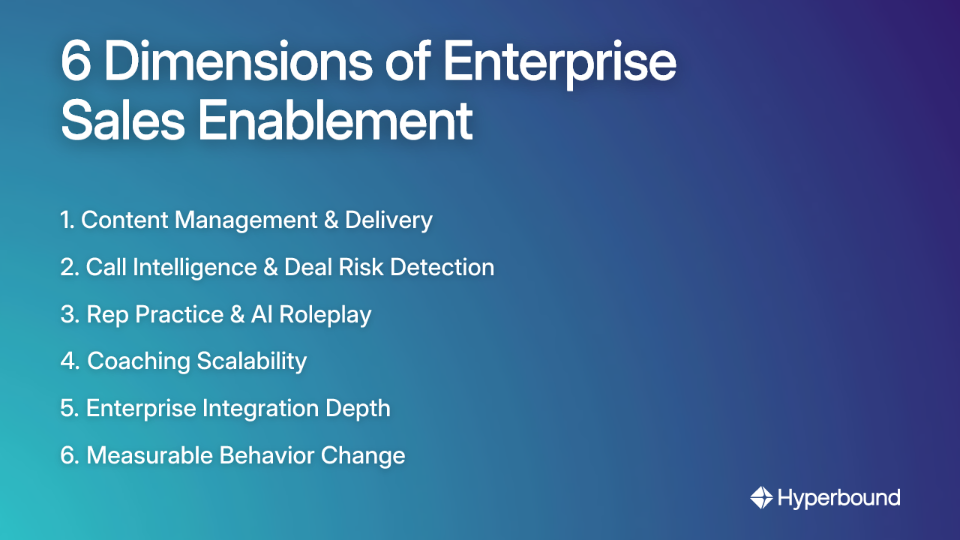
In this article, we'll break down the gaps in the modern sales tech stack. We'll explore six critical dimensions of sales enablement and show how a Revenue Activation Platform like Hyperbound closes the loop between the data in tools like Gong, the content in platforms like Highspot, and the on-the-field performance of your reps.
Highspot is a powerful tool for content governance. It tackles one of the most persistent pains in enterprise sales: reps circulating outdated decks, new hires asking "which version is the right one?" three weeks after joining, and managers forgetting to update materials after a product launch. Highspot's AI-powered search, content scorecards, and version control mean reps find the right asset at the right moment — and according to some research, that alone can reclaim close to 440 hours per rep annually that would otherwise be lost to content hunting.
Gong has minimal content management capabilities. Its focus is analyzing what happens on calls, not organizing what reps use before or during them.
Hyperbound isn't trying to out-organize Highspot. Instead, it activates the content already sitting in your library. Because Hyperbound integrates natively with Highspot and Seismic via SCORM, you can embed AI sales roleplays directly into existing training paths. A new battlecard drops? Reps practice delivering it against a realistic AI buyer persona before it ever touches a live call. Content stops being a passive resource and becomes an active training tool.
Gong helped pioneer conversation intelligence. It tracks keywords, talk ratios, topic progression, and rep behavior at the call level — giving managers and enablement leaders a detailed view of what's happening in conversations. That's genuinely valuable.
The limitation is scope. Gong analyzes individual calls in isolation. It can tell you your rep didn't ask a discovery question in Tuesday's demo — but it struggles to connect that moment to why the deal went cold two weeks later. And with processing delays of up to 20–30 minutes after a call ends, insights often arrive too late for immediate coaching.
Highspot has no native call intelligence. It's not designed for it.
Hyperbound's Perform product complements Gong by shifting from call-level analysis to deal-level intelligence. Rather than reviewing what happened in one conversation, Perform pulls insights across every call touchpoint in a deal — from the first cold call to the closing conversation — to surface deal health signals, identify behavioral risk, and recommend what the rep should do next to keep momentum. It automatically scores 100% of real customer conversations against custom methodology scorecards, providing an objective view grounded in actual buyer behavior rather than CRM fields or gut instinct. The goal isn't to replace Gong's call-level insights — it's to connect them to pipeline outcomes while there's still time to act.
This is where both Gong and Highspot go quiet — and where the skill-practice gap becomes impossible to ignore.
Gong lets you listen to recorded calls. That's like watching game tape but never running drills. Highspot gives reps the playbook without a field to practice on. Neither platform offers a dedicated, interactive environment where reps can rehearse real conversations, get immediate feedback, and build the muscle memory needed to perform under pressure.
The result? Reps practice on live buyers. They burn pipeline while learning. And 80% of sales training is forgotten within 30 days, meaning the investment in coaching and content continuously leaks value.
Hyperbound Practice was built specifically for this gap. Its AI buyer personas are trained on over 2 million hours of real B2B sales conversations — not generic scripts — which directly addresses the user frustration that most AI roleplay tools feel "a bit unrealistic for B2B." Reps can practice cold calls, discovery, demos, objection handling, renewals, and QBRs — including complex multiparty scenarios that simulate a champion plus an economic buyer in the same room.
AI Scorecards deliver instant, objective feedback on methodology adherence and talk ratios. AI Coaching pinpoints exactly where a rep went off track. For tenured reps who rightfully push back on generic training, Bitesized Roleplays let them focus on one specific skill — say, handling a new pricing objection — in a short, targeted session, without sitting through a full-length module. The platform supports 25+ languages, making it viable for global enterprise teams scaling across regions.
Traditional role-play creates anxiety and insecurity that makes reps avoid it. Hyperbound removes the social stakes while keeping the realism high — giving reps the at-bats they need without burning real pipeline to get there.
The coaching problem in enterprise sales is structural: enablement practitioners are routinely outnumbered — one EP supporting 50 to 100 reps — and frontline managers spend just 5–8% of their time on coaching. When things get busy, coaching is the first thing cut.
Gong surfaces coachable moments, but acting on them still requires a manager to manually review the call, find the relevant clip, schedule a review session, and follow up. That process doesn't scale, and it doesn't close the feedback loop.
Highspot offers coaching features tied to content delivery and pitch practice, but without dynamic conversational AI, it can't simulate the pressure of a real buyer objection.
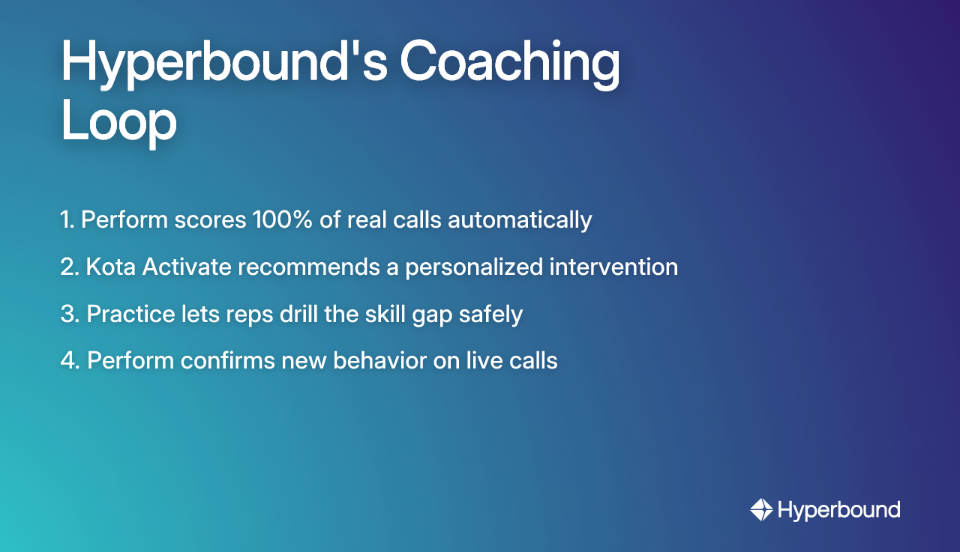
Hyperbound creates a continuous improvement loop that removes the manual bottleneck entirely. The cycle works like this:
The result: managers save up to 3.5 workweeks of coaching time that would otherwise be spent triaging basic mistakes that the system now handles automatically. Their time goes where it matters — high-stakes deal strategy and senior rep development.
Enablement platforms like Gong and Highspot often have mature integrations with Salesforce, HubSpot, Microsoft Teams, and the broader enterprise stack. For RevOps teams, that existing connectivity is a real asset.
Hyperbound is built to work within that stack, not around it. The integration story is one of genuine complementarity:
For RevOps leaders worried about tool sprawl, the message is practical: Hyperbound doesn't ask you to rip out Gong or Highspot. It connects to them, creating a closed loop where Gong's conversation insights fuel Hyperbound practice scenarios, which are delivered through Highspot, with performance data pushed back to Salesforce.
This is the dimension that ultimately justifies any investment in sales enablement for enterprise teams. Tools need to produce outcomes — not just activity.
Gong provides rich analytics on what reps did and said. But connecting a training initiative to a measurable change in behavior on subsequent calls is notoriously difficult. It shows correlation; causation is harder to establish.
Highspot measures content engagement — which assets were viewed, shared, and associated with won deals. That's genuinely useful for content strategy, but it doesn't measure whether reps can actually deliver the message when a skeptical CFO pushes back.
Hyperbound closes the loop between practice, performance, and revenue outcomes — and has the proof points to back it up:
The data connects training behavior to revenue outcomes in a way that satisfies the VP of Sales asking "what is this actually doing for us?" — a question that neither Gong's dashboards nor Highspot's content reports can answer on their own.
Here's the honest summary:
For most enterprise teams, the question isn't which one — it's how they fit together. There are two clear paths:
The Complementary Layer: Keep Gong and Highspot. Add Hyperbound to fill the practice gap. Use Gong's conversation data to inform roleplay scenarios, embed them in Highspot's training paths, and measure skill development back through Perform. Each tool becomes more valuable because the others exist.
The Consolidation Play: For RevOps teams under pressure to cut tools and reduce overhead, Hyperbound offers a genuine consolidation path. With its built-in Hyperbound Call Recorder, it handles recording, AI scoring, deal coaching, and practice in a single, integrated platform — without sacrificing the enterprise security and integration requirements your IT and legal teams will scrutinize.
The main difference is that Hyperbound focuses on active practice and skill development, while Gong analyzes past calls and Highspot manages sales content. Hyperbound acts as a "flight simulator" for sales reps to practice real-world scenarios, turning the insights from Gong and the materials from Highspot into measurable skills that improve future performance.
Hyperbound is designed to integrate seamlessly with your existing tech stack, not replace it. It connects to tools like Gong to pull call recordings for analysis, embeds AI roleplay modules into content platforms like Highspot via SCORM, and syncs performance data with CRMs like Salesforce to create a closed-loop system for skill development and revenue impact.
AI-powered sales practice offers a safe, scalable, and objective environment for reps to build skills without the anxiety of live role-play or the risk of practicing on real buyers. Unlike traditional methods, AI provides instant, consistent feedback, allows for unlimited repetitions, and can be personalized to target specific skill gaps identified from real call data, making training far more efficient and effective.
Hyperbound's AI buyer personas are trained on over 2 million hours of real B2B sales conversations, not generic scripts. This allows the AI to simulate nuanced, industry-specific objections and buying committee dynamics, including complex multiparty scenarios. This realism ensures reps practice against challenges they'll actually face, making the training directly applicable to their live deals.
While Hyperbound is most powerful as a complementary layer that fills the practice gap in your existing stack, it can also serve as a consolidation tool for some teams. With its own call recording, AI scoring, and coaching features, Hyperbound can provide a unified platform for organizations looking to reduce tool sprawl and streamline their sales enablement process.
The ROI of Hyperbound is measured through direct improvements in key sales metrics tracked within the platform. Customers typically see measurable behavior change that leads to outcomes like a 50-60% reduction in ramp time, a 150% increase in demo conversion rates, and a 2x faster time to the first won deal. The platform connects practice activities directly to on-the-field performance and revenue results.
Hyperbound automates the process of identifying skill gaps and assigning personalized practice. Its AI scores 100% of real calls against your sales methodology, identifies where individual reps are struggling (e.g., with pricing objections), and automatically assigns a targeted AI roleplay exercise to address that specific weakness. This frees up managers from manually reviewing calls for basic mistakes and allows them to focus on high-level strategy and deal coaching.
If you're unsure where your current stack has gaps — or whether Hyperbound is the layer you've been missing — there are two ways to find out:
Your reps have the content. You have the call data. The missing piece is practice — and that's a fixable problem.










Use Cases
Legal