
You finally invest in a proper RevOps stack. You wire up a call intelligence tool, add a forecasting platform, and watch the dashboards light up. For two weeks, everyone's excited. Then, slowly, the team goes back to managing deals in their heads, stalled opportunities get forgotten, and your pipeline reviews devolve into the same gut-feel conversations you were having before you spent six figures on software.
Sound familiar? Research shows that "the problem that costs most sales teams the most revenue is deals that stall" — and that fancy visuals only hold a team's attention for about two weeks before everyone goes back to ignoring pipeline details. The tools matter far less than the habits and process behind them.
Here's the uncomfortable truth about Hyperbound, Gong, and Clari: they're three of the most frequently mentioned tools in RevOps tech stack conversations, but they are not interchangeable. They solve fundamentally different problems. Buying the wrong one — or worse, buying all three without understanding how they connect — means you're pouring budget into visibility without changing outcomes.
Here's the short version before we go deep:
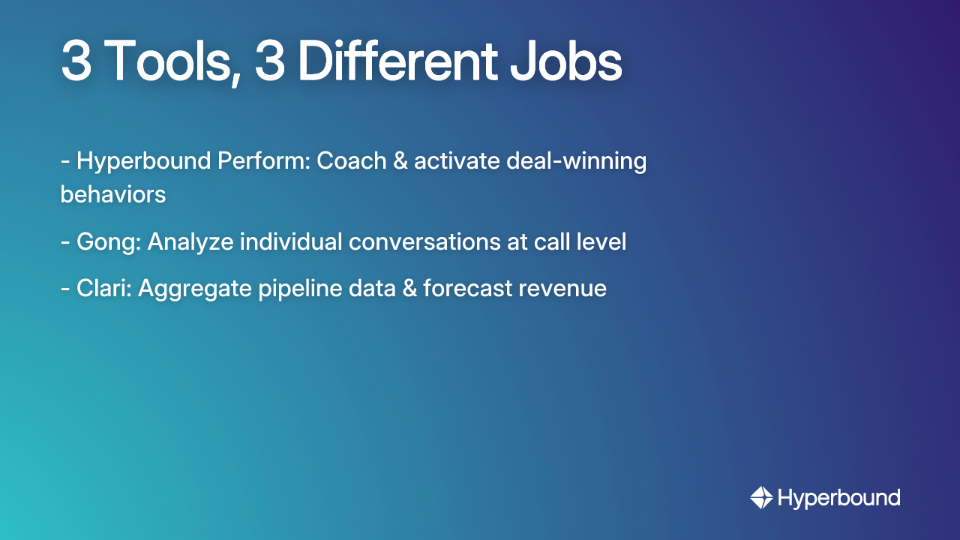
Let's break down each one, compare them head-to-head, and give you a clear framework for what to add, and when.
Hyperbound Perform is purpose-built for one job: closing the gap between analyzing calls and changing revenue outcomes. It's the core of what Hyperbound calls "Revenue Activation" — the idea that data alone doesn't close deals, but coached reps executing the right behaviors do.
Where most sales pipeline visibility software stops at surfacing what happened, Perform goes further by analyzing all the calls in a deal — from first outreach to late-stage negotiation — and rolling them up into deal-level intelligence. It catches deal risk while deals are still winnable, grounding its signals in real buyer conversations rather than static CRM fields or rep intuition.
Key capabilities for pipeline visibility:
Important caveat: Perform is NOT a forecasting tool. Forecast accuracy is a result of better deal execution, not the primary value proposition. If you're looking for a replacement for Clari's forecast aggregation, keep looking. If you need a behavioral signal layer that tells you why deals are moving or stalling — and what to do about it — Perform is purpose-built for exactly that.
Gong built the conversation intelligence category and is still the gold standard for call-level visibility. It automatically records, transcribes, and analyzes sales interactions — giving managers and reps a searchable library of every customer conversation.
Its AI flags topics, objections, competitor mentions, and risk signals within individual calls. It integrates activity data into your CRM and gives leadership a bird's-eye view of what's being said across the team.
Where Gong excels:
Where Gong falls short for sales pipeline visibility:Gong is strong at the micro level but struggles at the macro. It gives you a library of moments but doesn't effectively connect them into a coherent story of deal health. Research shows managers review only about 5% of calls manually — meaning the vast majority of Gong's data sits untouched. It also offers limited prescriptive guidance: Gong can tell you a rep talked too much on a call, but it won't tell you what behavioral pattern across the last five calls is putting this specific deal at risk, or what the manager should coach on today to save it.
Clari is the category leader for forecast aggregation and revenue predictability. It connects data from your CRM, ERP, and other systems to give leadership a consolidated, real-time view of pipeline health — eliminating the painfully manual spreadsheet-based rollup that plagues most RevOps teams.
Its AI analyzes deal stage, last-activity dates, CRM field changes, and historical patterns to flag at-risk opportunities and improve forecast accuracy. For sales leadership that needs to answer "are we going to hit the number?" with confidence, Clari is a powerful tool.
Where Clari excels:
Where Clari falls short for pipeline visibility:Clari is excellent at telling you what is happening — a deal hasn't moved in 14 days, forecast category was downgraded, no activity logged. But it falls short in explaining why. Its risk detection is grounded in CRM fields and activity metadata, not in the actual behavioral signals from buyer conversations. That means it can surface a stalled deal, but it can't tell you whether the champion went cold, the economic buyer raised a blocker in the last call, or the rep lost control of the narrative in discovery. Without that behavioral context, your deal inspections still rely on what the rep tells you — which is subjective at best.
Here's how the three tools stack up across the dimensions that matter most for sales pipeline visibility software:
.png)
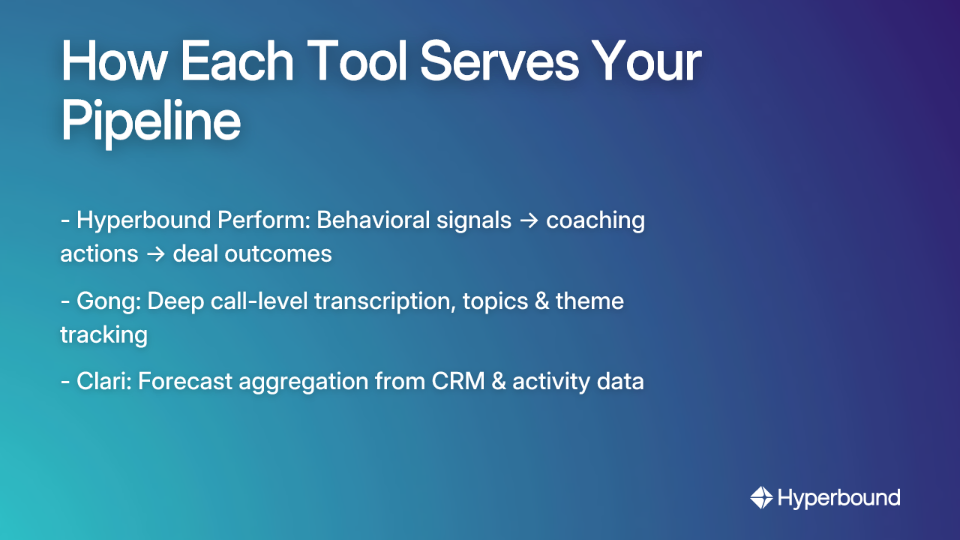
The matrix reveals a clear pattern: Gong gives you depth at the call level, Clari gives you breadth at the pipeline level, and Hyperbound Perform gives you the behavioral signal layer that connects the two and transforms visibility into action.
The goal isn't to pick one tool and call it done. It's to build a stack where each component does its job well — and feeds the next layer. Here's how to think about it based on where you are today.
You have a massive library of call recordings. The problem is that 95% of it is sitting unreviewed, and even the reviews that do happen happen too late — after the deal is already lost, not before.
Adding Hyperbound Perform on top of your Gong recordings changes this dynamic entirely. Perform analyzes 100% of your calls, rolls insights up to the deal level, and flags specific deals and skill gaps that need a manager's attention while there's still time to course-correct. Instead of a library, you get an actionable coaching engine. Instead of reviewing calls randomly, managers get surfaced to the deals that need them most — along with recommended coaching actions grounded in what's actually been said across the deal.
The result: fewer stalled deals, more consistent rep execution, and a direct connection between call behavior and deal outcomes.
Your forecasting is solid. You know what is happening in the pipeline. The problem is that your deal inspections still rely on rep-reported data in the CRM — which is subjective, often incomplete, and always a lagging indicator.
Adding Hyperbound Perform gives Clari something it fundamentally lacks: behavioral context. Perform analyzes what's actually being said in buyer conversations — not just what stage the deal is in or when the last activity was logged — to provide an objective, real-time signal of deal health and momentum. Champions going quiet? Economic buyers raising blockers? Competitors getting mentioned more in late-stage calls? Perform surfaces those signals before they show up as a slipped forecast.
When you feed those behavioral signals into your Clari inputs, your forecast accuracy improves — not because Perform is a forecasting tool, but because your CRM data and deal assessments become more grounded in reality. Deal inspections move from "what's the rep saying about this deal?" to "what is the buyer's behavior actually telling us?"
Here's the simplest way to summarize the distinction between these three tools:
The real problem most sales teams face isn't a lack of data. It's a surplus of it, with no clear path from insight to action. As one sales leader put it: "every deal should move or die" — but you can only enforce that discipline if you have visibility into why deals are moving or stalling, and a clear prescription for what to do next.
That's the gap Hyperbound was built to close. The company coined the term Revenue Activation to describe what happens when teams stop just analyzing call data and start using it to change outcomes — through AI deal coaching, automated call scoring, and targeted rep practice tied directly to live deals.
If you're evaluating sales pipeline visibility software and you want to move beyond dashboards that get ignored after two weeks, the question isn't "which one of these should I buy?" It's "which layer am I missing?"
Gong and Clari are powerful tools in their lanes. But if you need the layer that connects conversation behavior to coaching actions to deal outcomes — Hyperbound Perform is built for exactly that job.
The main difference lies in their primary function: Hyperbound Perform coaches deal-winning behaviors, Gong analyzes individual conversations, and Clari forecasts revenue from pipeline data. They are not interchangeable tools. Gong provides deep insights at the call level, Clari offers a high-level view of pipeline health and forecasts, and Hyperbound Perform connects the two by analyzing behaviors across all calls in a deal to explain why it's moving or stalling and what coaching actions to take.
No, Hyperbound Perform is designed to complement tools like Gong and Clari, not replace them. It acts as a behavioral signal and coaching layer that enhances their value. Hyperbound integrates with conversation intelligence tools like Gong to analyze 100% of calls and provide deal-level coaching insights. It also provides the "why" behind the numbers that forecasting tools like Clari report, making your entire RevOps stack more effective by turning visibility into action.
You need Hyperbound with Gong to automatically analyze 100% of your call recordings and translate them into actionable, deal-level coaching insights. While Gong provides a library of call recordings, the vast majority often go unreviewed. Hyperbound Perform analyzes every call, rolls up insights across the entire deal, identifies risks based on behavioral patterns, and recommends specific coaching actions to managers before a deal is lost. It turns Gong's passive data library into an active coaching engine.
Hyperbound improves your pipeline by providing the real-time behavioral context that Clari's CRM-based forecasting lacks. Clari is excellent at telling you what is happening in your pipeline (e.g., a deal has stalled). Hyperbound analyzes buyer conversations to tell you why it's stalling (e.g., the champion went silent, a new blocker was raised). This behavioral signal provides a leading indicator of deal health, making your Clari forecasts more accurate and your deal inspections more effective.
Revenue Activation is the process of using data and AI-driven insights to actively change sales behaviors and improve deal outcomes, rather than just passively observing them. This concept, coined by Hyperbound, describes the shift from simply having visibility into calls and pipeline to using that visibility to drive specific coaching actions. This includes AI deal coaching, automated call scoring, and targeted practice for reps, closing the loop between insight and execution.
AI Deal Coaching in Hyperbound Perform works by analyzing all customer touchpoints within a deal to identify behavioral patterns that help or hurt the opportunity, and then it recommends specific next steps. Instead of looking at calls in isolation, the AI assesses the entire deal lifecycle to detect momentum shifts and flag risks based on buyer language. It then surfaces these insights to managers with concrete recommendations for coaching.
The right tool depends on your most urgent problem. If your primary goal is to improve rep execution and coach deal-winning behaviors, start with Hyperbound Perform. If you lack visibility into customer conversations, start with a conversation intelligence tool like Gong. If your biggest challenge is manual forecast rollups, start with a platform like Clari. The ideal stack often includes all three, each performing its specific job to create a comprehensive RevOps engine.









Use Cases
Legal