
Alex Herrmann runs enablement for LinkedIn. He oversees more than 3,000 sellers across three business units in NAMER and EMEA. When his team evaluated their sales enablement platform stack, they did not find that Gong was broken. They found that Gong was doing exactly what it was designed to do. The problem was that what it was designed to do was not what enablement needed. His team needed a gong alternative for sales enablement that could actually build rep skills at scale. That search led them to Hyperbound, which provided the AI roleplay layer that Gong was never built to provide.
That distinction matters. It is the difference between a diagnostic tool and a coaching platform. And it is the decision more enablement leaders are now being forced to make.
Let's be precise here. Gong is one of the best conversation intelligence (CI) tools on the market. It was built to answer one question well: what happened on that call?
Here is what it genuinely delivers:
Call recording and transcription. Gong captures every sales conversation and makes it searchable. Managers can pull up any call, skip to key moments, and review what was said. That is genuinely useful.
Coaching scores. Gong generates scores based on tracked criteria, such as talk ratio, question frequency, and use of specific language. These scores give managers a structured view of call quality over time.
Team-wide pattern visibility. Gong excels at identifying trends across the entire sales team. It surfaces what top performers are doing differently, tracks competitor mentions, and shows how new messaging is landing across the org.
These are real strengths. For revenue operations leaders, sales managers, and CROs who want visibility into what is happening across hundreds of calls, Gong delivers.
The issue is not what Gong does. The issue is what enablement leaders often ask it to do next.
Gong surfaces problems. It does not solve them.
A pattern that shows up repeatedly in sales team discussions is that leadership starts treating Gong data as the primary measure of rep performance. Metrics become the goal. PIPs get tied to Gong scores. Managers stop coaching and start auditing. One rep described it plainly: "The only thing Gong surfaces up is who is shit."
That is not Gong's fault. It is a category error. Gong was built for visibility, not skill development. Here is where the gap opens up:
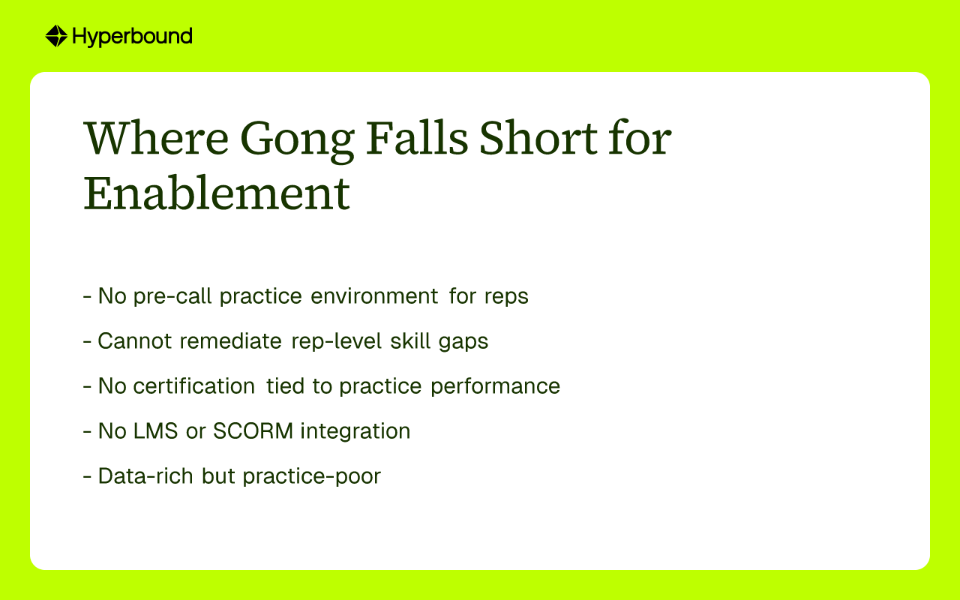
No pre-call practice environment. Gong analyzes past calls. It provides no way for a rep to rehearse a new talk track, practice a difficult objection, or build confidence before a live customer conversation. There is no safe space to fail.
No rep-level skill gap remediation. Gong can show that a rep's discovery questions are weak. It cannot give that rep 20 repetitions of practicing better discovery questions with instant feedback. Seeing the problem and fixing it are two different workflows.
No certification tied to practice performance. Enablement leaders cannot certify a rep on a new methodology through Gong and then directly verify that the rep can execute it correctly in a rehearsal environment before taking it live.
No LMS or SCORM integration. Gong sits outside the core learning ecosystem. That means your training content, your competency frameworks, and your call data all live in separate systems with no clean connection between them. According to a comparison of leading platforms, this gap is one of the most consistent friction points for enterprise enablement teams who need a unified skill-building program.
The result is an enablement program that is data-rich and practice-poor.
The Salesforce State of Sales report found that 75% of sales reps feel better prepared to meet quota when they have access to effective enablement tools. The keyword is "prepared." Preparation requires practice, not just analysis.
Modern enablement is moving away from passive learning toward active repetition. Watching a call recording is not the same as doing a rep. Here is what a genuine coaching and skill-building platform needs to provide:
High-volume, scalable practice. A rep learning a new methodology needs to practice it dozens of times, not once in a team meeting. The practice needs to be available on-demand, without a manager having to schedule a session.
Consistent, immediate feedback loops. Waiting a week for a manager to review a Gong call and schedule a debrief is too slow. Reps need feedback in the moment so they can iterate, adjust, and build the skill before it matters.
Certification that connects practice to performance. Enablement leaders need a way to verify that a rep has actually mastered a skill in a controlled environment before deploying it with a buyer. That certification needs to live alongside the training content, not in a separate system.
Multilingual support for global teams. For organizations operating across NAMER and EMEA, the training experience cannot be English-only. Reps in France, Germany, the Netherlands, and Spain need to practice in the language they sell in. Inconsistent localization creates inconsistent results.
These are not nice-to-have features. For a Head of Enablement managing a globally distributed team, they are the baseline requirements for a program that actually changes rep behavior.
This is where Alex Herrmann's experience at LinkedIn is instructive.
LinkedIn's evaluation covered more than 3,000 sellers across three business units in NAMER and EMEA. At that scale, manager-led roleplay is not a realistic solution. There are not enough hours in a manager's week to give every rep meaningful practice repetitions on a new product launch, a new methodology, or a competitive scenario.
Gong gave Herrmann's team visibility. It could show which reps were struggling and where. What it could not do was give those reps a place to practice closing that gap safely, consistently, and at scale.
The answer was adding an AI roleplay layer. Not replacing Gong, but filling the space Gong was never designed to occupy.
Here is why AI roleplay addressed what manager-led practice could not:
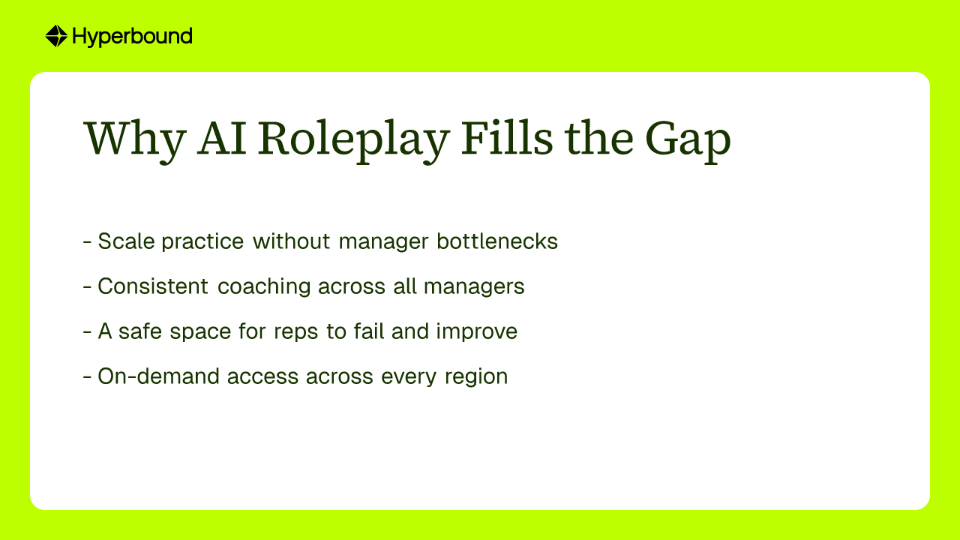
Scale without bottlenecks. Every rep in every region can practice on-demand. There is no scheduling dependency, no manager availability constraint, and no variance in the quality of the practice partner.
Consistency across managers. One of the most persistent problems in large sales organizations is manager-to-manager coaching variability. One manager coaches objection handling well. Another skips it. AI roleplay removes that variability. Every rep gets the same high-quality scenario with the same feedback criteria.
A safe space to fail. Reps who are new to a message or a method need room to make mistakes. Real buyer conversations are not that room. A controlled AI practice environment is. This is especially important for new hires in the ramp period.
The outcomes that follow from adding this layer are measurable. Vanta, for example, cut ramp time by 60% and got reps to pipeline generation 30% faster after implementing an AI-driven practice platform alongside their existing stack. That kind of result does not come from more call recordings. It comes from more practice repetitions.
If Gong is your primary enablement platform, it is worth asking exactly what you are buying.
Gong is a retrospective tool. It tells you what happened. That is valuable for revenue operations, for forecasting, for identifying deal risk, and for giving managers a structured view of call quality. Those are real use cases worth paying for.
But enablement's job is different. Enablement's job is to change what happens on the next call.
Ask yourself these questions honestly:
Are you buying retrospective analysis or proactive preparation? A call recording library is not a practice environment. If your reps are only learning from their real calls, they are learning at the customer's expense.
Are you investing in a dashboard for managers or a development system for reps? Gong scores are most useful to the person reviewing them, not the person being scored. A practice platform inverts that. The rep is the primary beneficiary.
Is your goal to identify struggling reps or to build a system that prevents the struggle? As many reps have described directly, when enablement leans too heavily on Gong metrics, the culture shifts from development to surveillance. Leadership starts managing activity scores instead of building skills. Morale drops. The metrics become the goal, not a proxy for it.
Gong is a visibility tool doing a visibility job. When enablement asks it to carry the full coaching load, it creates a program that is great at identifying problems and poor at solving them. That is not a Gong failure. It is a category mismatch.
The main problem is that Gong is a diagnostic tool, not a development platform. It can identify skill gaps from past calls but provides no environment for reps to practice and fix them before the next live call. This leaves reps with valuable data but no structured way to improve their performance through active repetition.
No, Hyperbound does not replace Gong; it complements it. Gong is an essential tool for conversation intelligence and analyzing past calls, while Hyperbound provides the forward-looking practice environment to prepare for future calls. Teams use Gong to see what happened and Hyperbound to change what happens next.
Hyperbound and Gong work together to create a complete skill development loop. Insights from Gong's call analysis—like a competitor mention that consistently stumps reps—can be used to build a targeted AI practice simulation in Hyperbound. Reps can then practice that exact scenario until they master it, closing the gap that Gong identified.
AI roleplay helps reps improve by providing a safe, on-demand environment to practice sales scenarios, receive instant feedback, and build muscle memory through repetition. Unlike manager-led roleplay, which is difficult to scale, AI simulations are always available. Reps can rehearse a new pitch or a difficult objection dozens of times, getting consistent, objective feedback on each attempt to build confidence and competence.
Teams that add a dedicated practice layer can expect measurable improvements in key metrics like faster ramp time for new hires, increased pipeline generation, and higher quota attainment. For example, Vanta cut new hire ramp time by 60% and saw reps generate pipeline 30% faster by using an AI practice platform.
No, Hyperbound is designed for sales teams of all sizes that are focused on skill development, from fast-growing startups to large enterprises. While the challenges of coaching at scale are more pronounced in a large organization, the core need for consistent, effective practice is universal for any team looking to improve performance.
Yes, Hyperbound integrates with leading sales enablement platforms and Learning Management Systems (LMS). As a SCORM-compatible application, it can be embedded directly into platforms like Seismic and Highspot. This allows you to place AI-driven practice exercises inside your existing learning paths, creating a seamless experience for reps.
Hyperbound provides comprehensive support for global teams with AI coaching available in over 25 languages. This ensures that reps can practice in the language they actually sell in, whether it's German, French, Spanish, or another language. The AI personas and scenarios can also be localized to reflect regional buyer nuances, ensuring the practice is relevant and effective for teams across NAMER, EMEA, and beyond.
They are different jobs.
Gong is a powerful tool for the job it was designed to do. No enablement leader should stop using it for call visibility, trend analysis, or manager review workflows. It is genuinely good at those things.
But if it is carrying your entire enablement program, there is a gap in your stack. Your reps have visibility into their weaknesses and no structured way to fix them. Your managers have dashboards and not enough hours to coach everyone who needs it. Your global teams are practicing in a language that is not theirs.
The enablement leaders at LinkedIn identified that gap. They added Hyperbound’s AI roleplay layer to give 3,000+ sellers a scalable practice environment that Gong was never designed to provide. The result was a program where visibility and skill-building worked together instead of one trying to do both jobs.
The future of enablement is not more dashboards. It is more practice. The right platform does not just show you where the gaps are. It gives every rep, in every region, a safe and consistent way to close them.
See how Hyperbound fits into an enterprise enablement stack.










Use Cases
Legal