
You've invested in Gong. You've built a library of recorded calls. You've clipped the great ones, shared them in Slack, and told your team to study up. And yet, when quota pressure hits, that library gathers digital dust. Sound familiar?
It's the most common pain point in modern sales enablement: the tools that were supposed to help reps perform better end up feeling like homework. As one sales ops leader put it, sales enablement just feels like added work "that gets ignored once the month-end pressure hits." The hard truth? "If it lives outside the workflow, it dies."
Conversation intelligence platforms were genuine breakthroughs. For the first time, sales leaders could see and hear exactly what was happening on real deal calls — no more guesswork, no more "vibes-based" coaching. But visibility was never the same as improvement. By the time a call ends up in a summary or scorecard, the moment to change it is already gone. You're looking at a rear-view mirror while your reps are driving forward.
This is the intervention gap — and it's where most enablement programs quietly fail. The teams that consistently win aren't just watching what happened. They're actively preparing for what comes next. Here's how modern enablement teams are going beyond call recordings to build reps who are ready before the call ever starts.
When conversation intelligence tools arrived, the promise was transformative. Call review gave enablement leaders an evidence base for coaching. You could identify what top performers were doing differently, spot the objections tripping up your mid-tier reps, and build a case for your training programs with something more concrete than gut feel. Studies suggest that systematic call review can contribute to a 15–20% improvement in win rates — real, meaningful impact.
But the reality of running call review at scale quickly sets in:
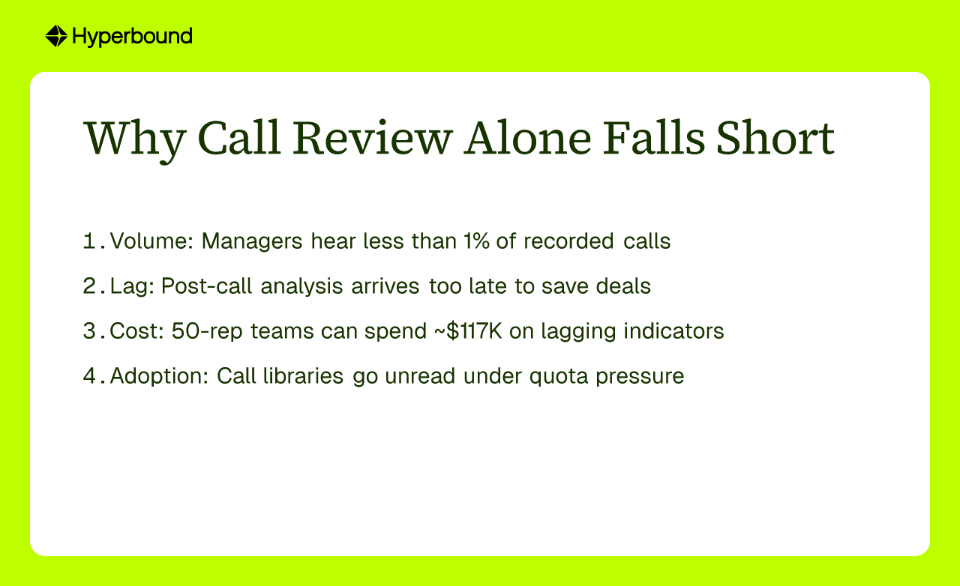
None of this means call recording isn't valuable. It means that call recording alone was never designed to be the full answer.
The core challenge with any call library is the leap from insight to behavior change. Watching a great call tells a rep what good looks like. It does almost nothing to help them do it.
This is the forgetting curve in action. Passive learning through observation has notoriously low retention. Reps learn by doing. The most effective training involves real-world application — mock calls, live drills, scenarios that mirror the actual conversations they'll face. One enablement leader captured it well: "What actually stuck was recording top reps on real deal calls and breaking those down in weekly team sessions." Great instinct. But completely impossible to scale across every rep, every scenario, every new product launch, or every competitive shift.
The coaching bottleneck makes this worse. Managers are stretched thin. The average frontline manager spends only 5–8% of their time on coaching, and coaching is often the first thing cut when deals are on the line. The result? Inconsistent feedback that arrives days after the call, long after the learning window has closed.
And when enablement teams try to fill this gap with LMS modules or separate training platforms, they run into the same wall: "The moment it lives in a separate doc or LMS module, reps ignore it." The content isn't bad — the placement is. Enablement has to show up in the workflow, not next to it.
This is where Hyperbound enters the picture — not as a replacement for Gong, but as the activation layer on top of it. Where Gong captures what happened, Hyperbound turns those insights into practice, preparation, and measurable behavior change. Think of it as the difference between watching game tape and actually running plays.
Here's how enablement teams bridge the gap using both tools together:
Instead of manually sifting through hours of recordings and writing up coaching notes, Hyperbound's AI Real Call Scoring integrates directly with your existing call recorder — including Gong — and automatically evaluates calls against your custom scorecards and playbooks.
This solves one of the biggest complaints in modern enablement: coaching that's "vibes-based" instead of grounded in data. With auto-scorecard routing, the right scorecard gets assigned based on meeting type and content — a discovery call gets evaluated differently than a late-stage negotiation. Managers get AI deal summaries that surface key moments, objections, and buying signals without needing to scrub through the full recording. That time savings — estimated at 3.5 workweeks of coaching saved per manager — adds up fast.
The data also flows both ways. Automated follow-up suggestions and next steps ensure that insights from the call don't die in a summary email that reps never write. Sales discipline improves because the system creates it, not willpower.
This is the step that Gong simply can't take. Once you know what good looks like — through your call recordings and AI scoring — you need a way to scale it. That's what Hyperbound's AI Sales Roleplays are built for.
Reps can practice the full sales cycle: cold calls, discovery conversations, demo objections, competitive pricing pushback, and even post-sales renewals and upsell scenarios with AI-driven customer personas. These aren't generic simulations — they're built from your actual ICP, your actual objections, your actual playbook. The AI buyer responds dynamically, raising the specific objections your reps will face in real deals.
Critically, this is just-in-time practice that lives where reps already work — embedded in their calendar, CRM, Slack, or LMS. It's not another tab to open or a module to complete. It's preparation that shows up in the workflow, not next to it.
After every roleplay, reps receive immediate, personalized AI coaching feedback aligned to your methodology. No waiting for the weekly 1:1. No vague feedback like "you need to dig deeper in discovery." Instead, specific, actionable insights: which questions were skipped, where the rep lost control of the conversation, what talk track move would have addressed the objection more effectively.
The gamification layer — leaderboards, scoring, and certifications — gives reps a reason to engage without requiring manager pressure. Skill development becomes something reps opt into rather than avoid.
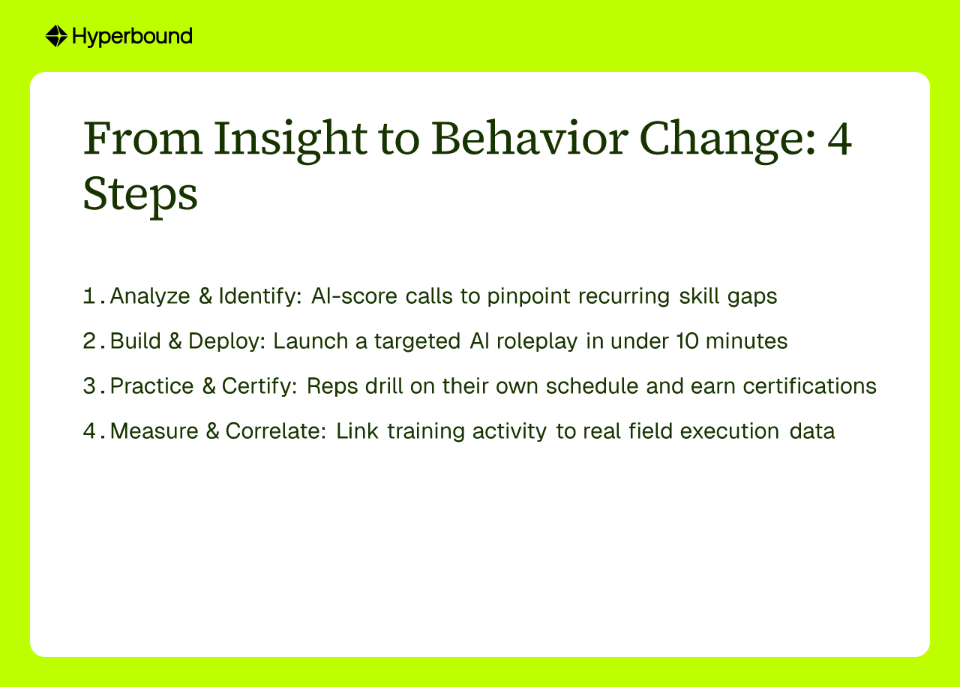
This is what it looks like when enablement stops being a separate thing and gets embedded into what reps already do. The shift Vanta's team experienced — cutting ramp time from 210 to 72 days, growing the BDR team 4x, and generating 5x pipeline — came from exactly this kind of system: practice that's connected to real call analysis, with a closed feedback loop between the two.
Gong opened the door to conversation intelligence, and that was genuinely valuable. For the first time, sales leaders could ground their coaching in real evidence from real deal calls. But a library of recordings is still just a library. You can watch every play a championship team has ever run and still not be able to run them yourself. The gap between watching and doing is where most enablement programs quietly break down.
The enablement teams closing that gap aren't abandoning their call recording tools — they're building on top of them. They're using objective AI scoring to identify exactly where skill gaps exist, then giving reps the just-in-time practice to close those gaps before the next deal is on the line. They're making coaching scalable, consistent, and embedded in the workflow rather than layered on top of it as a separate obligation.
That's what the Revenue Activation era looks like in practice: not more dashboards, not more recordings to watch, but a continuous loop from real call analysis to targeted practice to measurably better execution. Stop watching. Start winning.
The main problem is that call recording tools provide post-call analysis, which is a lagging indicator of performance. They show you what already happened but don't help reps actively prepare for future conversations, creating an "intervention gap" where insights don't translate into behavior change. While platforms like Gong are excellent for visibility, they promote passive learning. Reps watch recordings, but this doesn't build the muscle memory needed to handle objections or navigate complex deals in real-time.
Passive call review fails because it relies on observation rather than active participation, leading to low knowledge retention due to the "forgetting curve." Watching a great call shows a rep what to do but doesn't equip them with the skills to actually do it under pressure. True skill development in sales comes from doing—practicing conversations, handling unexpected objections, and getting immediate feedback—elements that passive review lacks.
Hyperbound acts as an activation layer on top of Gong, not a replacement. It integrates with Gong to analyze your call recordings and then uses those insights to create targeted, AI-powered sales roleplays for your team to practice. The workflow is simple: Gong records the call, Hyperbound's AI automatically scores that call to identify skill gaps, and then Hyperbound generates realistic practice scenarios to help reps master those skills.
AI Real Call Scoring is a feature that automatically evaluates recorded sales calls against your custom scorecards and playbooks. It removes subjective, "vibes-based" coaching and replaces it with objective, data-driven feedback. It analyzes conversations for key moments, buying signals, and adherence to your sales methodology, providing managers with quick summaries and ensuring coaching is consistent and targeted.
AI Sales Roleplays provide reps with a safe, scalable environment to practice real-world sales scenarios before they face a live customer. This "just-in-time" practice builds confidence and muscle memory for handling everything from cold calls to competitive objections. Unlike traditional mock calls, AI roleplays are available on-demand, are built from your actual playbooks, and provide immediate, personalized AI coaching after every session.
The "intervention gap" is the critical space between analyzing a past sales call and preparing a rep for their next one. It's where insights from call recordings fail to become actual behavior changes in future conversations. Most enablement tools focus on reviewing what happened, but improvement only occurs when reps can actively practice new behaviors before they are in a high-stakes situation.
Sales teams can bridge this gap by creating a continuous feedback loop between call analysis and active practice. This involves using AI to automatically score calls to identify skill gaps and then deploying targeted AI-powered roleplays to let reps practice and master those specific skills. This connects training directly to real-world performance data.
If you're looking for a Gong alternative for sales enablement that adds real practice and activation on top of your existing call data — rather than replacing what's already working — see Hyperbound in action with a free demo.







Use Cases
Legal