
When Stevie Case, CRO at Vanta, decided to add a dedicated sales coaching layer on top of Gong, the results were hard to argue with. Vanta cut rep ramp time by 60% and generated a $125M pipeline. Vanta already had Gong. The question was never whether to replace it. The question was what conversation intelligence alone could not do.
This article is for Heads of Enablement and RevOps leaders who are in that same position right now. You have Gong. You trust it. And you are starting to suspect that your coaching program has a gap that conversation intelligence alone cannot close. If you are looking for a gong alternative for sales coaching that works alongside your existing stack, keep reading. This is what that looks like in practice.
Before identifying the gap, it is worth being precise about why Gong is valuable. This is not a "Gong vs. anything" conversation. Gong earns its place in the stack.
Call recording and analysis. Gong is the system of record for every customer conversation. It captures everything and makes it searchable. That alone has significant value for any team managing a high volume of deals.
Transcript search. Managers can search across thousands of calls for competitor mentions, specific objections, or key phrases. This is a genuine superpower for identifying patterns across the entire team.
Deal visibility. Gong surfaces deal health signals that CRM notes cannot. It gives leadership a real view into what is happening in pipeline, not just what reps have logged.
Team-wide pattern surfacing. Gong aggregates data to show which talk tracks and discovery questions are working. It tells you that your top performers consistently ask about business impact early in discovery. It tells you that struggling reps get stuck at the pricing conversation.
Gong tells you what is happening. That is its core strength.
So the question is not whether Gong is good at what it does. The question is whether what it does is sufficient for a mature coaching program.
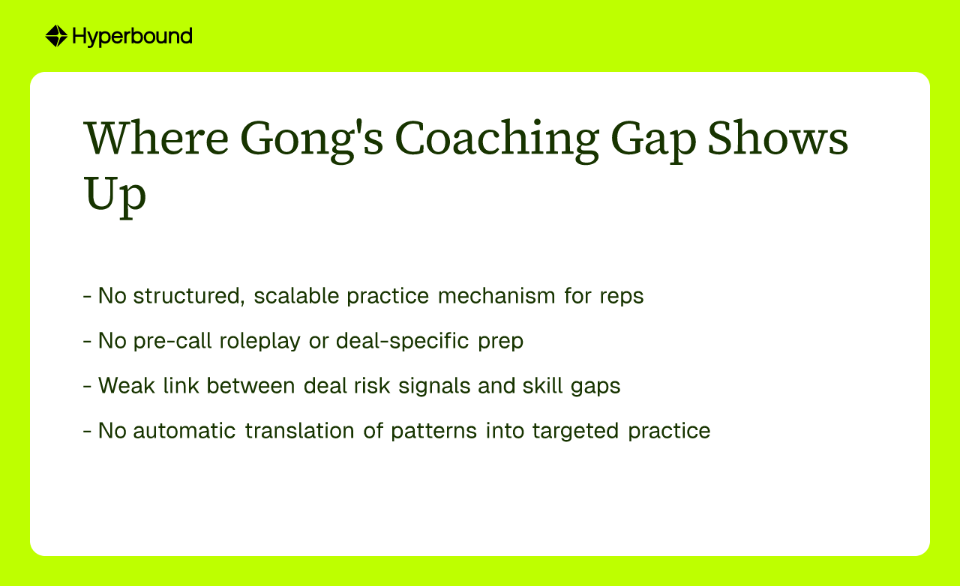
Sales teams discover this gap the same way. Gong shows you a pattern. Your manager sees it. Your enablement team knows it. And then there is no structured way to turn that pattern into a behavior change at the rep level.
Here is where that gap shows up in practice.
No structured practice mechanism. Reps can listen to great calls. They can read their own transcripts. But passive review is not practice. There is no built-in, scalable environment in Gong where a rep can work through a skill until it becomes automatic. As one RevOps leader noted on Reddit, "I've seen reps develop bad habits just by doing without any feedback, or they avoid tough situations altogether." Watching film does not fix the problem. Running the play does.
No pre-call roleplay. The highest-leverage coaching moment is before a call, not after it. Gong is post-mortem by design. It cannot help a rep prepare for a specific deal scenario, simulate a difficult stakeholder, or practice handling a pricing objection before it happens live. Users evaluating AI roleplay tools have noted that the quality of that practice environment matters enormously, and that low-fidelity roleplay fails to prepare reps for the unexpected directions real prospects take.
Limited deal-level coaching that connects behavior to skill gaps. Gong can flag that a deal is at risk. It is harder to connect that risk signal directly to a specific skill deficit in the rep and then prescribe a targeted intervention for that deal. The link between deal data and development action is a manual one.
No cross-deal analysis generating targeted practice. If a rep is consistently losing at the pricing conversation across five different deals, Gong surfaces that pattern at the team level. But it does not automatically translate that rep's recurring weak point into a personalized practice curriculum focused on that exact skill. That translation step is where coaching falls through.
RevOps teams on Reddit are direct about this: they are "not huge fans of Gong's pipeline management, gamification, or 1:1 coaching tools." The gap is not in the intelligence layer. It is in the activation layer that sits downstream from it.
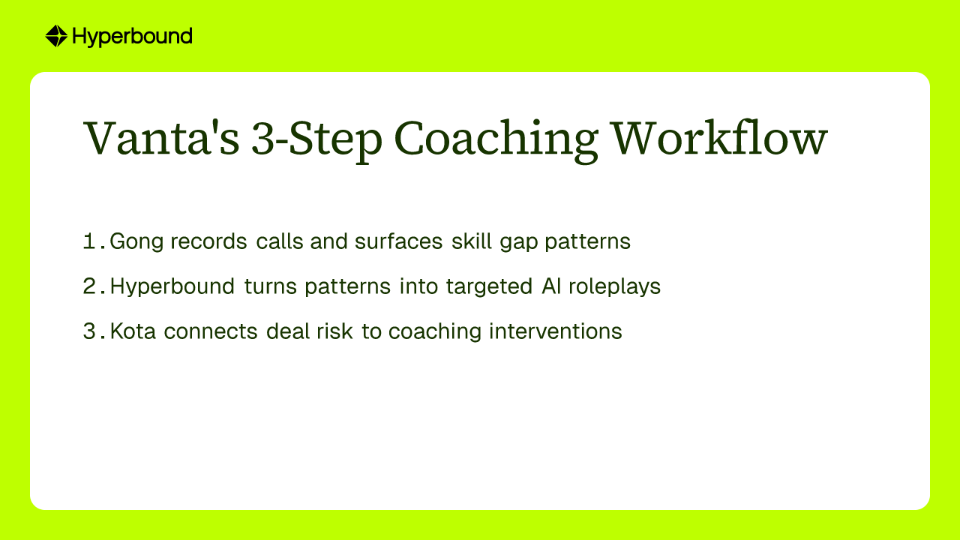
Vanta did not choose between Gong and a coaching platform. They built a workflow where each tool does what it does best, and the two systems reinforce each other.
Here is how that workflow runs.
Step 1: Gong records and surfaces patterns. Gong remains the intelligence engine. Every customer call is recorded, analyzed, and tagged. Managers and enablement teams use Gong's analytics to identify where deals are stalling, which objections are landing hardest, and which skills differentiate top performers from the rest of the team.
Step 2: Hyperbound translates patterns into targeted practice. The patterns Gong surfaces become the inputs for Hyperbound. If Gong shows the team is struggling to articulate the value of a specific product feature against a key competitor, enablement builds that exact scenario as an AI-powered roleplay in Hyperbound. Reps practice it repeatedly in a low-stakes environment before they face it on a live call. The roleplay is not generic. It is built from actual call data. That specificity is what makes practice transfer to performance.
Step 3: Kota orchestrates deal-level interventions. Vanta uses Kota as the orchestration layer that connects deal data to coaching action. When a rep's pipeline is stalling and their Hyperbound practice data shows a skill gap in the same area, that triggers a targeted manager intervention. The 1:1 coaching conversation is no longer based on intuition. It is based on correlated data from two systems working together.
As detailed in multiple sources covering Vanta's approach, the result of this closed-loop system was a 60% reduction in ramp time and a $125M pipeline. The workflow did not replace Gong. It completed it.
This is the operational model that Heads of Enablement and RevOps leaders are replicating. Gong generates the insights. The coaching layer converts those insights into rep behavior. The orchestration layer connects behavior to revenue outcomes.
If you are evaluating whether to add a coaching layer, you are probably asking a few of the same questions your peers have already worked through.
How does this integrate with Gong and Salesforce?
Platforms like Hyperbound are built to connect with existing conversation intelligence tools. Call transcripts, topic tags, and deal data can flow into the coaching platform to inform the practice scenarios reps are assigned. This directly addresses what RevOps practitioners have flagged as a persistent frustration: "Gong still misses a ton of context from Salesforce, documents, and other integrations." A dedicated coaching layer that connects SFDC data to rep skill development closes that context gap.
Are we getting the same data twice?
No. Gong provides conversation data: what was said, how deals are progressing, which behaviors are correlated with winning. Hyperbound provides competency data: how well a rep can perform a skill in a structured practice environment before it counts. One measures performance in live situations. The other measures readiness before those situations occur. The data sets are complementary, not redundant.
Who owns it: Enablement or RevOps?
In most teams, ownership is shared by function. Enablement owns the content layer. They build the practice scenarios, design the coaching curricula, and manage the roleplay library. RevOps owns the integration layer. They ensure that Gong, the coaching platform, and SFDC are connected, and that coaching activity can be tied to revenue outcomes. Front-line managers are the primary daily users, running 1:1 sessions informed by both systems. Neither team can abdicate ownership entirely. The tools work because both functions contribute to the workflow.
The headline numbers from Vanta deserve more than a mention. They deserve unpacking.
A 60% reduction in ramp time is not a training metric. It is a revenue metric. If your average ramp is 10 months, a 60% reduction means reps are generating quota-retiring pipeline in four months instead of ten. Across a growing team, that difference compounds fast. Six months of additional revenue productivity per new hire adds up before the end of a single fiscal year.
The $125M pipeline is the downstream effect. Better-trained reps run better discovery. They handle objections without stalling. They articulate value with precision because they have practiced those specific skills in scenarios built from actual deal data. Vanta's growth from sub-$20M to over $100M ARR happened in a market with 40-plus competitors. Execution was the differentiator, not the product alone.
Stevie Case has been direct about this framing. Execution is the moat. Not positioning, not pricing, not the pitch deck. The ability to consistently run a great sales process, across every rep, at every stage, is what compounds over time. A coaching layer is the operational infrastructure for that kind of execution excellence. It is what turns a Gong insight into a changed behavior, and a changed behavior into a closed deal.
Sales coaching research consistently shows that frequent, structured coaching is one of the highest-leverage investments a sales organization can make. Vanta's results are an example of what that looks like when it is operationalized correctly.
The primary difference is that Gong analyzes past conversations to tell you what happened, while a dedicated coaching platform provides a structured environment for reps to practice and improve before their next live call. Gong provides the diagnostic insights; a coaching platform provides the active-learning solution to fix the issues Gong finds.
No, Hyperbound is designed to complement Gong, not replace it. Think of it as an action layer on top of Gong's intelligence layer. Teams continue to use Gong as the system of record for customer conversations and deal analysis. They use Hyperbound to turn the skill gaps Gong identifies into targeted, repeatable practice for reps.
Active practice is better because it builds the muscle memory required for behavior change. Reviewing calls in Gong is a form of passive learning, which is helpful for identifying mistakes but insufficient for mastering new skills. Active, deliberate practice in a simulated environment—like AI-powered roleplay—allows reps to internalize new talk tracks and objection-handling techniques so they can execute them flawlessly under pressure.
Hyperbound integrates with Gong to create a seamless coaching workflow. Insights from Gong's call analysis—such as common objections, competitor mentions, or key phrases from top performers—can be used to automatically build relevant and realistic AI roleplay scenarios in Hyperbound. This ensures that reps are practicing the exact situations they are facing in their current deals.
Responsibility is typically shared between Sales Enablement and RevOps. The Enablement team usually owns the content and strategy, building the practice scenarios and designing coaching curricula. The RevOps team owns the technical integration, ensuring data flows correctly between Gong, Hyperbound, and your CRM to measure the impact of coaching on revenue outcomes.
Having Gong already in place significantly accelerates the implementation process. The rich history of conversation data and identified patterns in your Gong instance provides an immediate foundation for building targeted practice scenarios in Hyperbound. Instead of starting from scratch, you can begin translating existing intelligence into action right away, with initial value often visible within weeks.
Gong is indispensable. It gives you the most accurate picture of what is happening in your deals and across your team. No credible conversation about sales technology dismisses that.
But data does not change behavior. Practice does. Structured feedback does. Targeted repetition in high-fidelity scenarios, built from your own call data, does.
The teams adding a sales coaching layer are not expressing dissatisfaction with Gong. They are recognizing that insight without action is incomplete. They are closing the loop between what Gong surfaces and what reps actually do differently on the next call.
Vanta closed that loop. The outcome was 60% faster ramp times and $125M in pipeline.
The question for your team is not whether you need Gong. You already know the answer to that. The question is what happens after Gong tells you what is going wrong. Do you have the infrastructure to fix it?
That is what a dedicated sales coaching layer is for.







Use Cases
Legal