How Hyperbound Perform Gives Sales Coaches What Gong Can't: Deal-Level Coaching Across Every Call
9
min read

9
min read
You invested in conversation intelligence. You have thousands of recorded calls sitting in a searchable library. Your managers can pull up any conversation, add a comment, and flag a coaching moment. On paper, you've solved the coaching problem.
But here's what your pipeline is quietly telling you: win rates haven't moved. Ramp time is still long. That rep who struggles in discovery is still struggling in discovery, three months and a dozen deal losses later.
You're not alone. Across sales communities, leaders who rely on call recordings are asking the same uncomfortable question: "We have all this call data — why aren't our reps actually getting better?"
The answer isn't that your conversation intelligence platform is broken. It's that it was never designed to be a coaching system. And confusing the two is costing you deals.
Conversation intelligence changed the game when it launched. For the first time, revenue teams had a system of record for every customer conversation. Managers could stop relying on rep self-reporting and actually hear what happened on a call. That was real progress.
But here's the problem: a library of recordings isn't a coaching program. It's raw material — and raw material still requires someone to transform it into performance improvement.
The default coaching workflow with these tools puts the entire burden on the manager. They have to find the time to review calls, diagnose the issue, schedule a 1:1, and deliver feedback — days after the call happened, when the context has faded and the deal has already moved (or stalled). Sales managers already spend only 5–8% of their time on coaching, and it's the first thing that gets cut when pipeline pressure rises. Asking them to also become full-time call reviewers is a losing equation.
Then there's the feedback itself. Even when managers do review calls, the diagnosis tends to be uneven. One manager coaches on tone. Another focuses on competitive positioning. A third doesn't have a framework at all and just runs on intuition. Your reps end up with inconsistent development, shaped more by their manager's preferences than by what actually closes deals.
And then there's the tooling. The features meant to surface keyword-based insights often rely on outdated technology, require significant manual setup, and produce high false-positive rates. They can tell you a competitor was mentioned on 40% of your calls, but they can't tell you whether your rep handled that objection well or fumbled it.
Real users feel this gap acutely: "I am looking for how to improve rep skill gaps not just on a deal or call. Then help me recommend what to change across all rep calls." That's a coaching problem. And conversation intelligence, by design, is an intelligence problem — it tells you what happened, not what to do about it.
The insight is visible. The intervention is missing. That's the gap.

So if a passive library of call recordings isn't enough, what does effective, scalable deal coaching actually look like?
According to ATD research, 91% of B2B go-to-market leaders who implement AI in skills and deal coaching report that their sales goals were met or exceeded. That's not a coincidence — it's a signal that the coaching model itself needs to evolve.
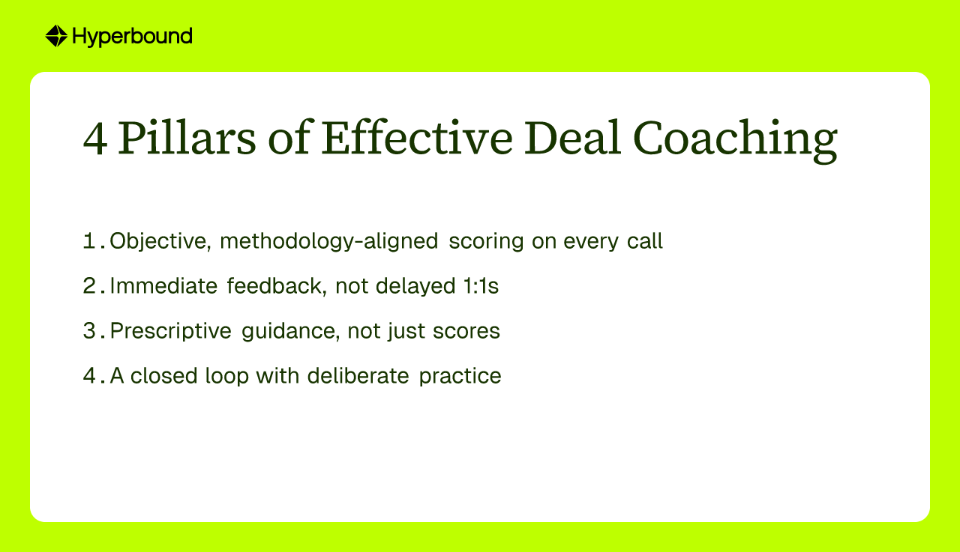
Effective deal-level coaching isn't about reviewing more calls. It's about building a system with four interlocking components:
1. Objective, methodology-aligned scoring on every call. Coaching can't be based on a manager's gut feeling. Every call needs to be assessed against your specific sales framework — whether that's MEDDPICC, SPICED, or a custom playbook — so coaching is consistent and comparable across reps and managers.
2. Immediate feedback, not delayed 1:1s. When feedback arrives three days after a call in a 30-minute review session, the cognitive connection to the actual moment is almost gone. Learning sticks when it happens close to the experience. Every call should generate coaching automatically, while the conversation is still fresh.
3. Prescriptive guidance, not just scores. A scorecard that says "Discovery: 62%" isn't actionable. Effective coaching tells the rep exactly what they missed and when — "After the prospect mentioned an upcoming budget review, you moved to a product demo. That was the moment to ask about their decision criteria and internal stakeholders."
4. A closed loop with deliberate practice. This is the piece that almost no conversation intelligence tool offers. Identifying a skill gap is only valuable if you have a way to close it. Reps need a safe environment to practice the specific scenario they struggled with — not a generic certification, but a targeted simulation tied directly to the deal context they just experienced.
This is exactly what practitioners are asking for: "Juniors practice mock calls there, it generates a call score and review of the call which seniors review and provide feedback." The concept is right. The execution — when it's entirely manual and human-dependent — doesn't scale.
The question is: what does that closed loop look like when it's automated, deal-specific, and running across your entire pipeline simultaneously?
This is where Hyperbound Perform enters. It's not a replacement for your call recorder — Hyperbound integrates with the conversation intelligence tools you already use. Think of it as the active performance layer that sits on top of your call library and turns recorded calls into actual coaching actions.
Here's how the closed loop works in practice:
Hyperbound's AI Real Call Scoring automatically assesses sales calls based on your custom scorecard, tracking specific behaviors, talk tracks, and adherence to your sales framework across every interaction. Not 1% of calls. Not the ones managers happen to get to. Every call.
What makes this different from a standard keyword tracker approach is specificity and context. Rather than flagging keyword mentions, Hyperbound's scoring evaluates how a rep handled a moment — did they follow up on a buying signal? Did they quantify pain before moving to the solution?
The Auto-CRM Fill feature (currently on HubSpot, with Salesforce coming soon) and AI Deal Summary extract key moments, objections, and next steps from each call — saving managers from spending the first 10 minutes of every 1:1 just reconstructing what happened. The deal context is already there.
Crucially, Perform analyzes insights across all the calls in a deal, not just individual call snapshots. That cross-deal view is what surfaces real deal momentum problems before they show up as a loss in your CRM.
Most call intelligence tools operate call by call. But deals unfold across multiple conversations, multiple stakeholders, and email threads. A risk that's invisible on Call 1 becomes obvious on Call 4 — by which point it's often too late.
Hyperbound Perform surfaces deal-level insights by analyzing stakeholder engagement, email interactions, and the cumulative pattern across all touchpoints in a deal. It matches those patterns against historical closed-won and closed-lost data to surface early risk signals — not as a forecast, but as a prompt to act now, while the deal is still yours to change.
This is the difference between a dashboard that reports what happened and a coaching tool that intervenes while outcomes are still changeable.
Here's what a true coaching platform has to offer that conversation intelligence alone simply cannot: the ability to turn a coaching insight into a practice repetition, immediately.
When Hyperbound flags that a rep missed a champion-building moment in their last deal, it doesn't just log the observation. Through Hyperbound's AI Sales Roleplays, a manager can assign a targeted bite-sized roleplay tied directly to that deal scenario — a simulation built around the specific stakeholder type, objection, or deal stage where the rep struggled.
Reps in the field have been clear about what they actually want: "We want something that can help improve real-world selling skills, objection handling, and real customer conversations." They don't want generic certification modules. They want practice that mirrors the deal they're actually working. That's exactly what deal-specific Bite-Sized Roleplays deliver.
And because these roleplays are built on a foundation of real B2B sales conversations — Hyperbound's models are trained on 2M+ hours of actual sales calls — the simulations respond the way real buyers respond, not the way a scripted bot would.
The operational loop looks like this: Score Real Calls → Identify Skill Gaps → Practice Targeted Roleplays → Score Real Calls. It's a continuous cycle, and it runs automatically across your entire team, not just the reps whose managers happen to find time.
Conversation intelligence gave revenue teams something valuable: visibility. For the first time, you could see exactly what was happening inside every customer conversation. That was a genuine leap forward, and it still plays an important role in modern sales tech stacks.
But visibility was never the same as improvement. You cannot dashboard a deal into closing. Nobody improved their win rate by watching recordings. The call ends, the summary lands in your inbox, and the moment to change the outcome is already behind you.
Effective sales coaching requires more than a library — it requires a system that scores every call objectively, delivers immediate and prescriptive feedback, and closes the loop with targeted practice before the next call happens. That's deal-level coaching. That's what moves win rates.
Hyperbound Perform is that system. And it's built on top of the call data you're already generating.
Conversation intelligence tools record and transcribe calls to tell you what happened, acting as a passive library of conversations. A true sales coaching platform like Hyperbound Perform is an active system that analyzes those calls to provide objective scoring, identify skill gaps, and deliver targeted practice to proactively improve performance.
No, Hyperbound Perform is designed to integrate with and enhance the conversation intelligence tools you already use. It acts as the performance and coaching layer on top of the call library your CI tool provides, turning your passive recordings into actionable, deal-winning interventions.
AI-powered call scoring provides objective, consistent, and scalable feedback on 100% of calls, removing the bottleneck and subjectivity of manual reviews. Instead of managers reviewing a small percentage of calls with potential bias, every conversation is assessed against your specific sales methodology, ensuring coaching is uniform and targeted at the most critical areas.
While keyword tracking simply flags the mention of a word (e.g., a competitor), Hyperbound's AI analyzes the context and quality of the conversation to evaluate how a rep handled that specific moment. It determines if the rep followed your playbook, successfully navigated an objection, or missed a key buying signal, providing much deeper coaching insights than a simple keyword count.
Deal-level coaching analyzes patterns and momentum across all interactions within a deal—including multiple calls, emails, and stakeholders—not just isolated conversations. This is crucial because single-call analysis can miss the bigger picture. Deal-level coaching connects all the touchpoints to surface risks, like a lack of multi-threading or unaddressed objections, before they cause a deal to stall or be lost.
Hyperbound closes the loop between insight and action with AI-powered, deal-specific roleplays. When a skill gap is identified on a real call (e.g., handling a pricing objection), the platform generates a targeted simulation for the rep to practice that exact scenario. This ensures reps get deliberate practice that is directly relevant to the deals they are actively working.
Teams using Hyperbound Perform can expect to see tangible improvements in key sales metrics, such as shorter ramp times, higher win rates, and increased pipeline generation. For example, customers like Vanta have used Hyperbound to reduce new hire ramp time by 60% and grow their sales pipeline 5x by implementing this systematic approach to coaching.
Ready to see what deal-level coaching actually looks like in your pipeline? Book a demo with Hyperbound and see how teams like Vanta reduced ramp time by 60% and grew pipeline 5x.










Use Cases
Legal