
You've researched the perfect prospect, crafted your value proposition, and you're ready to make that crucial B2B sales call. Then reality hits: "I'm sorry, but they're not available right now. May I ask what this is regarding?" The gatekeeper has appeared, and suddenly your carefully planned approach seems to crumble.
If you're in print media sales or any B2B industry, you know this scenario all too well. Gatekeepers are often explicitly instructed to filter out sales calls and protect their decision makers' time. As one sales professional put it, "The gatekeeper has no incentive to help you; they are incentivised to help decision makers turn people away."
But what if the most effective strategy isn't to "get past" gatekeepers at all? What if, instead, we focused on turning these perceived obstacles into powerful allies?
This comprehensive guide will show you how to build meaningful relationships with gatekeepers, transforming them from barriers into bridges that connect you with key decision makers. We'll cover specific scripts, rapport-building techniques, and practical strategies that have been proven effective, especially in industries like print media and marketing services.

Before diving into tactics, it's crucial to understand who gatekeepers are and what motivates them.
Gatekeepers come in many forms: receptionists, personal assistants, executive assistants, office managers, and increasingly, automated systems (often called "roboscreeners"). Their primary responsibility is to manage access to decision makers and filter communications—protecting their executives from unnecessary interruptions.
When approaching gatekeepers, be prepared for responses like:
Remember that these aren't personal rejections—gatekeepers are simply doing their job. The key insight that will transform your approach: gatekeepers aren't your enemies; they can become your most valuable allies in the sales process.
Before making that call, invest time in researching:
This preparation allows you to speak with confidence and relevance, immediately separating you from the dozens of unprepared salespeople who call each day.
The foundation of any successful gatekeeper interaction is genuine respect. Gatekeepers are professionals who hold significant influence within their organizations. Acknowledging their importance sets a positive tone for the conversation.
Speak clearly and confidently. A hesitant or apologetic tone signals to gatekeepers that you don't believe you deserve the decision maker's time. Remember that if your solution genuinely adds value, you're doing their organization a service by reaching out. This confidence doesn't just appear—it's built through practice. Mastering your opening lines and responses in a simulated environment can make all the difference when you're on a live call.
.png)
Most sales professionals treat gatekeepers as obstacles. Stand out by treating them as valuable team members deserving of your full attention.
Script:
Gatekeeper: "Marketing department, Sarah speaking."
You: "Hi Sarah, this is Alex from PrintTech Solutions. I have a quick question about your company's marketing materials—do you have a moment?"
This approach immediately differentiates you by engaging the gatekeeper directly rather than trying to rush past them.
Mentioning a mutual connection instantly increases your credibility and lowers defenses.
Script:
"Good morning, Jessica. My name is Michael from Quality Print Media. I'm calling on a referral from John at Thompson Manufacturing. He mentioned that your company might be looking to refresh your marketing collateral this quarter."
This approach works particularly well in the print media industry, where companies often share vendors and suppliers through community events and industry gatherings.
A cold call feels warmer when it references previous communication.
Script:
"Hi Mark, I'm following up on an email I sent to Ms. Johnson last Tuesday about improving your print media ROI. I wanted to make sure it reached her desk."
Empowering gatekeepers by seeking their expertise often yields surprising results.
Script:
"Good afternoon. I'm reaching out because we've helped similar companies reduce their print media costs while improving quality. I'm not sure who handles these decisions at your organization—could you point me in the right direction?"
This approach acknowledges the gatekeeper's knowledge of organizational structure and invites their participation in solving your problem.

Take notes about personal details shared during conversations and reference them in future interactions.
Script:
"Hi Linda, it's Chris from Marketing Solutions. Before I ask for Mark, how did your daughter's graduation go last weekend? You mentioned you were excited about it when we spoke last."
This demonstrates that you value the gatekeeper as a person, not just a barrier to overcome. These casual conversations build relationships that can significantly impact your access to decision makers.
Sometimes, a straightforward approach works best, especially with busy gatekeepers.
Script:
"Good morning. This is Jennifer from Elite Print Services. I'd like to speak with Mr. Davis about how we've helped companies similar to yours improve their response rates on direct mail campaigns by 35%. Is he available?"
This approach works well when you have a clear, compelling value proposition that directly addresses business pain points.
Active listening demonstrates respect and builds rapport. When gatekeepers provide information, acknowledge it and adapt your approach accordingly.
Script:
Gatekeeper: "Ms. Reynolds is swamped with the quarterly budget review this week."
You: "I completely understand how hectic budget periods can be. Would next Tuesday be a better time to connect with her about optimizing your print media spend?"
Decision makers often answer their own phones before 8:30 AM or after 5:00 PM when gatekeepers might not be present.
For B2B sales in the print media industry, early morning calls can be particularly effective as marketing directors often arrive early to plan their day before meetings begin.
If direct access isn't possible, request to leave a voicemail. This respects the gatekeeper's process while still allowing you to communicate your message.
Script:
"I understand she's unavailable. Would it be possible to leave her a brief voicemail about how we helped ABC Company reduce their print media costs by 22% while improving lead generation?"
Even if you don't reach the decision maker, every conversation with a gatekeeper is an opportunity to gather intelligence.
Script:
"Since we can't connect today, could you tell me when would be the best time to reach Ms. Johnson? Also, is there anyone else involved in decisions about marketing collateral that I should be aware of?"
This information helps refine your approach for future touchpoints and builds your understanding of the organization's decision-making structure.
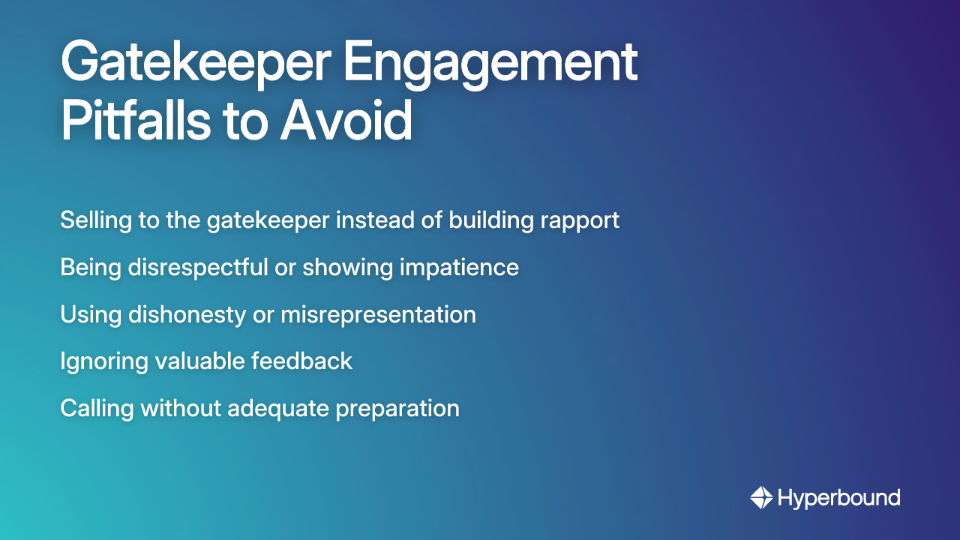
Identifying and correcting these common mistakes requires self-awareness and targeted coaching. This is where analyzing real call interactions becomes invaluable. By reviewing call recordings, managers and reps can pinpoint specific moments where conversations went off-track and develop targeted strategies for improvement. This data-driven approach transforms mistakes from failures into powerful learning opportunities.
The most successful B2B sales professionals don't see gatekeeper interactions as one-time obstacles to overcome but as opportunities to build lasting relationships. When you consistently demonstrate respect and add value, gatekeepers become advocates who might proactively mention to decision makers, "You should talk to this person—they seem to really understand our challenges."
For print media and marketing services sales, this approach is particularly valuable. As one industry veteran shared, "I've had gatekeepers call me directly when new projects come up because I took the time to build a relationship with them rather than just trying to get past them."

The most effective way to "get past" gatekeepers isn't to bypass them at all—it's to collaborate with them. By shifting your mindset from seeing gatekeepers as obstacles to recognizing them as valuable allies, you transform a common sales challenge into a competitive advantage.
Remember that gatekeepers have significant influence within their organizations. When you build genuine relationships based on respect, provide real value in every interaction, and demonstrate professionalism, you don't just reach decision makers once—you establish a reliable pathway for ongoing communication.
The next time you hear that familiar gatekeeper greeting, don't sigh in frustration. Instead, see it as an opportunity to showcase your relationship building skills and turn a potential barrier into a bridge that leads directly to your next successful B2B sale.
The best way to handle a gatekeeper is to shift your mindset from "getting past" them to collaborating with them. Treat them as a valuable part of the organization by being respectful, honest, and direct. Engaging them as an ally, rather than an obstacle, builds trust and can turn them into an internal advocate for you and your solution.
Building rapport with a gatekeeper is crucial because they hold significant influence and valuable information. A strong relationship can provide you with insights into the decision maker's schedule, company priorities, and internal politics. Over time, a gatekeeper who trusts you is more likely to help you connect with the right person and may even champion your cause when new projects arise.
When a gatekeeper asks about the purpose of your call, you should provide a clear, confident, and concise value statement, not a sales pitch. Be honest and focus on the potential benefit to their company. For example: "I'd like to speak with Mr. Davis about how we've helped companies similar to yours improve their response rates on direct mail campaigns by 35%."
The biggest mistakes include selling to the gatekeeper instead of building a relationship, showing impatience or disrespect, being dishonest about the call's purpose, ignoring the gatekeeper's feedback, and calling without doing any research on the company or decision maker. These actions quickly destroy trust and ensure you won't get through.
To increase your chances of reaching a decision maker directly, try calling during off-peak hours when the gatekeeper may not be at their desk. This typically includes early mornings before 8:30 AM or late afternoons after 5:00 PM. Decision makers are often the first to arrive and the last to leave, so they may answer their own phones during these times.







Use Cases
Legal