
Frontline managers are asked to coach behavior change while forecasting a number and running their own deals. The core problem is time allocation rather than motivation. Most of what is called coaching is chasing: checking who completed an assignment, reminding a rep to update a field, restating a rollout that enablement already sent. Chasing is the first activity cut when the calendar fills, and it does not produce behavior change. The conversation that does produce change, in which a manager works with a rep to determine why the same objection continues to sink the same type of deal, is the conversation managers have the least time for. Time allocation, not another reinforcement rollout, is the primary lever.
The mandate on frontline managers is real and not unreasonable. Enablement ships a new methodology, a new battlecard, or a new pricing motion and asks managers to ensure it takes hold in the field. Nearly half of sales managers spend under 30 minutes a week coaching each rep, even though coaching is widely described as the highest-impact activity a manager can perform. The gap between the time coaching warrants and the time it receives is the central reason reinforcement fails, and the problem is time allocation rather than motivation. Managers do not skip coaching because they undervalue it; the hours are already spent on forecast calls, pipeline reviews, and their own accounts, and reinforcement is the item with no deadline attached.
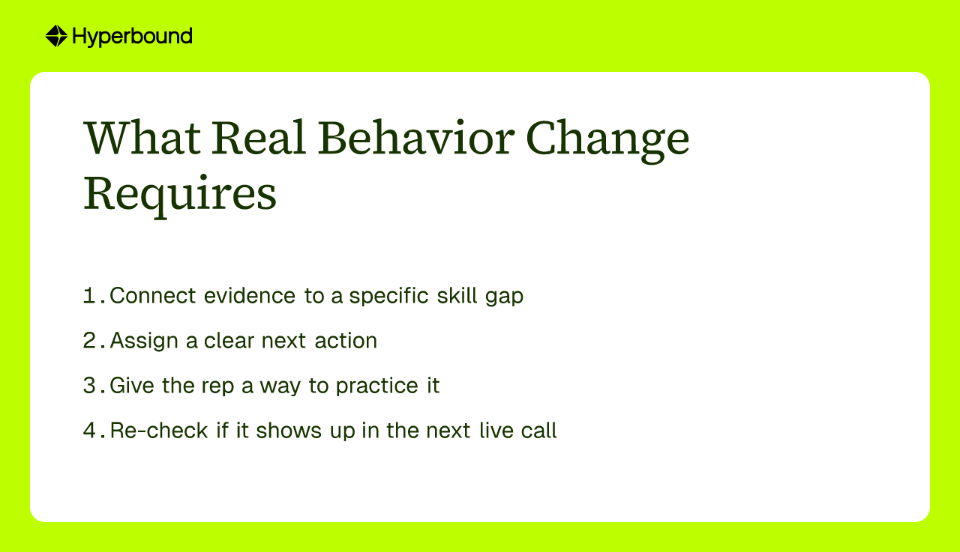
Every coaching technique that changes behavior does the same four things: connects a piece of evidence to a specific skill, assigns a clear next action, gives the rep a way to practice that action, and checks whether the action appears in the next live call. A transcript or call-scoring dashboard describes what happened. It does not connect that description to a skill gap, a next action, or a follow-up measure, and that connection is where coaching either occurs or does not. The evidence chain that separates coaching from activity is direct: the targeted behavior changes, that behavior appears in a live call, and the outcome metric moves in the expected direction. A technique that terminates before the outcome metric, at a completion checkbox or a satisfied nod in a one-on-one, is not coaching. It is documentation of intent.
The sorting test follows from that mechanism. A technique that produces observable, scoreable behavior change in the next batch of real calls belongs in the coaching category. A technique that produces only a completed activity, a reviewed transcript, a signed-off checklist, or a delivered speech belongs in the busywork category, however much time it consumes. Behavior-based rubrics make this test concrete: instead of scoring a call on a vague impression such as good rapport, a rubric checks for specific observable actions, including an opened call with an agenda, three open-ended discovery questions, a confirmed statement of pain, impact, and priority, and a secured next step. Rubrics built this way also reduce manager-specific bias, such as the favorite-rep effect and the recency effect that lead two managers to grade the same call differently. That consistency is the reason reps trust the feedback enough to act on it, which is a precondition for changing behavior.
The feedback sandwich, the motivational speech before a major push, and the exhaustive call critique that walks through every minute of a recording are one-directional. They deliver a verdict or a speech and stop there, leaving the evidence unconnected to a next action, a practice loop, or a follow-up measure. A rep can hear a critique, agree with every point, and still make the identical mistake on the next call, because nothing in the exchange requires the rep to rehearse the correction before the next real conversation. Telling techniques are often treated as coaching because they consume a manager's time and produce visible activity, such as a documented one-on-one or a completed review. They fail the behavior-change test because the loop never closes. Manager diagnostic judgment is irreplaceable in this context: the reason a rep keeps missing a particular pattern is not always the same. It can be a missing skill, an unclear expectation, a confidence problem, or thin preparation. A system can flag that the miss occurred, but only a manager with context on that rep and that account can attribute it to the correct cause and choose the next move. That diagnosis is the high-value conversation, and it is high-value because it cannot be automated away.
Academic research on sales manager time allocation has directly examined how the split between selling, managing, and coaching activities affects team performance, which is the appropriate question before recommending more hours on either side of that split. Formal coaching produces lift only when it clears the behavior-change bar: evidence connected to a skill, a next action, a practice rep, and a re-check against a live call. Formal coaching that stops at a documented review, however rigorously scheduled, does not clear that bar simply because it appeared on a calendar. The counter-argument that managers are already stretched is correct as stated. The response is to ensure the hours a manager spends land on the diagnostic conversation rather than on the search for something to diagnose.
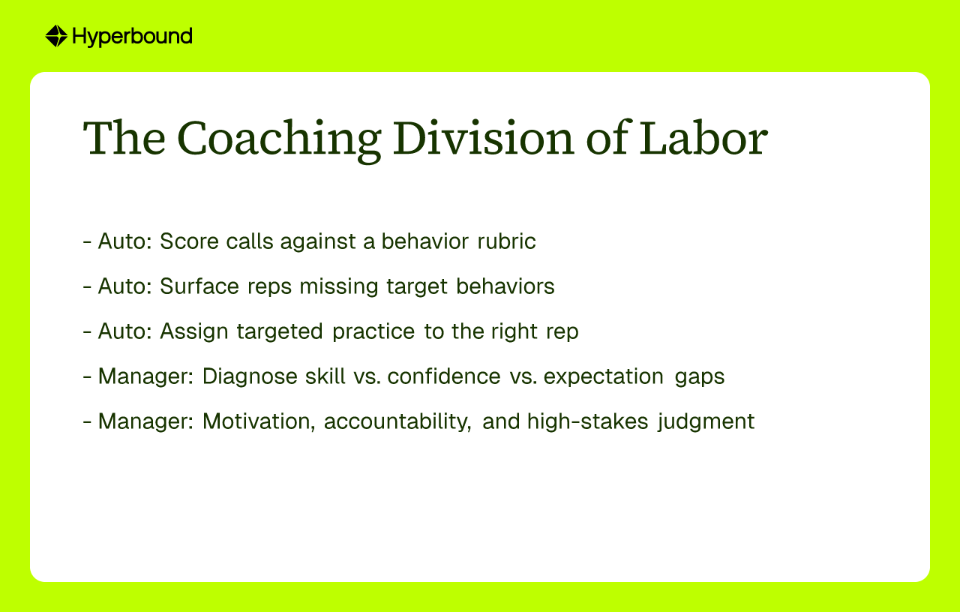
The clearest way to see the division of labor is side by side.
Can be made automaticRequires the managerScoring a call against a behavior rubricDeciding whether a miss is a skill gap, an expectation gap, or a confidence gapSurfacing which reps have not yet shown a target behavior in a real callMotivation, confidence, and accountability conversationsAssigning a practice rep tied to the exact call and deal a rep just missedJudgment calls on strategic or high-stakes accountsDetecting patterns across thousands of calls no manager could review manuallyBehavior that never shows up in recorded activity at allRemoving manager-to-manager scoring biasComp, promotion, and performance decisions
Software creates coverage; the manager creates commitment. The reinforcement mandate on managers is misdesigned rather than mistargeted: enablement has been asking managers to do the coverage work, such as checking who practiced and chasing who has not, when coverage is the part a system should own.
Accounts running Hyperbound show a consistent pattern. Klaviyo used Hyperbound to scale coaching beyond manager availability and reported a 42% increase in new-hire PPR. Staff Domain saw a 300% increase in meetings. Vanta cut ramp time by 60% and grew pipeline 5x. ALKU cut time to first deal from six months to three months. The common thread is the same loop: score real calls, identify the gap, assign targeted practice, and re-check against live outcomes, without requiring a manager to drive it step by step.

For enablement leaders sizing a rollout, the decision is where manager time goes. Every new initiative, methodology refresh, or launch reinforcement requires manager time, and the relevant question is where the manager's time on that rollout goes: to observation, such as watching who completed the assignment, or to diagnosis, such as determining why a specific rep still cannot execute a specific behavior on a live call. Conversation intelligence tools solved half of the problem by making calls visible at scale, but visibility alone leaves the connecting step, matching a real call to a practice assignment and re-checking it, with the rep or the manager. Roleplay tools solved the other half by generating practice, but without a view into what happened on a real call, that practice is generic rather than targeted. An initiative-based approach closes the circuit directly: a rep's real call is scored against the behavior enablement is reinforcing, a rep who misses that behavior receives a practice rep built from that exact call, deal, and stakeholder rather than a library scenario, and the next eligible call re-scores the same criterion without requiring a manager or the rep to connect the two manually, a loop that passes through targeted practice against the exact gap. At the end of the initiative, enablement has a record of who changed behavior and the calls that prove it, rather than a completion rate showing who clicked through a module. This does not remove the manager's coaching conversation; it removes the chasing that consumed the manager's week before that conversation occurred.
Because chasing does not change behavior, the better response is a redesign of what is asked of a manager's calendar: automate observation, scoring, and practice assignment, and protect the manager's remaining hours for the one conversation a system cannot run, where a manager decides whether a rep needs a new skill, a clearer expectation, more confidence, or better preparation. Sales leaders and enablement teams sizing a rollout should ask one question before adding it to a manager's workload: does this require the manager's judgment, or does it require someone to notice an event and remind someone else? The second type of work belongs to a system, not a calendar. Managers carrying a number have grounds to push back on any reinforcement request that turns out to be the second type. For a closer look at how the loop between real calls and targeted practice runs without a manager driving each step, see how Hyperbound Perform turns live deal activity into a coaching loop and the Agentic Enablement approach to closing the gap between certification and field behavior.

Chasing is activity tracking: checking who did the assignment, reminding reps to update fields, and restating rollouts. Sales coaching, by contrast, connects evidence from a live call to a specific skill gap, assigns a clear next action, and re-checks that action on the next call. Chasing consumes manager time without closing the behavior loop; coaching changes observable behavior in real calls.
Effective sales coaching moves through four connected steps: connect evidence to a skill gap, assign a clear next action, give the rep a way to practice that action, and re-check whether the behavior appears in the next live call. If a coaching technique stops before the outcome metric, at a completion checkbox or a satisfied nod, it is documentation of intent rather than behavior change.
A coaching moment requires the manager's presence when the underlying issue involves motivation, confidence, strategic account judgment, or a comp and promotion decision that recorded activity cannot capture. If the miss is a specific, observable behavior that a rubric can score, the coverage work can run without the manager watching for it directly.
Treat it as a diagnosis problem rather than an execution problem. The call can score well against a behavior rubric while the real issue is targeting or qualification, which only a manager reviewing the account and the rep's pipeline judgment can identify and correct.
Coaching variability traces back to inconsistent scoring criteria rather than inconsistent effort. Managers who grade calls against a vague impression rather than a shared, behavior-based rubric reach different conclusions about the same call. Standardizing what gets scored, not just how often coaching occurs, is a precondition for any measurable lift.
No. Removing chasing increases the time managers spend on relationship-building diagnostic conversations, which are the source of trust and performance improvement. Chasing was not the part of the job that built the relationship; automating observation and practice assignment protects more time for the conversations that do.
Automate the observation, scoring, and practice assignment work that a system can do, and protect the remaining calendar time for diagnosis and accountability conversations. This reallocates the coaching hours a manager already has rather than adding new ones, so the manager spends time on the high-value conversation instead of the search for something to diagnose.
Conversation intelligence makes real calls visible at scale, while roleplay tools create practice opportunities; the connection between them is the missing element. An initiatives-based approach scores a real call against a target behavior, assigns a practice rep built from that exact call, deal, and stakeholder, and re-scores the next eligible call automatically, closing the loop without manager chasing.










Use Cases
Legal