
You're mid-conversation when it happens—that dreaded awkward silence. Your mind races for something to say, but it's completely blank. The pressure mounts as seconds tick by, your anxiety spikes, and you're left wondering why something as natural as conversation feels so impossibly difficult.
If this sounds familiar, you're not alone. Many people with perfectly healthy social skills struggle with maintaining engaging conversations, particularly those dealing with anxiety disorders or other mental health challenges. The good news? Asking effective follow-up questions isn't an innate talent—it's a learnable skill with specific formulas anyone can master.
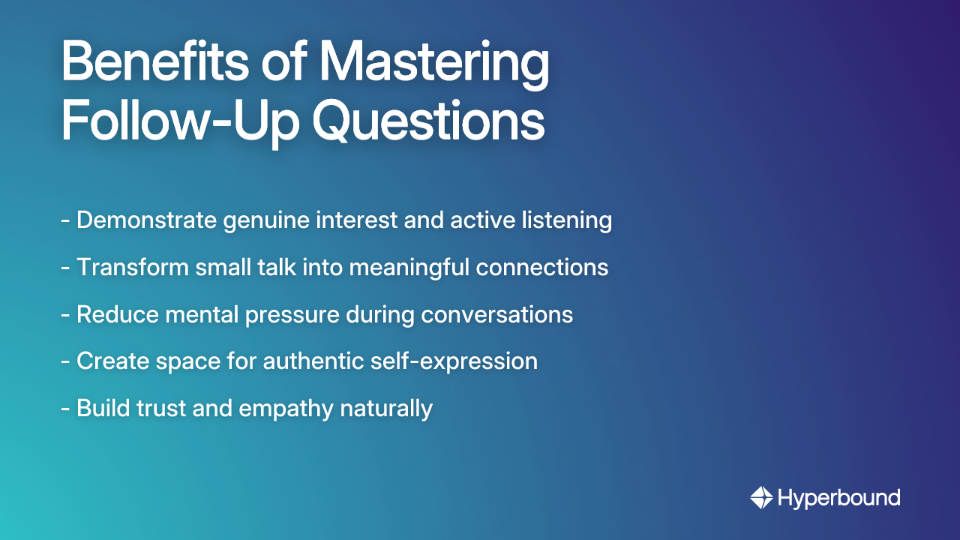
Follow-up questions are inquiries that build upon what someone has just shared. They dig deeper into a subject, clarify points, or explore new aspects of the conversation. But they're far more than just conversation fillers:
As one Reddit user noted, "If you were genuinely interested... then you can relate to them." This highlights a crucial truth: meaningful conversation isn't about clever tactics—it's about making a genuine investment in others.
Let's dive into two powerful frameworks that will ensure you never run out of things to ask.
This three-part sequence helps you explore any topic from multiple angles:
This formula works because it naturally progresses from understanding the past and present (Why and How) to imagining future possibilities (What If).
This chronological framework gives you three distinct avenues for questions:
This framework is particularly valuable because it helps you understand the complete arc of someone's experience with a topic.

For those who want to master the art of inquiry more deeply, the "QUESTIONS" framework provides a comprehensive approach:
This framework, developed by Shaleen Agarwal, goes beyond basic conversation to help you develop true mastery in the art of questioning.
Sometimes having specific examples is the best way to build confidence. Here are questions you can adapt to virtually any conversation:
.png)
These questions work because they invite elaboration rather than yes/no answers, demonstrate genuine interest, and create opportunities for emotional connection.
Even with great frameworks, certain pitfalls can derail your conversations. Here are the most common mistakes to avoid:
Understanding frameworks is one thing; applying them in real conversations—especially when dealing with social anxiety or mental health challenges—is another. Here's how to bridge that gap:
The foundation of good questions is good listening. When your attention is focused on truly understanding the other person rather than planning what to say next, follow-up questions emerge naturally.
Initial exchange: "I just got back from a trip to Colorado."
Level 1 response (basic acknowledgment):"That's cool."
Level 2 response (using Past, Present, Future framework):"What made you choose Colorado for your trip?" (Past)"What was the highlight of your time there?" (Present)"Would you go back, or where are you thinking of traveling next?" (Future)
Level 3 response (using Why, How, What If framework):"What drew you to Colorado specifically?" (Why)"How did you plan your itinerary there?" (How)"If you could spend a month anywhere in the world, where would you go?" (What If)
Notice how the Level 2 and 3 responses create multiple pathways for meaningful conversation.
For many, the fear of saying the wrong thing in a live conversation is a major hurdle. This is where technology can provide a safe space to practice without pressure. AI-powered platforms like Hyperbound allow you to engage in realistic roleplay scenarios, whether you're a sales professional preparing for a client call or simply someone looking to improve their conversational fluency. Practicing with an AI persona helps build muscle memory for these questioning frameworks, making them feel more natural when you need them most.
For many, the biggest barrier to asking good questions isn't knowledge—it's anxiety. Here are strategies specifically for those dealing with anxiety disorders or mental health challenges:
Many people wrongly believe that spontaneity in conversation requires some special talent, when in reality, it's about having reliable frameworks and managing anxiety. As one Reddit user shared, "Focus on active listening and find common ground to help guide your conversation naturally."
The ability to ask thoughtful follow-up questions isn't just a social skill—it's an expression of empathy and an investment in others. By using these simple formulas, you transform conversations from potential sources of anxiety into opportunities for genuine connection.
Remember that mastering this skill takes practice. Start with one framework from this article and try it in your next conversation. Notice how it feels to approach interaction with curiosity rather than fear. With time, you'll find that you're not just avoiding awkward silences—you're creating meaningful connections that enrich your life and the lives of those around you.
The most beautiful part? These frameworks aren't simplistic solutions that ignore the complexity of human interaction or the real challenges of anxiety and mental health. Instead, they're practical tools that acknowledge those emotional burdens while providing concrete ways to move through them toward authentic connection.
Your next great conversation is just one good question away.
Follow-up questions are inquiries that build upon what someone has just shared, and they are crucial for transforming basic small talk into meaningful conversations. By asking them, you demonstrate genuine interest, create a deeper connection, reduce your own mental pressure to think of new topics, and build trust and empathy with the other person.
To avoid sounding like you're interrogating someone, focus on your tone and intent. The key is to be genuinely curious, not just firing off questions. Mix questions with your own related thoughts and experiences. Active listening is essential—listen to understand, not just to find your next opportunity to ask a question. This makes the conversation a balanced, two-way exchange rather than an interview.
It's completely normal to forget formulas, especially when you're feeling anxious. If your mind goes blank, fall back on the simplest approach: curiosity. A simple, "Can you tell me more about that?" or "What was that like for you?" works in almost any situation. The goal isn't to perfectly execute a framework but to show you're engaged and interested.
A short answer doesn't have to be a dead end. First, consider if the question was closed-ended (a "yes/no" question) and try rephrasing it to be more open-ended. If they still give a brief reply, you can share a brief, related thought of your own to see if it encourages them to elaborate. If not, they may not want to discuss that topic, so it's okay to gracefully switch to a new subject.
The "Past, Present, Future" framework is often the easiest and most natural for beginners. It provides a simple chronological structure that helps you explore someone's experience with a topic from its beginning, through their current situation, to their future aspirations. This logical flow makes it intuitive to remember and apply in real-time conversations.











Use Cases
Legal