How to Write a Follow-Up Email After a Discovery Call (With Real Examples, Not Templates)
7
min read

7
min read
The follow-up email after a discovery call is the point at which most sales conversations either advance or stop. A discovery call can end with clear pain points and agreed next steps, yet the subsequent email often receives no response.
The issue is rarely persistence; it is purpose. A follow-up that only announces itself gives the prospect no reason to reply. According to research from The Small Business Expo, 80% of sales require five or more follow-ups, yet most sales representatives stop after one or two. Successful follow-up depends on knowing what to say.
This article provides sales teams with a concrete framework and fully written examples for every stage of the post-call sequence, rather than fill-in-the-blank templates or placeholder text.
Effective sales teams require every follow-up to provide new value, not function as a reminder or a bump.
Salesforce research shows that 87% of business buyers expect sales representatives to act as trusted advisors. That expectation does not pause between meetings. A follow-up that only asks for a reply positions the representative as a vendor chasing a deal. A follow-up that includes a relevant resource, a clear recap, or a specific next step positions the representative as engaged. The adjustment is minor in execution and significant in outcome.
Response speed is a material qualification factor. Slashit reports that companies that respond within the first hour of a discovery call are seven times more likely to qualify the lead than those that respond one hour later, and a 24-hour delay makes it 60 times less likely.
The primary barrier is memory. Details fade quickly, so two immediate post-call steps protect accuracy.
Step 1: Record a 90-second voice memo.
Before opening a laptop, record a brief voice memo covering the prospect's key pain points in their exact phrasing, stated goals and timeline, other stakeholders mentioned, and the specific next steps agreed upon during the call. Prospeo identifies this as one of the most reliable techniques for capturing the nuance that makes follow-up communication personal rather than generic.
Step 2: Find one relevant resource.
Based on the memo, identify a single piece of content directly relevant to the prospect's situation: a case study, a short article, or a data point. One targeted resource performs better than several generic resources. Woodpecker notes that overloading a follow-up email with links reduces impact rather than increasing it.
Prospeo recommends sending the initial follow-up within two hours of the call, keeping the email between 50 and 125 words, and crafting subject lines between 41 and 60 characters. The goal is readability on a mobile screen without scrolling.
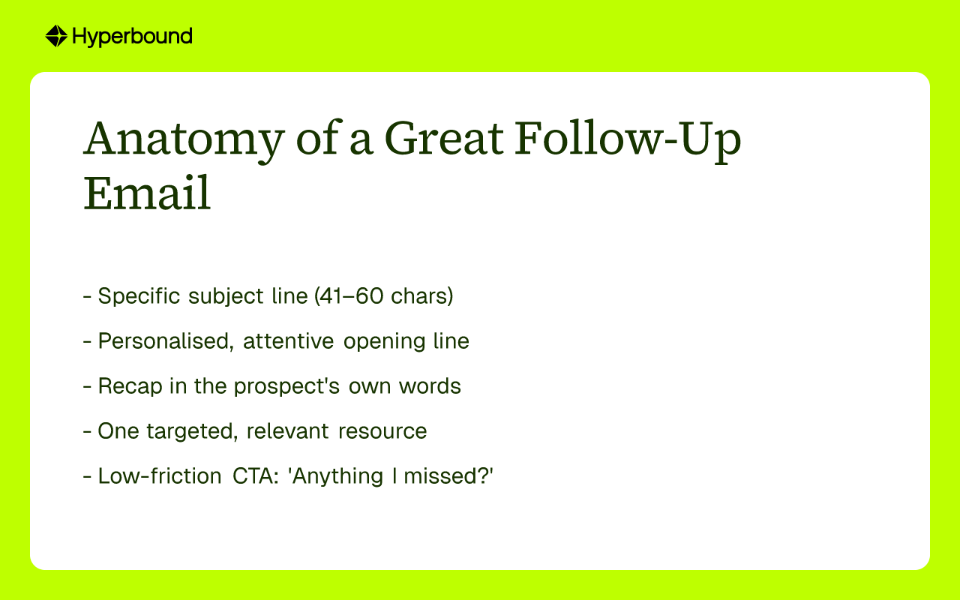
Subject line: Subject lines should be specific. Generic subjects such as "Following up" or "Checking in" are deleted without being opened. Effective subject lines reference something concrete from the call.
Recap + next steps for Acme CorpCutting your 6-week onboarding - next stepsNext steps: [Company] + onboarding timelineOpening line: Opening lines should be specific. "Thanks for your time" does not signal attention. "Thanks for walking me through your team's current lead assignment process today" demonstrates that the representative was attentive.
Recap section: Use the prospect's own words. If they said their team is "drowning in manual data entry," that phrase belongs in the recap. It demonstrates active listening and builds trust faster than any polished summary.
Call to action: Avoid passive closings such as "Let me know your thoughts." The most effective closing question identified by Prospeo is "Anything I missed?" It is low-friction, invites collaboration, and is easy to answer.
Subject: Recap + next steps for Globex Corp
Hi Jane,
Thanks for walking me through your team's current lead management process today.
Our demo to show you how to automate lead assignment is confirmed for Thursday, October 26th at 10 AM EST.
Here is a quick recap of what I heard:
I have attached a short case study showing how we helped a similar SaaS company achieve a five-minute lead response time.
Anything I missed?
Best,Sarah
Why this works:
The subject line names the company and signals forward motion. The confirmed meeting date appears in the second line rather than at the end. The recap uses the prospect's framing rather than the representative's. The case study is singular and specific to the stated pain. The closing question invites correction rather than demanding a decision.
This applies when the call ended without a confirmed meeting or a clear commitment. The goal is re-engagement through relevance rather than pressure.
Subject: Cutting your 6-week onboarding - next steps
Hi Mark,
Thanks for the conversation today about shortening the onboarding timeline for new clients.
From what you described, the core bottleneck is the manual back-and-forth required to collect client data before setup can begin.
This article on automating client data collection is directly relevant to what you are working through: [Link to article].
If this is still a priority, I have a few slots open next week for a 15-minute call to walk through a potential approach. Does Tuesday or Thursday work?
Best,Sarah
Why this works:
The subject line references the prospect's specific problem, not the rep's process. The recap is one sentence and uses the prospect's own framing. The resource is singular and contextualised. The call to action offers two concrete options rather than an open-ended request.
Prospect silence after a substantive discovery call is a common sales challenge. Sales teams often stop outreach after two or three attempts to avoid appearing persistent. Outreach data does not support that practice.
The Small Business Expo identifies Tuesday, Wednesday, and Thursday mornings between 9 AM and 11 AM local time as the highest-response windows for follow-up emails. Timing and sequencing both matter.
A four-touch cadence built on the value-first principle follows:
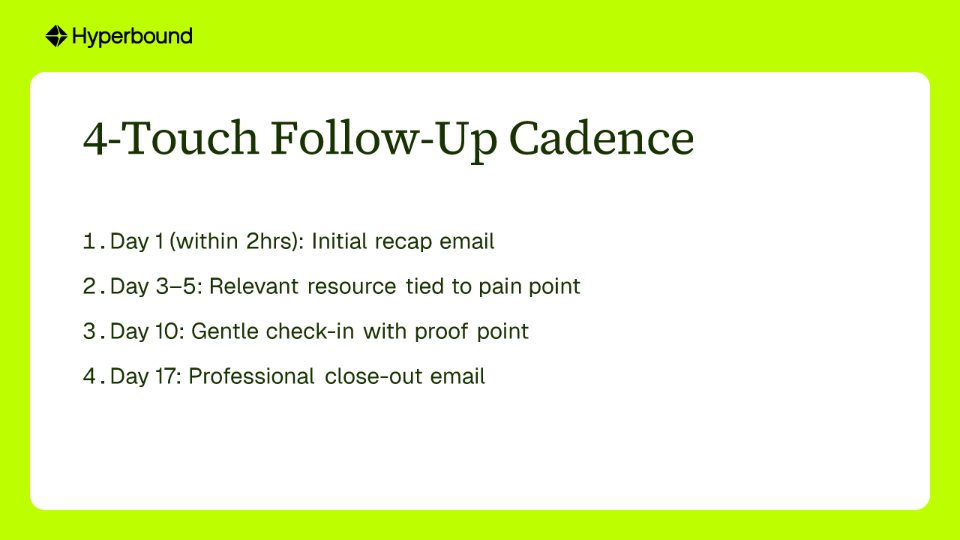
Day 1, within 2 hours of the call: Send the initial recap email as detailed above.
Day 3 to 5: Send a different, relevant resource tied to a specific pain point from the call.
Subject: A resource for [Company Name]
Body: Hi [Name], following up on our conversation. This piece on [specific topic] is directly relevant to the challenge you mentioned around [pain point]. Hope it is useful. Happy to answer any questions.
Day 10: A gentle check-in with a concrete proof point.
Subject: Quick question re: [Project Name]
Body: Hi [Name], just checking in on the next steps we discussed. We recently helped [Client] reduce [specific metric], which reminded me of what you are working toward. Still worth a quick call?
Day 17: The close-out email.
Subject: Closing the file on [Project Name]?
Body: Hi [Name], I have not heard back since our call, so I am assuming priorities have shifted. I will close out your file for now to avoid cluttering your inbox. If [specific pain point] becomes a focus again, do not hesitate to reach out.
The final email functions as a professional close rather than a pressure tactic. It provides a clean exit and consistently generates replies from prospects who had not previously responded.

When the deal involves multiple stakeholders or a longer evaluation cycle, attaching a Mutual Action Plan (MAP) to the initial follow-up email increases accountability on both sides. A MAP outlines agreed milestones, owner assignments, and target dates. Prospeo cites research showing that including a MAP can increase win rates by 26%. The plan removes ambiguity about next steps and indicates that the representative manages a defined process rather than waiting for a reply.
The difference is precision. Generic follow-ups use the prospect's company name as personalisation. Effective follow-ups use the prospect's exact words to describe the problem, reference a specific timeline mentioned during the call, and attach one resource selected for that problem rather than for general interest.
A discovery call is designed to capture the prospect's situation in enough detail to make the relationship useful. The follow-up email after a sales call puts that detail to work. Every element, from the subject line to the closing question, should reflect something the prospect stated during the call.
When every element reflects the prospect's stated situation, the email functions as a continuation of the conversation rather than a follow-up. That precision earns the reply.

Send the first follow-up email within two hours of the call, and ideally within the first hour. Response speed has a direct impact on lead qualification. Companies that respond within the first hour are seven times more likely to qualify the lead than those that wait longer, while a 24-hour delay makes it 60 times less likely.
A strong follow-up email includes a specific subject line, a personalized opening, a short recap using the prospect’s own words, one targeted resource, and a low-friction call to action such as “Anything I missed?” Each element should trace back to something the prospect stated during the call.
Use a specific detail from the conversation and keep the subject line between 41 and 60 characters. Avoid generic phrases like “Following up” or “Checking in.” Effective examples include “Recap + next steps for Acme Corp” and “Cutting your 6-week onboarding - next steps.”
Plan for at least four value-first touches. Research shows that 80% of sales require five or more follow-ups, yet most reps stop after one or two. A practical cadence includes an initial recap within two hours, a relevant resource on days three to five, a gentle check-in on day ten, and a professional close-out on day seventeen.
Tuesday, Wednesday, and Thursday mornings between 9 AM and 11 AM local time are the highest-response windows for follow-up emails. Sending within these windows improves open and reply rates compared with late afternoons, weekends, or Monday mornings when inboxes are busier.
Prospects go quiet when the follow-up does not give them a clear reason to reply. Emails that only announce themselves as a follow-up or use generic check-ins are easy to ignore. Adding new value, referencing a specific pain point, and offering a low-friction next step makes a reply more likely.
A Mutual Action Plan is a shared document that outlines agreed milestones, owners, and target dates after a discovery call. It is especially useful for complex deals with multiple stakeholders. Adding a MAP to a follow-up email removes ambiguity about next steps and can increase win rates by 26%.
Send a concise value-add email that references the prospect’s core bottleneck and includes one relevant resource. Then offer two specific options for a short next conversation, such as “Does Tuesday or Thursday work?” This keeps the focus on the prospect’s problem rather than on chasing a meeting.










Use Cases
Legal