You've been there before. The sales manager announces it's time for "role-play practice," and a collective groan ripples through the room. If the phrase "sales role-play" makes you cringe, you're not alone.
For many sales reps, role-playing feels like "performance theater for middle managers" without real-world relevance. As one frustrated sales rep put it: "If I could act well enough for role play to be effective, I'd be doing that instead of sales."
But here's the truth: The problem isn't role-play itself—it's how most companies implement it. When done right, role-playing isn't about acting; it's about creating realistic simulations that build specific skills and confidence.
This article breaks down why traditional sales role-play fails and provides a blueprint to transform these sessions from awkward, ineffective exercises into powerful training tools your team will actually value.
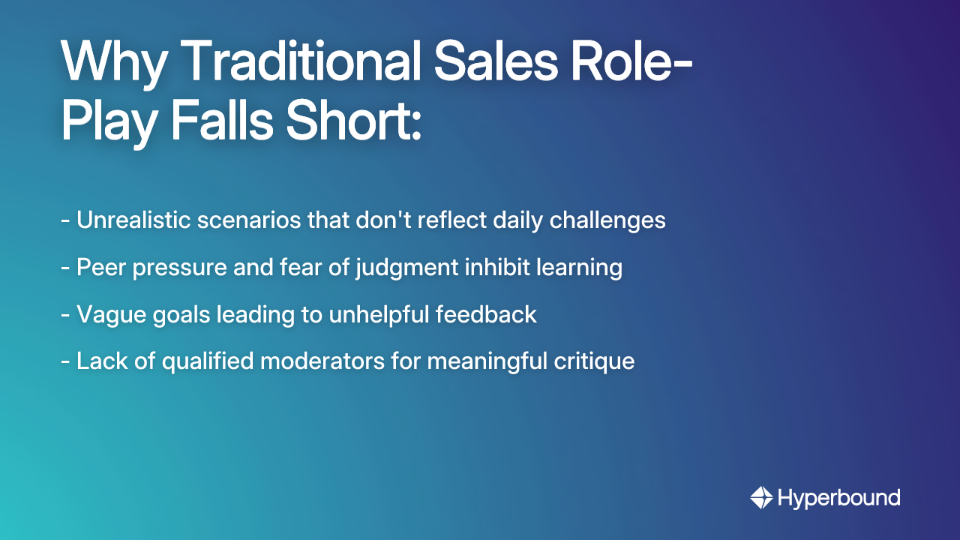
The number one reason role-plays fail is a lack of realism. Your sales reps disengage when scenarios don't reflect their daily challenges.
As one sales rep candidly shared: "You can't recreate a live customer meeting because there's so many factors that go into how a conversation goes."
Common scenario failures include:
When role-plays feel artificial, they become what many reps describe as "busywork" rather than valuable training.
Even well-designed role-plays can fail when they ignore the human element of peer awkwardness and fear of judgment.
Reps feel self-conscious performing in front of colleagues, which hinders their ability to take risks and learn. Without psychological safety—an environment where team members feel safe to be vulnerable without fear of negative consequences—training feels punitive rather than educational.
"It always feels like everyone is just trying to memorize their lines and not embarrass themselves," explains one sales professional. This performance anxiety transforms what should be a learning opportunity into a stressful evaluation. This is where modern tools can help. For instance, AI role-play platforms like Hyperbound provide a private, judgment-free space for reps to practice without fear of peer critique.
Many role-plays are doomed from the start because they lack specific objectives and structured feedback mechanisms.
When sessions have no clear goals, reps don't know what success looks like, and the exercise feels pointless. This leads to vague, unhelpful feedback that reps hate: "Most of the feedback given is vague and unhelpful. You hear things like 'you need to work on closing,' but no one explains how."
The problem is compounded by a lack of qualified moderators who can provide meaningful, specific critiques. Without expert guidance, role-plays become a case of the blind leading the blind. AI coaching platforms solve this by offering objective, data-driven feedback on every practice session, ensuring critiques are always targeted and actionable.
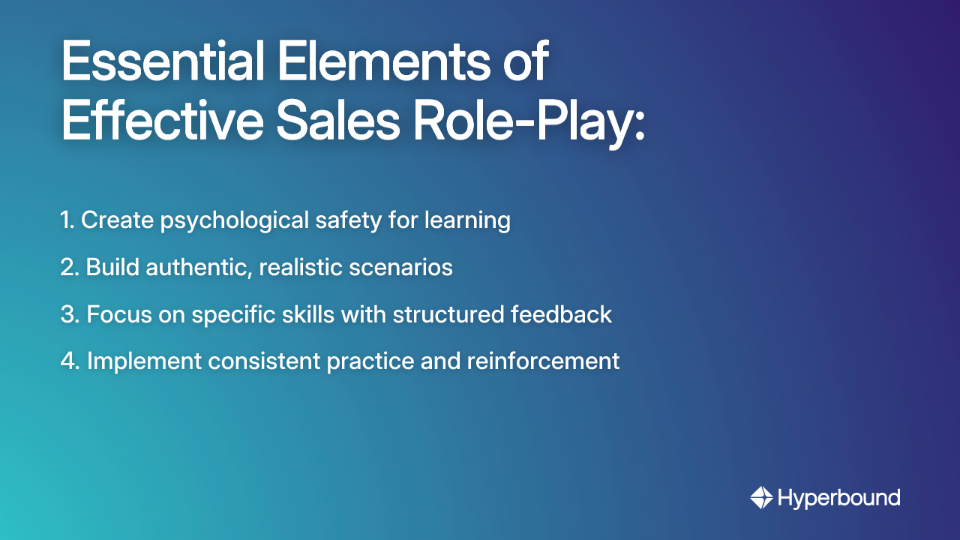
Before any role-play begins, set the stage for safety and learning:
The core of effective role-play is authenticity:
Transform role-play from a vague activity into a focused simulation for skill development:
Role-play shouldn't be a one-off "event." It must be an integrated part of your coaching culture:
Here are concrete examples that managers can implement immediately:
Discovery Call Scenario:
Objection Handling Scenario:
Closing Trial Scenario:
Different formats keep sessions engaging and effective:
Effective sales role-play isn't about acting—it's a structured simulation that builds real-world skills. By creating psychological safety, using authentic scenarios, focusing on specific skills, and providing structured feedback, you can transform role-playing from dreaded busywork into a powerful training tool. Leveraging AI-powered platforms can automate and scale these best practices across your entire team.
Remember: well-executed role-play is one of the most effective ways to build your sales team's competence, confidence, and collective cadence. When done right, it doesn't just prepare reps for customer conversations—it gives them the confidence to excel in them.
Most sales role-plays fail because they are built on unrealistic scenarios, create peer pressure, and lack clear goals. This combination makes them feel like awkward, ineffective "busywork" rather than valuable training. To be effective, role-plays must use authentic customer situations, foster a psychologically safe environment, and focus on developing specific, measurable skills.
The most important factor for effective sales role-play is psychological safety. Without a judgment-free environment where reps feel safe to make mistakes, they become too focused on "performing" for their peers and managers. When psychological safety is established, reps can be vulnerable, take risks, and genuinely learn from the experience.
To make role-play scenarios more realistic, base them on real customer data and interactions from your CRM or call recordings. Ditch generic scripts and instead use common objections, pain points, and challenges your team actually faces. Creating detailed customer personas with specific motivations also prevents the exercise from feeling artificial and ensures the practice is relevant.
A sales team should conduct role-play practice consistently, integrating short, focused sessions into their regular routine, such as weekly team meetings. This "spaced learning" approach is more effective than cramming training into a single event, as it reinforces skills over time, builds muscle memory, and makes practice a normal, less awkward part of the team's culture.
Using AI for sales role-play provides a private, scalable, and judgment-free space for reps to practice anytime, which eliminates peer pressure. AI platforms can also analyze real call data to create hyper-realistic scenarios and deliver instant, objective, data-driven feedback, ensuring critiques are always specific and actionable.
The success of a role-play session is measured by its focus on a specific, narrow goal. Define a clear objective beforehand, such as "mastering the 'it's too expensive' objection." Success is then determined by the rep's ability to apply the target skill or framework during the simulation, which can be assessed through structured peer feedback or automated scoring from an AI platform.
Managers can get sales reps to buy into role-playing by leading by example and proving its value. Start by performing the first mock call yourself to demonstrate vulnerability and set a non-judgmental tone. When you use realistic scenarios that solve reps' daily challenges and clearly state that the goal is skill development, not evaluation, they will see the exercises as a valuable use of their time.











Use Cases
Legal