You've just finished presenting your brilliant ideas to a room of colleagues or classmates. The content was solid, your research impeccable. Yet as people file out of the room, you catch fragments of feedback: "Good information, but a bit dry..." or worse, someone stifles a yawn and mutters something about your "robot voice."
If you've ever been told your speech sounds "really flat with no voice modulation or natural pauses" or that your delivery feels "dull and robotic," you're not alone. Many people struggle with monotone speech patterns that can undermine their message and disengage their listeners—no matter how valuable their ideas might be.
A monotone voice lacks variation in pitch, pace, and volume. It's the vocal equivalent of typing in all lowercase with no punctuation—technically readable, but missing the emotional cues and emphasis that make communication dynamic and engaging.
The good news? Voice modulation is a learnable skill, not an innate talent. With targeted practice and the right techniques, you can transform from flat to fascinating, from monotone to magnetic.
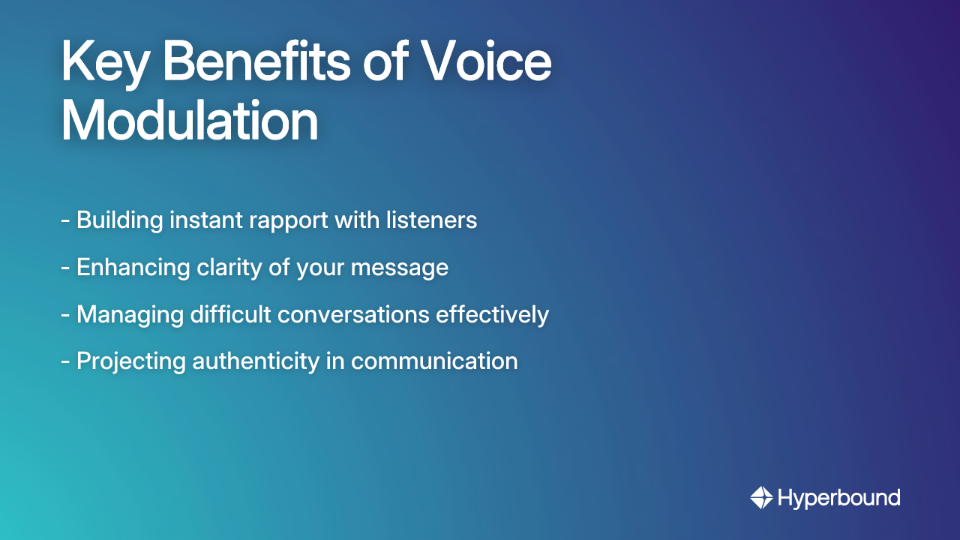
Voice modulation is the ability to adjust your pitch (high/low), tone (emotion), and volume during speech. When mastered, it becomes your secret weapon for:
As one Reddit user confessed, "I feel like it makes people lose interest when I'm presenting in class or talking to anyone." This common pain point highlights why mastering vocal expressiveness isn't just nice to have—it's essential for effective communication.
Before diving into specific modulation techniques, you need to prepare your vocal instrument. Tension in your body creates tension in your voice, limiting your expressive range.
Try these essential warm-ups before important speaking engagements:
These exercises might feel silly at first, but they're scientifically proven to release tension and expand your vocal capabilities. As one voice coach notes, "These warm-ups prepare the vocal mechanism for the demands of expressive speech, much like athletes warm up before competition."

Now that your voice is warmed up, it's time to tackle the core elements of expressiveness: pitch, pace, and pause.
Many monotone speakers use only a narrow band of their natural vocal range. These exercises help you explore and expand:
A truly dynamic approach to speech involves strategic variations in speed and strategic silences.
As noted by a leading communication expert, "The pause is one of the most underutilized yet powerful tools in speech. It gives the listener time to process, creates anticipation, and signals importance."
Take this sentence: "I didn't say she stole the money."
Say it seven times, each time stressing a different word. Notice how the entire meaning shifts based on which word you emphasize:
This exercise dramatically demonstrates how voice modulation changes meaning—not just delivery style.
Theory alone won't transform your speech. You need to apply these techniques in realistic scenarios.
One of the most effective techniques recommended by successful communicators is "shadowing"—closely mimicking expressive speakers.
As one Reddit user who overcame monotone speech shared: "Shadowing short clips from YouTube or Netflix helped me develop a rhythm and flow I couldn't find on my own." This technique builds muscle memory for expressiveness that gradually becomes natural.
Many monotone speakers hold back due to fear of sounding "too much." The solution? Practice in private with deliberate exaggeration.
As another Reddit user brilliantly suggests: "Practice over-emoting in private. Go nuts, pull faces, project your voice cartoonishly, speak in sing-song, Jim Carrey stuff. You'll sound goofy, but you need to train yourself to be more expressive."
This approach works because it:
Reading prose aloud "as if you were acting" is another powerful recommendation from those who've successfully overcome monotone speech. Choose dialogues with emotional content and try:
Your voice doesn't exist in isolation—it works in concert with your physical presence. Try these integration techniques:
Perhaps the most crucial tool for improvement is the recording device in your pocket. Regular recording and review creates the feedback loop essential for improvement:
For personalized feedback and interactive practice, modern tools and traditional methods can accelerate your progress:
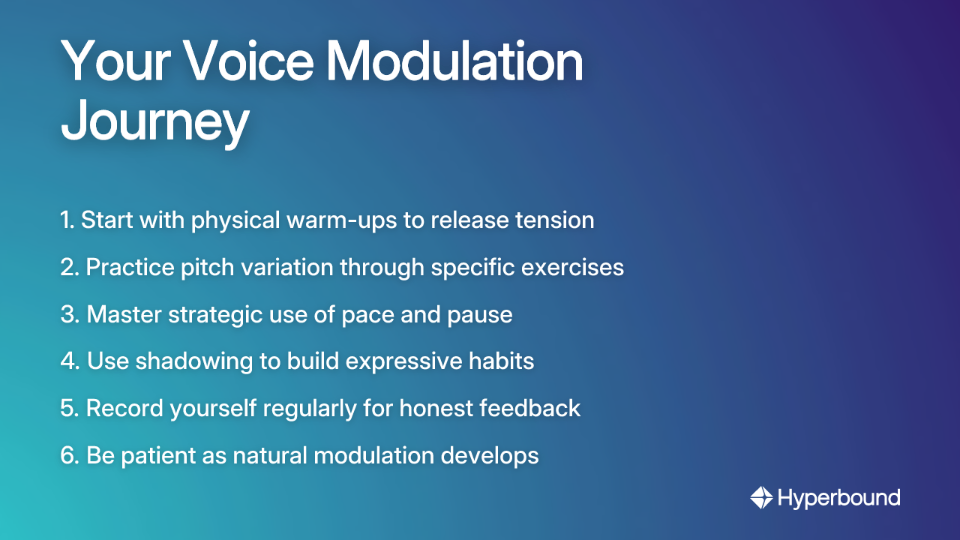
Overcoming monotone speech isn't an overnight transformation—it's a journey of consistent practice and gradual improvement. As you implement these techniques, remember:
With dedication to these practices, you'll develop a voice that engages, influences, and authentically expresses your ideas with all the color and depth they deserve. No more "robot voice"—just you, communicating with clarity, confidence, and the natural pizzazz that turns listeners into fans.
Your voice is your most portable tool for influencing others. By mastering voice modulation, you don't just fix a monotone delivery—you unlock your full potential as a communicator.
Voice modulation is the skill of varying your pitch, tone, and volume while speaking to make your communication more dynamic and engaging. It's important because a modulated voice helps capture and maintain listener interest, enhances the clarity of your message, builds rapport, and projects authenticity, preventing your ideas from being perceived as "dry" or "dull."
You can stop your voice from sounding monotone by consistently practicing specific vocal exercises to increase your expressive range. Key practices include physical warm-ups like lip trills and humming, exercises to expand your pitch range like the "sliding scale," and mastering the use of pace and strategic pauses. Techniques like shadowing engaging speakers and recording yourself for feedback are also highly effective.
The fastest way to improve voice modulation is through focused, consistent practice combining self-recording and a powerful technique called "shadowing." Shadowing involves mimicking short clips of expressive speakers to build muscle memory for vocal variety. For even faster, targeted feedback, using AI-powered coaching tools can accelerate your progress by providing instant analysis on your pitch, pace, and volume.
Yes, anyone can learn to modulate their voice. Voice modulation is a learnable skill, not an innate talent. While some people may be naturally more expressive, anyone can expand their vocal range and overcome a monotone delivery through targeted exercises, consistent practice, and releasing physical tension that restricts the voice.
Fixing a monotone voice is a gradual process, and the timeline varies for each individual. With consistent daily practice of about 15-20 minutes, you can start noticing improvements in your awareness and control within a few weeks. Achieving a naturally expressive delivery that feels authentic may take several months of dedicated effort. Consistency is more important than the duration of each practice session.
Before a presentation, you can perform several simple warm-ups to prepare your voice. These include deep diaphragmatic breathing to control airflow, gentle jaw massages to release tension, lip and tongue trills to increase flexibility, and humming to activate your vocal resonators for a richer sound. These exercises help ensure your voice is relaxed, flexible, and ready for expressive speech.










Use Cases
Legal