
Ask any sales rep what their coaching looks like, and you'll hear the same answers: "It's just a pipeline review," or "My manager rushes through our 1:1 to get to the next meeting," or the brutally honest "Coaching is usually just reacting to whatever deal is on fire that week."
These aren't just individual frustrations. They point to a structural problem hiding in plain sight across most B2B sales organizations.
When every manager coaches from their own playbook — their own instincts, their own sales philosophy, their own definition of "good" — your organization is running dozens of uncoordinated, untrackable experiments on its live pipeline. One manager prioritizes discovery questions. Another obsesses over talk time. A third barely reviews calls at all because they're stuck in senior leadership meetings all week. The result isn't just inconsistent coaching. It's inconsistent revenue.
The fix isn't hiring better managers or running another offsite training. It's treating coaching as an operational system, not a personal style. That requires a 3-part diagnostic:
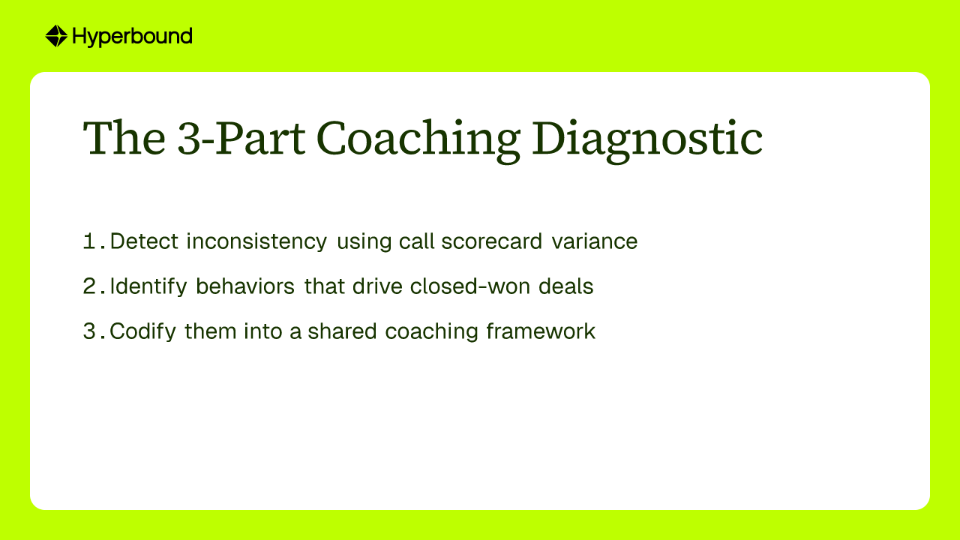
Let's break it down.
Most sales leaders assume their coaching is "good enough." The data says otherwise.
Only 19% of sales teams report having a consistent coaching schedule. Organizations that do invest in structured, consistent coaching processes see 28% higher win rates and 91% quota attainment — compared to 85% for teams without structure. That gap is expensive.
But before you can fix inconsistent sales coaching across teams, you need to measure it objectively. The tool for that is call scorecard variance.
A call scorecard is a standardized rubric that grades sales calls against defined criteria — things like discovery question quality, methodology adherence, objection handling, and whether the rep clearly identified next steps.
Here's the diagnostic test: deploy a single, standardized scorecard across all teams for 30 days, then analyze the average scores by manager — not by rep.
If Manager A's team is averaging 72/100 on discovery and Manager B's team is averaging 48/100, that's not a rep problem. That's a coaching standards problem. Manager A is coaching discovery; Manager B probably isn't even asking about it. You're now looking at concrete, objective evidence of inconsistent coaching — not a gut feeling.
The challenge is doing this at scale without drowning your managers in manual call reviews. Research shows that managers already spend only 5–8% of their time coaching — and manually reviewing calls is one of the primary reasons that number stays so low.
Hyperbound Perform solves this by automatically deploying AI scorecards on real sales calls, with auto-scorecard routing that matches the right rubric to the right meeting type — discovery calls get graded differently than demos, which get graded differently than closing conversations. The result is a continuous, objective picture of call quality and manager variance across your entire team, with zero manual review overhead.
Once you have scorecard data across teams, resist the temptation to immediately roll out blanket coaching. The next question isn't "who's underperforming?" — it's "what does 'good' actually look like in our specific context?"
This is where most organizations skip a critical step. They assume they know what top performers do differently. They usually don't.
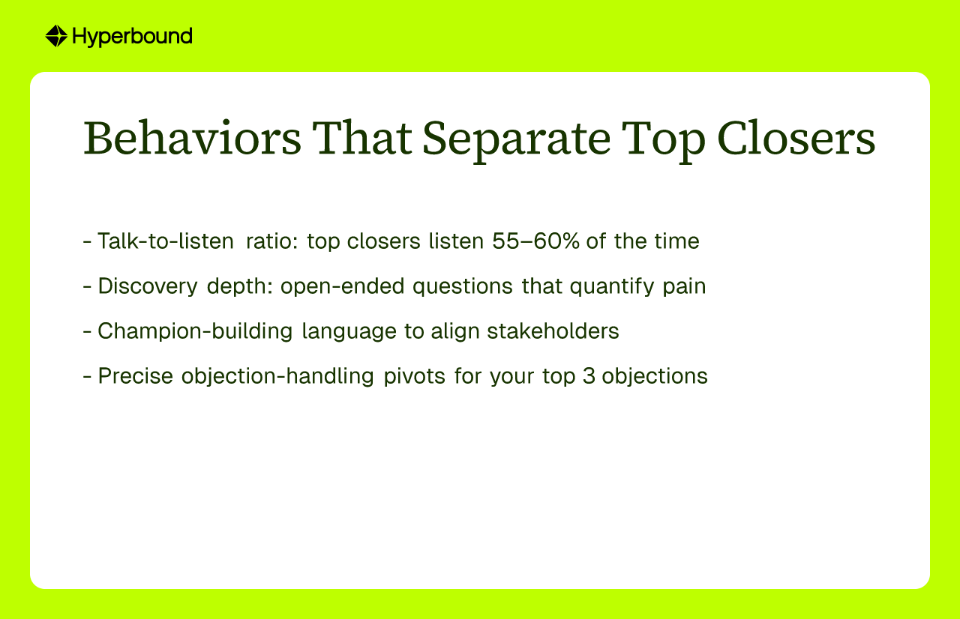
Pull your top 5–10% of reps — the ones consistently closing deals — and analyze their call patterns compared to median performers. You're looking for specific, repeatable behaviors that show up consistently in closed-won deals but are absent or weaker in closed-lost ones.
The point isn't to clone your top performers — it's to extract the transferable behaviors from their calls and turn those into standards, not suggestions.
Doing this manually across hundreds of calls is what makes pattern recognition feel impossible at scale. Hyperbound Perform's AI Deal Coaching analyzes patterns across all calls in a deal lifecycle — not just individual conversations in isolation — and surfaces what's helping or hurting based on your historical closed-won and closed-lost data. It's the difference between a manager's subjective opinion of what makes a great rep and an evidence-backed behavioral profile grounded in your actual pipeline.
You now know where the inconsistencies are (Part 1) and what winning behaviors look like in your organization (Part 2). The final step is the hardest: turning that insight into a durable, scalable coaching standard.
A shared coaching framework consolidates your winning behaviors into the single source of truth that every manager coaches against. This isn't a slide deck with aspirational advice. It includes:
The real barrier to this framework sticking isn't willpower. It's the forgetting curve — research consistently shows reps forget 80% of training content within 30 days unless it's reinforced through deliberate practice.
This is where Revenue Activation comes in. The framework needs to be practiced and reinforced continuously, not reviewed once in a kickoff meeting.
Hyperbound Practice gives reps a risk-free environment to rehearse the exact behaviors in your framework — from discovery call structure to objection handling — using AI buyer personas built from 2M+ hours of real B2B sales conversations. For tenured reps resistant to generic training, Bitesized Roleplays offer short, deal-specific practice scenarios they'll actually complete.
Hyperbound Perform then closes the loop: the same behaviors your reps practiced get scored on live calls, creating an objective before/after picture that connects training directly to deal outcomes.
And sitting above both is Kota Activate — the AI orchestration layer that replaces the guesswork of manager-dependent coaching with a data-driven standard. Available in Slack, Teams, or inside Hyperbound, Kota continuously analyzes data from both Practice and Perform across your entire team. Instead of a manager mentally tracking who needs what coaching, Kota surfaces rep-level skill gaps and recommends — or creates — personalized coaching interventions automatically.
Rather than a manager wondering why one team's pipeline keeps stalling at the proposal stage, Kota can surface that it correlates with talk-to-listen ratio issues on late-stage calls, and generate the targeted roleplay to address it before the next deal cycle.
The three-part diagnostic isn't a one-time project. It's the foundation of a continuous improvement cycle:
Score Real Calls → Identify Skill Gaps → Practice Winning Behaviors → Apply in Real Deals → Repeat
Over time, this flywheel produces the kind of results that don't come from any single training initiative:
These results aren't from a lucky quarter. They come from replacing subjective, reactive coaching with a system that continuously connects rep behavior to deal outcomes — and adjusts in real time.
Inconsistent sales coaching across teams is a silent pipeline killer. Every manager with their own playbook is a new variable your forecasting can't account for, your enablement can't measure, and your reps can't rely on.
The path forward is clear:
Coaching shouldn't be a gut feeling. It should be a system.
Sales coaching inconsistency occurs when different sales managers use their own personal styles, philosophies, and metrics to coach their teams, rather than following a standardized, organization-wide framework. This means one manager might focus on talk time while another prioritizes discovery questions, leading to varied rep performance and unpredictable pipeline outcomes.
Inconsistent sales coaching is damaging because it leads to lower win rates, missed quotas, and an unpredictable revenue forecast. When coaching isn't standardized, best practices aren't scaled across the organization. Organizations with structured, consistent coaching see significantly higher win rates and quota attainment because they systematically replicate the behaviors that lead to closed-won deals.
The most objective way to detect inconsistent sales coaching is by measuring call scorecard variance across different managers' teams. By deploying a single, standardized scorecard, you can analyze average scores by manager. If one manager's team consistently scores differently on key criteria (like discovery or objection handling), it's a clear indicator of a coaching standards problem, not just an individual rep issue.
The best way to identify winning sales behaviors is to analyze the call patterns of your top-performing reps on their closed-won deals and compare them to median performers. Instead of relying on assumptions, let your own data reveal what works. Look for specific, repeatable behaviors—such as talk-to-listen ratio, the types of questions asked, or specific objection-handling techniques—that consistently appear in successful deals.
A sales coaching framework is a single, shared playbook that standardizes the winning behaviors, performance benchmarks, and coaching prompts for every manager to use. It's important because it turns coaching from a subjective, personal style into a scalable, operational system. A strong framework ensures every rep receives consistent feedback based on proven, data-backed behaviors that lead to better deal outcomes.
AI improves sales coaching by automating the analysis of calls at scale, objectively identifying skill gaps, and delivering personalized practice and feedback without manual review. AI scorecards can analyze every call for key behaviors, and AI orchestration can surface rep-level gaps and automatically recommend targeted practice exercises, ensuring that training is continuous, personalized, and tied directly to on-the-job performance.
Ready to see exactly which behaviors are winning deals in your pipeline right now? Schedule a personalized pipeline review or book a demo with Hyperbound — and we'll show you what your top performers are doing that the rest of your team isn't.









Use Cases
Legal