
You've invested in a conversation intelligence platform. It records calls faithfully, surfaces transcripts, and gives you dashboards full of data. But when you ask it to coach your advisors on fiduciary conversations, build a compliant roleplay for a new annuity product rollout, or demonstrate that your training is actually reducing ramp time? Crickets.
This is the core frustration echoing across sales operations teams in financial services: the tools that exist were built for SaaS reps selling 90-day deal cycles, not for financial advisors navigating FINRA compliance, multi-year client relationships, and licensing requirements that take months to clear.
This guide is written specifically for VPs of Sales and Sales Enablement leaders at wealth management firms, insurance agencies, banks, and high-growth fintech companies. If you're stuck evaluating broad platforms that weren't designed for financial services and purpose-built tools that may lack deep AI capabilities, this guide gives you a clear framework to make the right call.
We'll cover three decision sections:
General-purpose sales coaching tools are built around a fairly universal assumption: your reps sell software or services in a relatively low-stakes regulatory environment. Financial services blows that assumption apart. Here are the four pillars any coaching platform must support if it's going to work in your environment.
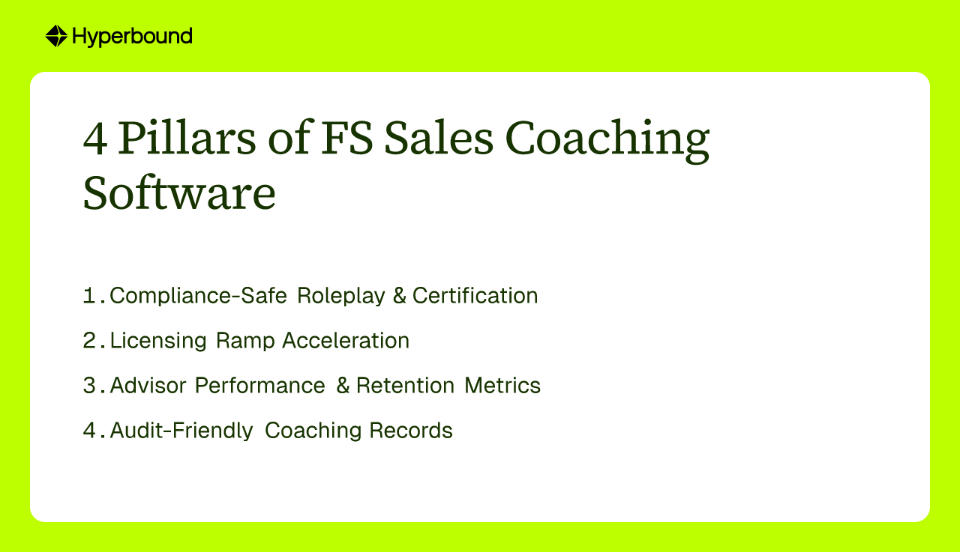
In wealth management, insurance, and banking, a misstep in a client conversation isn't just a lost deal — it's a potential regulatory violation. Your advisors need a safe-to-fail environment to practice KYC conversations, fiduciary disclosures, objection handling around fee structures, and the precise language required for new product rollouts.
This means your coaching software must support custom scenario creation that mirrors your actual compliance requirements. A generic cold call bot trained on SaaS objections won't prepare an advisor to explain the risks of a variable annuity in plain language, or to navigate a client's concern about recent market volatility without crossing a disclosure line.
According to Hyperbound's research on AI roleplay for financial services, AI-powered roleplay can speed up compliance training by 60% and deliver 6x more practice opportunities per team member compared to traditional role-play sessions. The ability to create repeatable, scored, and logged practice sessions isn't a nice-to-have — it's a compliance asset.
Long advisor ramp times represent one of the highest hidden costs in financial services. Between licensing requirements, product certification, and the time it takes for a new advisor to feel confident enough to lead client conversations independently, you can easily burn six months of salary before a single deal closes.
Consider this analogy: Vanta, a fast-scaling SaaS company, used AI-driven roleplay to cut BDR ramp time from 210 days to 72 days — a 60% reduction — while growing their BDR team 4x and generating 5x pipeline growth. Now translate that into the advisor context. If your current ramp is eight months and you could compress it to four, that's four additional months of productive client-facing time per new hire. Multiplied across a cohort of ten advisors, you're looking at material revenue acceleration.
The platform you choose needs structured onboarding paths that combine learning modules with practical application — specifically AI roleplay that mirrors real client conversations — to demonstrably reduce time to first deal.

High advisor turnover is devastatingly expensive. Industry research shows that inconsistent coaching is one of the primary drivers of early attrition — and most managers in financial services spend less than 8% of their time actively coaching. That's not negligence; it's bandwidth. Managers are overwhelmed with client escalations, compliance oversight, and administrative overhead.
The right financial services sales coaching software doesn't just track activity. It connects coaching interventions to performance outcomes: conversion rates, client retention rates, revenue per advisor, and engagement with training content. Without that connection, you're flying blind on whether your enablement investment is actually working.
Regulatory audits are a reality of financial services, and your coaching infrastructure needs to be audit-ready. This means secure, easily retrievable records of coaching sessions, roleplay completions, scorecard assessments, and advisor certifications — not buried in a spreadsheet or locked in a platform with limited export functionality.
Look for robust security certifications: SOC 2 Type II, GDPR, ISO 27001, and HIPAA compliance are the baseline. Your platform should also support data encryption, consent management, and role-based access controls. These aren't just IT checkboxes — they're the foundation of a defensible compliance posture.
Now that you've defined what you need, here's how to assess the vendors competing for your budget. Use these four evaluation lenses to cut through the marketing noise.
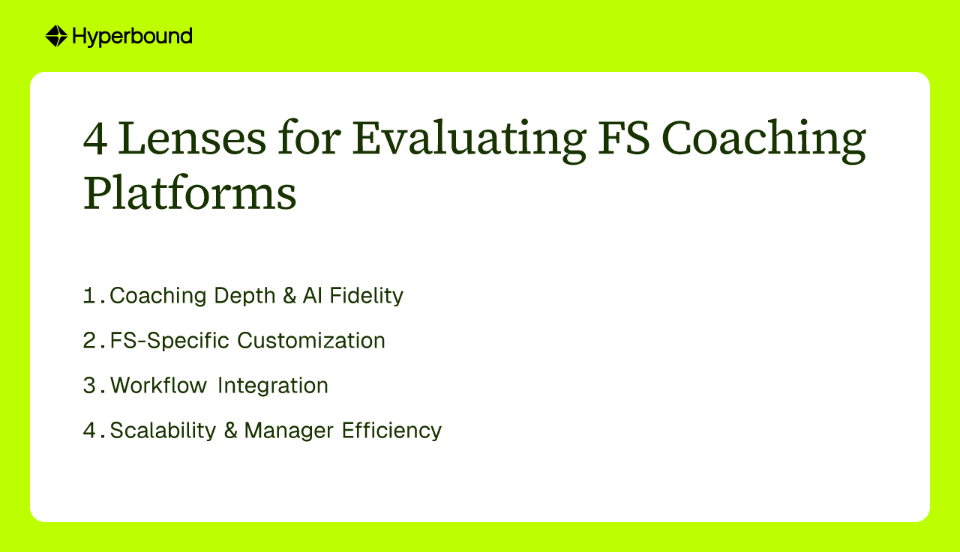
1. Coaching Depth & AI Fidelity Is the AI trained on real sales conversations from high-performing reps — or generic scripts built in a vacuum? Can the platform handle multi-party roleplays simulating a complex meeting with a client, their spouse, and a third-party financial advisor? Does it analyze your actual call data to inform what should be practiced next?
2. FS-Specific Customization Can you build custom scorecards aligned to your firm's specific compliance checklists and sales methodology? Can you create AI personas that genuinely reflect your client segments — the skeptical retiree reviewing their portfolio, the first-time investor overwhelmed by options, the HNW executive who's heard every pitch before?
3. Workflow Integration Your advisors are already drowning in tools — CRM tasks, email, Teams messages, compliance documentation. If your coaching platform adds friction instead of removing it, adoption will collapse. Look for native integrations with key platforms like Salesforce, Zoom, Google Meet, and Microsoft Teams, as well as your existing sales enablement tools.
4. Scalability & Manager Efficiency Does the tool surface the most critical coaching moments automatically, or does it require a manager to manually review hours of call recordings? In a world where managers spend less than 8% of their time coaching, the platform that automates the diagnostic work wins.
.png)
.png)
The most common mistake financial services leaders make in this evaluation? Treating recording and coaching as the same problem. They're not. A platform that excels at capturing what happened on a call is not automatically equipped to change what happens on the next one.
The biggest gap in today's sales technology landscape isn't data. Revenue teams in financial services have more call recordings, pipeline analytics, and performance dashboards than they can possibly act on. The gap is activation — turning that data into the specific behaviors that change outcomes on live client calls.
This is the gap Hyperbound was built to close. Hyperbound coined the "Revenue Activation" category to describe what happens when teams stop just analyzing call data and start using it to change what happens next. The platform's Practice → Perform → Activate loop creates a continuous improvement cycle that is particularly well-suited to high-compliance, relationship-driven sales environments like wealth management, insurance, and banking.
Here's how the loop works in practice:
Hyperbound Perform deploys AI scorecards across 100% of your team's real client conversations — not a sampled 5%, but every call. It integrates directly with Gong, Salesloft, Chorus, and other call recording tools your team already uses, so there's no rip-and-replace required.
What makes Perform different from standard call analytics is deal-level intelligence. Rather than analyzing individual calls in isolation, it rolls up insights across every touchpoint in a relationship — from the initial prospecting call to the portfolio review — to surface early risk signals and opportunities to build deal momentum. For a financial advisor managing dozens of client relationships simultaneously, this is the difference between reactive problem-solving and proactive relationship management.
Once the gaps are identified in real conversations, Hyperbound Practice delivers targeted AI roleplay scenarios built from those specific gaps — not generic training content. The AI buyer personas are trained on over 2 million hours of real B2B sales conversations, making them dynamically responsive rather than scripted.
For financial services teams, this translates directly into the four pillars we outlined earlier:
Kota Activate is the AI Revenue Analyst that sits above Practice and Perform, connecting both data streams into personalized coaching recommendations. Instead of a manager having to manually audit call recordings and guess which rep needs what kind of practice, Kota surfaces the specific intervention — at the right time.
For a VP of Sales managing a team of 40 advisors across multiple markets, Kota effectively gives you an AI coaching analyst working 24/7 to ensure no skill gap goes unaddressed and no coaching moment is missed. This directly addresses what sales enablement leaders consistently report: they're outnumbered, and they can't manually scale personalized coaching across the entire organization.
The results from firms that have deployed this loop speak to the core financial case for investing in financial services sales coaching software that actually closes the feedback loop:
And revisiting the Vanta proof point: a 60% reduction in ramp time (from 210 to 72 days) didn't just mean faster onboarding. It meant 4x BDR team growth and 5x pipeline. In advisor terms, that's the difference between a cohort that's generating revenue in Q2 versus Q4.

Choosing the right financial services sales coaching software in 2026 comes down to one question: Do you want a platform that tells you what happened, or one that changes what happens next?
Broad conversation intelligence platforms are excellent at the former. Purpose-built FS tools handle specific compliance workflows. But neither was designed around the continuous feedback loop that moves the needle on advisor ramp time, retention, and consistent deal execution.
The future of sales coaching in financial services isn't a call recorder with a coaching module bolted on. It's a system that scores real client conversations, identifies the exact skill gaps holding your advisors back, assigns targeted practice in a compliance-safe environment, and orchestrates the right coaching intervention at the right time — all without adding administrative burden to managers who are already stretched thin.
That's the Revenue Activation model. And it's the standard your next platform evaluation should be held to.
You can, but generic tools lack the specific features needed for financial services, particularly around compliance-safe practice, complex product training, and audit-readiness. These platforms are built for SaaS sales cycles, not for navigating FINRA regulations, fiduciary duties, or multi-year client relationships. They are excellent for recording calls but struggle to provide a safe-to-fail environment for practicing sensitive conversations or to connect coaching directly to the unique performance metrics of a financial advisor.
Revenue Activation is a model that uses call data to actively change advisor behavior, whereas conversation intelligence primarily analyzes and reports on what happened in past calls. Conversation intelligence tools are great for surfacing insights. Revenue Activation platforms like Hyperbound close the loop by taking those insights (Perform), creating targeted AI roleplay scenarios to fix skill gaps (Practice), and using an AI analyst to orchestrate the right coaching at the right time (Activate). It's the difference between analyzing a problem and actively solving it.
AI roleplay provides a safe, repeatable, and scalable environment for advisors to practice sensitive, compliance-critical conversations without risking real-world violations. You can create custom scenarios that mirror your firm's specific requirements, such as handling fiduciary disclosures, explaining the risks of a new annuity product, or navigating KYC conversations. Every practice session can be scored against a compliance checklist and logged, creating an audit-friendly record of certification and training.
The most critical features are compliance-safe roleplay, tools to accelerate licensing ramp time, advisor-specific performance metrics, and audit-friendly coaching records. These four pillars ensure the platform addresses the unique regulatory and operational challenges of the industry. Look for capabilities like custom AI scenario creation, structured onboarding paths, metrics that track client retention and revenue per advisor, and robust security certifications like SOC 2 and ISO 27001.
By providing structured, on-demand practice opportunities, this software helps new advisors build confidence and master critical conversations months faster than traditional methods. The typical ramp time for an advisor can be over six months. AI-driven roleplay compresses this by allowing new hires to practice key scenarios hundreds of times before they face a real client, demonstrably reducing time-to-first-deal and increasing early productivity.
Yes, a modern Revenue Activation platform is designed to integrate seamlessly with your existing technology stack, including CRMs like Salesforce and call recording tools like Gong or Chorus. The goal is to remove friction, not add another siloed tool. This allows the platform to analyze data from your real calls and push coaching insights back into the systems your team already uses every day.
By providing consistent, personalized, and high-impact coaching, the software addresses a primary driver of advisor attrition: a lack of meaningful professional development. An effective coaching platform empowers time-strapped managers to deliver targeted support efficiently. It also gives tenured advisors a way to hone specific skills with bitesized roleplays, keeping them engaged and demonstrating the firm's investment in their long-term success.
Ready to see how this works in a financial services context? Explore Hyperbound's Revenue Activation Platform and find out how firms like yours are cutting advisor ramp time and building more consistent client-facing skills at scale.










Use Cases
Legal