
The meeting gets booked. The rep prepares the deck. The activity log looks healthy. Then the deal stalls somewhere between the first conversation and the demo, and the pipeline can't tell you why.
If you have managed enough sales teams, you already know the most common culprit. Your rep opened with what the product does instead of what the prospect needs. They spent twenty minutes walking through capabilities the prospect never asked to hear about, and by the time the call ended, the buyer had not once felt understood. Discovery-to-demo conversion slips, and the number never explains itself.
Feature dumping is the name for it, and the fix is not a product refresher. It is coaching. This is a playbook for the managers and leaders who have to undo it.
You do not need a named framework to spot it once you know what to look for. It shows up in four consistent ways.
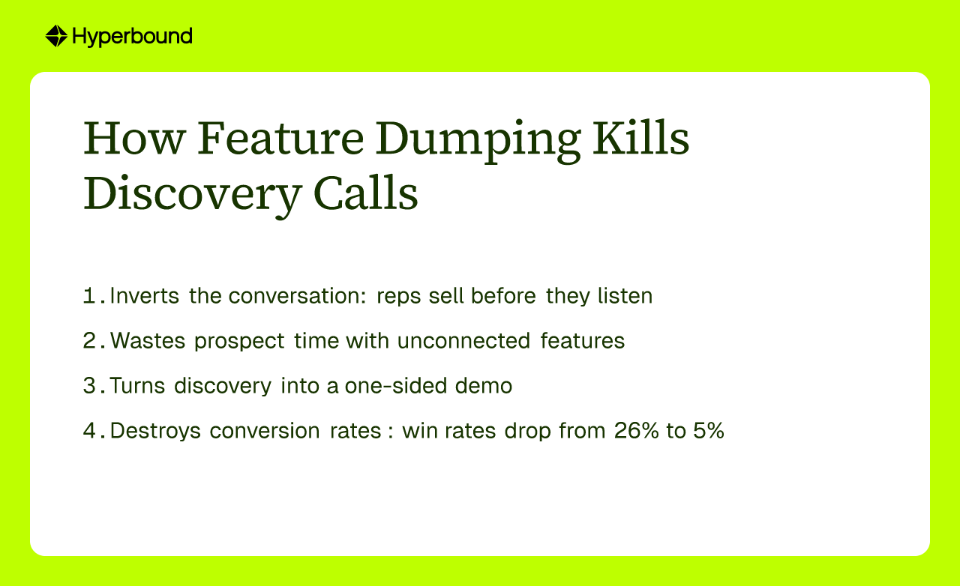
Feature dumping is a learned behavior. The behavior can be unlearned through consistent, structured coaching. Three approaches work in combination: making the behavior visible through scoring, building new habits through practice, and catching the pattern at the deal level before it costs a close.
Sales leaders cannot coach what they cannot see. The first step is adding a specific criterion to the call review scorecard that flags the moment a rep pitches before confirming the prospect's problem.
Use a concrete label, such as "Problem Before Solution" or "Pitched Before Pain Confirmed." The grading standard should be defined precisely:
If you want a fuller question set to work the discovery stage, build from our 20 discovery call questions that surface real buyer pain.
Richardson's research on effective sales training supports the principle: benchmarking specific behaviors creates awareness and enables reps to track their own improvement over time. The scorecard criterion converts an abstract coaching note, such as an observation that a rep feature-dumped, into a measurable, reviewable data point that a rep can see across multiple calls.
During call review, do not stop at the score. Ask the rep to identify the exact point at which the right to mention the feature was earned. Ask what business problem the prospect had shared in the ten seconds before that mention. If the rep cannot answer, the score reflects the right outcome. That question trains the cognitive habit even when no manager is listening.
Establish a baseline in the first two weeks of scoring, then set a target for improvement. The goal is not punishment. It is to make an invisible behavior visible enough that reps begin catching it themselves.
Scoring one criterion across a few calls is easy. Scoring it across every call, product, region, and vertical is where the time goes. If your scorecards already number in the dozens, Kota Actions lets you add the same "Problem Before Solution" criterion to every scorecard at once, then generate a matrix of discovery roleplay bots for every vertical and language your reps sell in. One request fixes a scoring gap everywhere instead of one scorecard at a time.
Knowing that feature dumping is a problem and being able to stop in the middle of a live call are different skills. Closing that gap requires repetition in a low-stakes environment. Role-play is the mechanism.
Design scenarios where the buyer persona has a specific but unstated problem. The buyer only reveals information when asked a direct, open-ended question. Background context the rep receives before the role-play should be general enough that the rep cannot assume the pain. The rep's sole objective in the exercise is to articulate the buyer's problem back to the buyer accurately. Pitching features before that point is a reset, not a detour.
The critical element is instant feedback. The moment a rep pivots to a feature ("Our platform has a capability that might be relevant here..."), the session pauses. The coach asks what specific problem the buyer mentioned and whether the rep confirmed that problem before moving on. If the answer to either is no, the rep rewinds and restarts from the last confirmed pain point.
The research points to a central mechanism: connecting the solution directly to the diagnosed problem must become a reflex rather than a deliberate decision. Instant feedback in practice builds that reflex. A rep who has been interrupted fifteen times in role-play for pitching before confirming will notice the same impulse arising in a live call and have the trained response to pause.
Run these scenarios at least twice per month. Vary the buyer persona, the industry, and the problem category so reps cannot rely on pattern recognition from the previous session.
Platforms like Hyperbound Practice make this cadence practical. Reps run realistic discovery roleplays with buyer personas that reveal information only when questioned well, and coaches configure resets for the moment a rep pitches before confirming a problem. That keeps the feedback loop consistent without requiring a manager to facilitate every session. For a fuller playbook on structuring those sessions, see our sales roleplay playbook.

Individual call coaching addresses one event. Deal-level coaching addresses a pattern, and it does so at a point when intervention can still affect the outcome.
When a deal is stalling, pull every recorded call associated with it and listen for the sequence. Review whether the same rep feature dumps in the initial discovery, in the follow-up, and again when a new stakeholder joins. If that pattern appears, the problem is not a single bad call. It is a behavioral pattern that has been reinforced across the entire sales cycle. Conversations grounded in business impact and specific use cases move deals forward. Conversations dominated by feature lists do not.
Identify what triggers the dumping. For many reps, it appears when the conversation loses momentum, when a senior stakeholder joins the call, or when a prospect asks a question the rep cannot answer without reverting to product. Once the trigger is named, the coaching becomes specific.
Deal-level platforms such as Hyperbound Perform surface this sequence across every recorded call in a deal, so the pattern is visible before the next conversation. Managers can see that the same rep has pitched before discovery in three straight calls and assign a focused practice scenario in response.
Before the next scheduled call on that deal, sit down with the rep and set a single behavioral goal for the call. The goal should not be a quota target or a deal stage outcome. A behavioral goal should be specific, such as: "Before this call ends, confirm the prospect's top three concerns about their current reporting process. Do not mention the reporting module until at least two of those concerns are on the table." That framing gives the rep a concrete instruction they can execute in the room.
This approach shifts coaching from retrospective to proactive. The CRO who is watching conversion rates decline does not need a team-wide training session. The requirement is the ability to intervene on the right deal, with the right rep, before the next call.
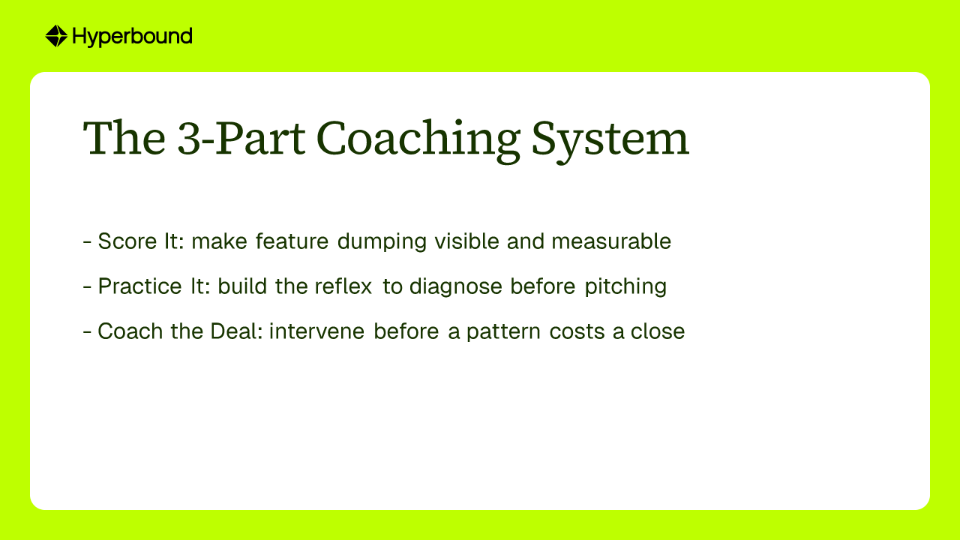
None of these three approaches works in isolation, and none works after a single cycle. Behavior formed over years of product-first training will not recalibrate in a week.
The scorecard makes feature dumping visible across the team, not just in the calls a manager happens to review. Role-play builds the conditioned response to pause before pitching. Deal-level review connects the coaching to consequences that matter: a real deal, a real prospect, an upcoming call with something at stake.
Reinforce the behavior shift by changing what the team celebrates. If managers highlight reps who gave strong demos but the underlying discovery was shallow, the signal is that product knowledge matters more than diagnostic skill. Sharing call recordings where a rep asked a question that unlocked an unstated problem resets that signal. It changes the team's working definition of a good call.
Coach reps to open discovery with a reference to a relevant business context rather than a product overview. A brief, concrete example of a problem a similar business faced earns the right to ask questions. "We recently worked with a company in this sector that was managing X manually. Before I assume that is a challenge for the team, I want to understand how the team currently handles it." That opening orients the conversation toward diagnosis and earns permission to explore rather than present.
The standard to hold is simple: no feature enters the conversation until a connected problem has been confirmed. Everything before that confirmation is discovery. Everything after it is a response to a stated need.
The coaching response to feature dumping is not a single conversation. It is a system: a scorecard that makes the behavior measurable, role-play that builds the reflex to diagnose before prescribing, and deal-level review that lets managers intervene before a pattern costs a close.
Sales teams that fix this do not present less. They present later, and when they do, every feature they raise connects to a problem the prospect has already named. That is what moves a discovery call to a demo, and a demo to a closed deal.

Sales reps feature dump because they are over-trained on product information and under-trained on discovery skills. When a rep knows the product deeply but has not built the habit of confirming pain before presenting a feature, the default response is to pitch. The behavior also increases under pressure, such as when a call loses momentum or a senior stakeholder joins.
Feature dumping has a measurable negative impact on win rates. Research on common sales mistakes shows that as feature dumping duration increases from 0 to 500 seconds, win rates drop from 26% to 5%. The pattern causes prospects to disengage because the conversation does not connect to a problem they recognize as urgent.
A discovery call is for diagnosis; a demo is for prescription. In a discovery call, the rep's job is to understand the prospect's business problem, confirm it, and build a case for change. In a demo, the rep presents specific capabilities that address problems already identified. Feature dumping collapses this boundary by turning discovery into an unrequested demo.
Sales managers can stop feature dumping with a three-part coaching system: score it, practice it, and coach the deal. First, add a scorecard criterion such as "Problem Before Solution" to make the behavior visible. Second, run structured role-play scenarios with instant feedback when reps pitch early. Third, review recorded calls within a deal to catch repeated patterns before the next interaction.
A discovery call scorecard should include a specific behavior criterion such as "Pitched Before Pain Confirmed" or "Problem Before Solution." Define pass and fail clearly. A pass means the rep introduced a feature only after the prospect stated a related problem and the rep confirmed understanding. A fail means the rep mentioned a feature before a connected problem had been discussed and confirmed.
Role-play builds the reflex to diagnose before pitching. When reps practice with buyer personas who reveal information only when asked a direct question, they learn to pause before presenting features. Instant feedback is essential: the moment a rep pivots to a product feature, the coach stops the session and asks what problem the buyer confirmed. Repeated resets make the correct sequence automatic in live calls.
Before pitching a feature, a rep should confirm the prospect's top business problems and their operational impact. Useful questions cover how the prospect handles the process today, what cost or risk the current approach creates, and what change solving the problem would produce for the buying team. The standard is simple: no feature enters the conversation until a connected problem has been confirmed.
To improve discovery-to-demo conversion rates, organizations should fix the discovery call before changing the demo. Track where reps feature dump, add a scorecard behavior, run role-play drills, and review deal-level call patterns. When every feature discussed connects to a confirmed problem, reps earn the right to move the deal forward and conversion rates recover.










Use Cases
Legal