
You've been here before. You sat through the slick demos, signed the contract, and rolled out the new sales coaching platform with a company-wide announcement and genuine excitement. Ninety days later? It's shelfware. A ghost haunting your tech stack, paid for in full, used by maybe 15% of your team.
You're not alone. As one sales leader put it on Reddit: "most of the 'all-in-one' training platforms looked great in a demo but then just became another tab my reps ignored." Another spent a significant budget rolling out "one of the big names" only to watch adoption crater. The kicker? The software wasn't defective. The evaluation process was.
The numbers back this up. Research shows 80% of training content is forgotten within 30 days — a brutal fact that makes generic, module-based training a money pit by design. Layer on top of that the "gaming the bots" phenomenon, where reps quickly learn to click through AI roleplay scenarios without actually practicing, and you've got a recipe for expensive, low-impact shelfware.
The problem isn't the concept of sales coaching. It's that most buyers evaluate platforms on features and price, not on the factors that actually determine whether those tools change rep behavior and impact revenue. That ends here.
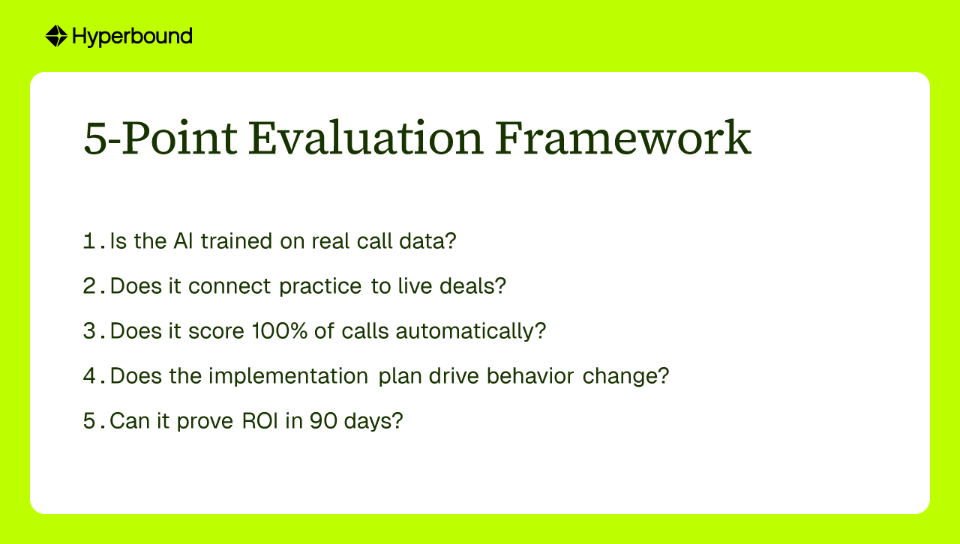
Below is a five-point evaluation framework built to help you separate the platforms that deliver behavior change and real ROI from the ones that deliver a polished demo and a disappointing renewal conversation.
Ask yourself: does practicing on this AI actually prepare reps for real conversations, or does it just teach them to pass a simulated test?
The dirty secret of many legacy AI roleplay tools is that their "AI buyers" are built on scripted templates and hypothetical scenarios — not the nuanced, unpredictable behavior of actual prospects. Reps figure this out fast. They learn the patterns, click through the objections, and check the box. Gaming the bot becomes a survival skill, not a coaching outcome.
What you want instead is an AI trained on millions of real sales conversations — one that mirrors actual buyer behavior, responds dynamically to what a rep says, and reflects the specific objections, hesitations, and buying signals that exist in your industry.
The question to ask every vendor: "What is your AI actually trained on — and can you show me the source data?"
Hyperbound Practice, for example, builds its AI buyer personas from over 2 million hours of real B2B sales conversations. That means when a rep practices a cold call or a discovery conversation, the AI isn't running a script — it's responding the way a real buyer would. Reps consistently describe it as "the first thing they actually stick with because it feels like practicing with a tough prospect." Features like Multiparty Roleplays and Demo Call Screen Sharing push realism even further, preparing reps for complex, multi-stakeholder deal cycles before a live dollar is on the line.
Here's the gap most platforms never close: a rep can ace every roleplay and still lose deals. Why? Because there's no feedback loop connecting what they practiced to what's actually happening in their pipeline.
As one sales leader noted, "the tools that last are the ones that plug right into daily workflows." That's not just about CRM integrations — it's about ensuring that the coaching a rep receives is directly informed by their real-world performance, and that their practice directly improves their live calls.
The question to ask every vendor: "Can you show me how a rep's practice activity is connected to their pipeline results?"
This is the core of Hyperbound's Practice → Perform → Activate model. Hyperbound Perform analyzes real customer calls and surfaces deal-level insights — not just call-level tips, but patterns across every touchpoint in a deal. Kota Activate, Hyperbound's AI Revenue Analyst, then orchestrates the next step: recommending targeted Bitesized Roleplays inside Hyperbound Practice that address the exact skill gaps showing up in real calls. The loop closes. Practice improves performance. Performance informs practice.
Most sales managers review somewhere between 2–5% of their team's calls. That's not a coaching program — that's a lottery. And it means the reps who need help the most are often the last to get it, because nobody's listening to their calls.
Sales enablement leaders are frequently outnumbered — one enablement professional supporting 50, 80, or 100+ reps — and the idea of manually surfacing "best moments from call recordings" doesn't scale. You need a platform that does the heavy lifting of call review automatically, at 100% coverage, so nothing falls through the cracks.
The question to ask every vendor: "Does your platform score every call automatically, or does scoring require someone to manually assign calls for review?"
Hyperbound Perform's AI Real Call Scoring automatically scores 100% of real customer conversations against custom scorecards mapped to your sales methodology — whether that's MEDDPICC, Challenger, SPIN, or something proprietary. It integrates directly with leading conversation intelligence platforms, Outreach, Aircall, and other call recording tools, or you can capture calls natively with the built-in Hyperbound Call Recorder. Every rep gets objective, consistent feedback on every call. Managers get a Rep View dashboard that surfaces coaching opportunities at a glance, without drowning in hours of recordings.
This is where most six-figure investments go to die. The software gets purchased, a CSV of users gets uploaded, a Zoom onboarding session gets scheduled and attended by a third of the team, and then... nothing. Adoption flattens. The tool collects dust.
One sales leader captured why with unusual clarity: "What actually worked for us was stepping back and getting our SOPs documented properly first." Behavior change requires architecture — clear expectations, embedded workflows, leadership buy-in, and a partner who helps you build a coaching culture, not just flip a software switch.
The question to ask every vendor: "Walk me through your implementation plan. What's the change management component?"
If a vendor hands you a help center link and a kickoff call, that's a red flag.
Hyperbound's structured Implementation Playbook treats deployment as a behavior change program from day one:
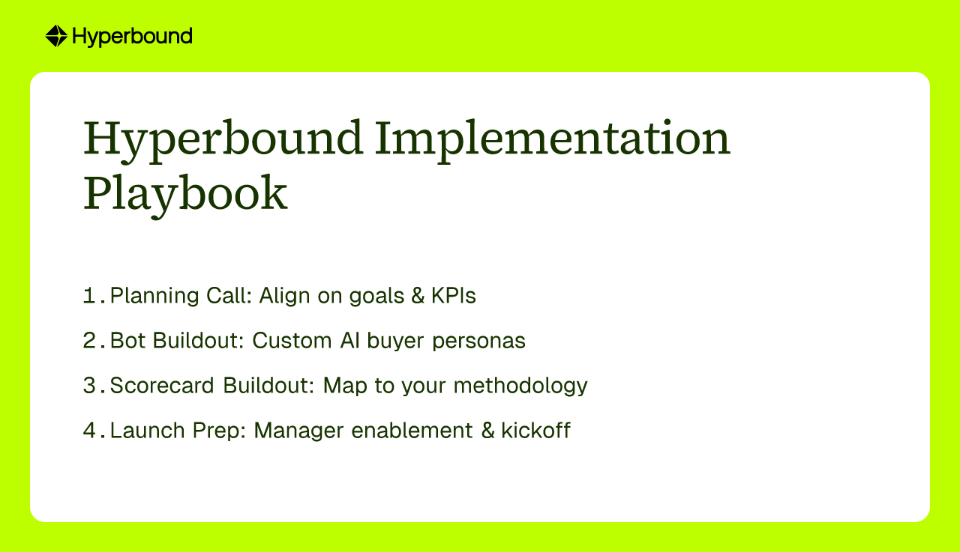
Every account is paired with a dedicated Account Manager and Solutions Engineer, with ongoing QBRs to track progress and adjust the program. It's not software delivery. It's a partnership.
Leadership doesn't want to hear about "long-term behavior change" when they're staring at a six-figure line item on the budget. They want to know: will this move a number we care about, and how fast?
The right sales coaching platform should make this conversation easy. If a vendor hedges on ROI timelines, or can only point to soft metrics like "engagement scores," that tells you everything you need to know.
The question to ask every vendor: "Show me three customer proof points with specific, measurable outcomes. What did ramp time, conversion rate, or win rate look like before and after?"
Look for metrics tied directly to revenue impact — faster ramp, higher demo conversion rates, shorter cycles to first won deal — not just usage statistics or training completion rates.
Hyperbound customers see results within the first 90 days:
Vanta reduced ramp time by 60% — from 210 days down to 72 — while scaling their BDR team 4x and growing pipeline 5x. Nivoda achieved a 50% reduction in ramp time alongside 2x revenue year-over-year and a 150% increase in demo rates. These aren't soft metrics. They're the outcomes you should demand proof of before signing any contract.
The right sales coaching platform isn't the one with the longest feature list or the most polished demo. It's the one that can answer five hard questions with evidence — not promises.
To summarize the framework:
Buying the wrong sales coaching platform doesn't just waste budget — it costs you the time your reps spent on ineffective training instead of improving, the deals that slipped while waiting for ramp, and the organizational trust you'll need to get budget approved for the right tool the next time around.
You deserve a platform that works as hard as your team does.
📋 Download the Sales Coaching Platform Evaluation Scorecard — a free tool that walks you through all five criteria with vendor-ready questions, scoring rubrics, and red flags to watch for. Use it in every demo and vendor conversation to make sure you're buying outcomes, not features.
Already know what you're looking for? Book a demo with Hyperbound and see how the Revenue Activation Platform turns sales practice into pipeline results — with proof points to show your leadership on day one.
A sales coaching platform is a software tool designed to improve the performance of sales representatives through practice, feedback, and skill development. These platforms often use AI to provide realistic roleplay scenarios, analyze real customer calls, and deliver targeted feedback to help reps close more deals effectively.
Most sales coaching tools fail because they are evaluated on features rather than their ability to drive real behavior change, they don't connect practice to live deal outcomes, and they lack a structured implementation plan. This leads to reps "gaming the system" or ignoring the platform, turning it into expensive shelfware.
An AI sales coaching platform works by using artificial intelligence to simulate realistic sales conversations and analyze 100% of real call recordings. The AI is trained on vast datasets of actual sales calls to create dynamic buyer personas for practice and to automatically score live calls against a company's sales methodology, providing scalable, consistent feedback to every rep.
A conversation intelligence (CI) tool primarily records, transcribes, and analyzes past customer conversations, while a sales coaching platform is an active training system designed to build skills before and after those calls. While CI tools are excellent for review, a platform like Hyperbound closes the loop by using insights from live calls to prescribe targeted AI roleplay practice, actively improving future performance.
The ROI of a sales coaching platform is measured by tracking key revenue-impacting metrics before and after implementation. Look for improvements in metrics like ramp time for new hires, conversion rates from discovery calls to demos, win rates, and the time it takes for a new rep to close their first deal. These hard numbers demonstrate a direct impact on the bottom line.
A successful implementation of a sales coaching platform should be treated as a change management program, not just a software deployment, with the goal of seeing measurable ROI within the first 90 days. A robust plan includes aligning on goals, building custom AI personas and scorecards, and executing a structured launch with manager enablement.
Everyone on the revenue team benefits from a sales coaching platform, not just new hires. New representatives can ramp up significantly faster, while experienced reps can use it to refine specific skills and practice for high-stakes calls. Sales managers benefit from automated call scoring and data-driven insights, saving them hours of manual review.










Use Cases
Legal