
You've carefully crafted your presentation, highlighting all the incredible features and benefits your solution offers. You're confident in your product's superior quality and long-term value. Then it happens—the prospect looks you straight in the eye and asks, "But how much cheaper are you than your competitors?"
Your heart sinks. Once again, you're trapped in the dreaded price war.
"Sometimes I wonder if the price guys have it easier because they can walk in and just say 'I'm your most cost-effective solution,'" laments one sales professional in a Reddit discussion. This frustration resonates with countless sales reps who prefer selling on value but find themselves constantly dragged into price comparisons.
The ugly truth? If you're selling what appears to be an "identical service" to your competitors, price becomes the only differentiator. And as another sales expert bluntly puts it: "If I earn someone's business by undercutting price by 5%, I should also expect to lose them at some point by that same 5%."
But there's a way out of this race to the bottom—a method that transforms your offering from a commodity into a "Cadillac product" that stands alone in your prospect's mind. The secret lies not in your pitch, but in your discovery process.
The fundamental challenge many sellers face is what experts call the "Challenge of Sameness." When prospects can't effectively differentiate between you and alternatives, price becomes the default deciding factor. This commoditization trap is particularly dangerous because it creates fragile customer relationships built solely on cost savings rather than value delivery.
This explains why many sales professionals struggle with customer loyalty. When you win business by being 5% cheaper, you're essentially setting yourself up to lose that customer the moment a competitor undercuts your price by 6%.
The alternative? Value-based selling—a consultative approach that shifts the conversation from "What can I sell?" to "How can I solve my client's problem?" This approach works: according to HubSpot's State of Sales Report, 90% of sales teams using value-based selling report revenue growth, compared to only 72% for those who don't.
The bridge between commodity selling and value selling is effective discovery. When done right, discovery transforms your offering from one of many similar options to the uniquely perfect solution for your prospect's specific needs—making your solution "apples and oranges" compared to competitors.
Discovery isn't just a stage in your sales process—it's an ongoing commitment to understanding your client's world. The goal isn't to find an opening to pitch your product, but to unearth the real problems behind your prospect's surface-level requests.
As one sales professional astutely observes, "If a client doesn't see the value of something, they'll usually disguise that as a price issue." Your mission during discovery is to peel back these layers and reveal the true value perception challenges.
To adopt the discovery mindset:
To transform your discovery calls from basic information gathering to value-revealing conversations, follow this structured six-step process based on industry best practices and analysis of successful sales calls:
.png)
Preparation prevents poor performance. Before the call:
This preparation allows you to ask targeted, relevant questions rather than generic ones that make you sound like every other salesperson.
Use situational questions to understand your prospect's current state:
These questions establish context and build rapport while gathering essential information. They also help you determine if this prospect is worth pursuing further.
This is where the magic happens. Dig deep to understand what's really driving their search for a solution:
One Reddit sales professional recommends: "Always ask why they are looking at changing providers, they will tell you, and base your sales off that." This advice is golden—the reasons for switching often reveal the exact value drivers that matter most.
Now that you've identified pain points, help the prospect understand their true cost through implication questions:
By quantifying the problem, you build the business case for your solution—making price a secondary concern compared to the cost of inaction.
Transition from pain to possibility by helping prospects envision a better future:
This is also the perfect time to incorporate social proof through relevant customer stories: "We worked with a company facing similar challenges, and after implementing our solution, they saw a 30% reduction in processing time."
Be careful not to overwhelm customers with features they don't need. As one sales professional notes, "You end up showing them too much they don't care about and they're concerned about overpaying for features/functionality they don't need." Instead, focus on modules and capabilities that directly address their specific pain points.
End the discovery call with clear next steps:
This framework transforms your discovery from an interrogation into a valuable consultation that positions you as a trusted partner rather than just another vendor.

Here's a practical set of discovery questions organized by objective to help you uncover the value drivers that make price comparisons irrelevant:
Remember that these questions should feel like a natural conversation, not an interrogation. The goal is to help prospects articulate their needs in ways that naturally align with your unique strengths.
As one sales professional suggests, breaking up your product into modules can help you find the "happy medium" between comprehensive offerings and cost-effective solutions. This modular approach allows you to tailor your solution precisely to the needs you uncover during discovery.
The escape from price wars isn't found in discounting or even in superior product features—it's in the quality of your discovery process. When you truly understand what drives your prospect's decisions, you can position your solution as the "Cadillac product" that stands apart from commodity alternatives.
As one successful value seller puts it, "When you're known as the best or one of the better products, you don't have to [compete on price]." Your discovery process is what establishes that reputation in your prospect's mind.
Remember the Resonate-Differentiate-Substantiate framework:
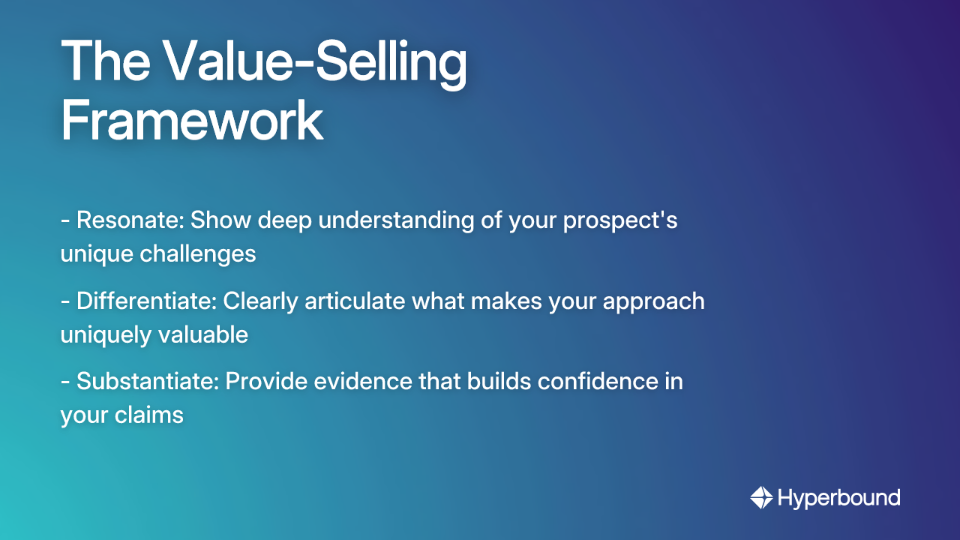
By mastering strategic discovery, you'll transform price objections into value conversations and build the kind of customer loyalty that can't be undercut by a competitor's discount.
Value-based selling is a sales methodology that focuses on the tangible business outcomes and value a solution delivers to a client, rather than on its price or features. It's a consultative approach where the salesperson acts as an advisor to deeply understand the client's problems, shifting the conversation from cost to the return on investment (ROI) your solution provides.
You likely get into price wars because prospects perceive your product or service as a commodity, making price the only clear differentiator between you and your competitors. If a buyer can't see a meaningful difference in the value you offer, they will default to the easiest comparison metric: cost. Effective discovery is the key to breaking this cycle by highlighting your unique value.
A thorough discovery call helps you avoid price discussions by uncovering specific pain points and quantifying their business impact. This process builds a strong business case for your solution's value that outweighs its cost. When you can demonstrate that the cost of inaction is far greater than the price of your solution, the price itself becomes a secondary concern.
The most critical part of the discovery process is moving beyond surface-level problems to unearth deep-seated pain points and then quantifying their financial and operational impact. Identifying a challenge isn't enough; you must help the prospect see and articulate the true cost of that challenge. This creates urgency and frames your solution as a valuable investment, not just another expense.
Acknowledge their question directly but gently pivot back to value. Explain that pricing depends on the specific solution that best fits their needs, which you can only determine after understanding their challenges. You can say, "That's a fair question. To give you an accurate number, I need to first understand your goals a bit better. Can I ask a few quick questions to make sure I recommend the right solution for you?"
You can differentiate a similar product by focusing on the unique value you provide through your process, service, expertise, and the specific outcomes you can deliver for that client. Even if product features are alike, your deep understanding of the client's business, your superior implementation support, or your industry-specific insights—all uncovered during discovery—can become powerful and compelling differentiators.

Your challenge: Select three questions from the toolkit above and use them in your very next discovery call. Watch how they shift the conversation from "How much?" to "How soon can we start?"










Use Cases
Legal