
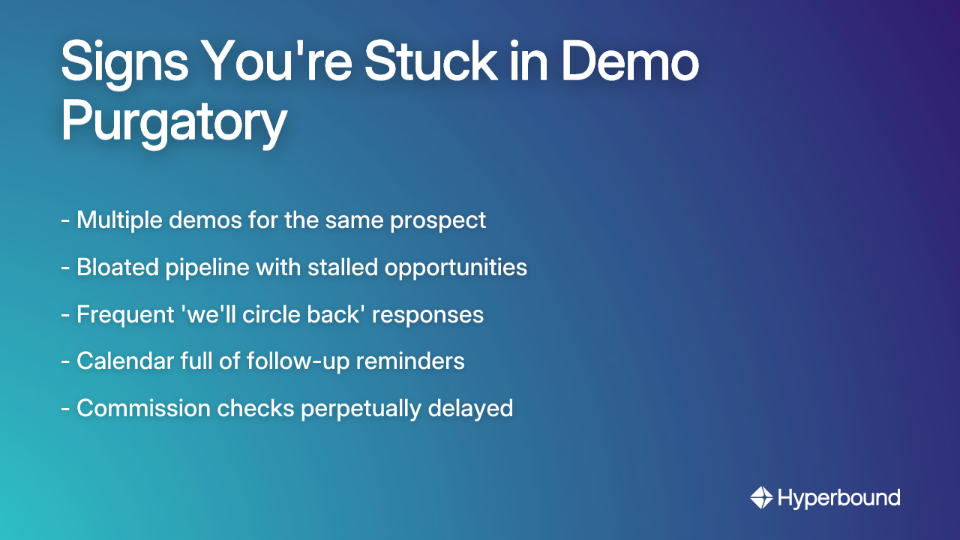
You've done it. The third demo for the same company. You know the product inside-out, you've answered every question, but the call ends with a familiar, non-committal phrase: "This looks great, we'll circle back internally and let you know."
Your calendar is filled with follow-up reminders. Your pipeline is bloated with opportunities stuck in the "demo completed" stage. And that commission check you've been counting on? It's still a distant dream.
Welcome to demo purgatory – the endless loop of presentations that never convert to sales.
The problem isn't your presentation skills or even your product. The issue begins much earlier in your sales process – specifically, with poor qualification.
Proper qualification means evaluating leads against an ideal customer profile to determine if they're worth pursuing. When qualification breaks down, the costs are significant:
Your time has real monetary value. Consider this calculation from Visualize.com:
For a salesperson with a $1 million quota, that's $455 per hour. Every demo in purgatory costs you real money.
Remember: Zero times anything is zero. If a key qualification element is missing, the deal is at risk, no matter how great your demo is.

According to sales intelligence research, not getting a commitment on next steps can lead to a 70% drop in close rates. Yet, spending just four extra minutes discussing next steps significantly improves your chances of closing.
Strategies for Establishing Clear Next Steps:
Follow-Up vs. Next Steps:

Many salespeople fear asking for the sale, mistakenly believing this will come off as pushy. This hesitation creates awkwardness and uncertainty that prospects can sense. The goal isn't to pressure, but to help the buyer discover their own urgency.
Uncover the "Why Now?" with Consultative Selling:
When they articulate the consequences of inaction themselves, you've created genuine urgency.
Ethical Urgency Tactics:
Salespeople often struggle with knowing when to disengage, fearing they'll lose a potential deal. This often stems from desperation or what veterans call "commission breathe" – that anxious energy prospects can sense a mile away.
Reframe "Walking Away": It's not giving up; it's a strategic reallocation of your most valuable asset—time—towards more promising opportunities. It demonstrates that you value your solution and aren't desperate for just any deal.
When to Walk Away (Red Flags):
How to Walk Away Professionally (The Breakup Email):
This "walking away tactic" often creates urgency and can re-engage a prospect who was simply procrastinating. The absent-minded beggar suddenly becomes attentive when they realize you're no longer chasing them.
Escaping demo purgatory requires a shift from being a presenter to being a process driver who guides clients through a high-ticket sales journey:
Remember that your value statement isn't just in your product demonstration – it's in your ability to guide prospects through a decision-making process that leads to solving their problems.
The mirror technique can be particularly powerful here: reflect back the prospect's own concerns and priorities to show you're truly listening and practicing consultative selling rather than just pitching.
By implementing these strategies, you stop being a victim of the endless loop and become a strategic partner who guides clients to confident decisions using permission-based closing. You'll spend less time in demo purgatory and more time handling objections that actually matter, leading to faster closes and more commissions.
Stop presenting. Start closing.

Demo purgatory is the endless cycle of giving product demonstrations to prospects who never convert into paying customers. It's characterized by bloated pipelines, numerous follow-ups, and deals stalling after the demo phase. This situation arises from engaging with unqualified leads who lack the budget, authority, need, or timeline to make a purchase.
The primary reason sales deals get stuck after a demo is poor qualification. When a salesperson fails to properly assess a prospect's budget, authority, need, and timing (BANT) before the presentation, they end up demonstrating to individuals who are not in a position to buy. Other key factors include not establishing clear, agreed-upon next steps during the call and failing to create a sense of urgency.
To better qualify leads, use a structured framework like BANT (Budget, Authority, Need, Timing) during your initial discovery calls. The goal is to determine if the prospect deserves a demo, not just to schedule one. Key actions include asking direct questions about their decision-making process, ensuring you have access to the ultimate decision-maker, and understanding if your solution aligns with their strategic goals.
Next steps are the specific, agreed-upon actions that move the deal forward, which are established during the sales call. A follow-up is the communication (usually an email) sent after the call to recap the discussion and confirm those mutually agreed-upon next steps. Mastering the next steps conversation is crucial for maintaining momentum, while a follow-up is simply a summary of what's already been decided.
Create genuine urgency by helping the prospect realize the cost of inaction, rather than applying artificial pressure. This is achieved through consultative selling. Ask questions like, "What happens if you don't solve this problem in the next quarter?" or "Who is most affected by this issue?" When the prospect articulates the negative consequences themselves, the urgency becomes their own discovery, not your sales tactic.
A salesperson should strategically walk away from a deal when a prospect consistently shows signs of disengagement. Key red flags include repeatedly missing or rescheduling meetings, refusing to grant access to decision-makers, being unable to define a decision timeline, or "going dark" despite clear next steps. Walking away is not giving up; it's a strategic reallocation of your time to more promising opportunities.
Have you been stuck in demo purgatory? What techniques have worked for you to escape the endless presentation loop? Share your experiences in the comments below.










Use Cases
Legal