
Your company just spent six figures on an enterprise sales training program. Ninety percent of reps completed the modules. Post-survey scores came back glowing. Leadership declared it a success.
Three months later, win rates haven't budged, ramp time is still painful, and your pipeline looks exactly the same.
This is the single biggest failure mode in enterprise sales training investment: completion rates and post-survey scores are the standard metrics, but neither one predicts revenue outcomes. Yet they remain the default benchmarks at most organizations. The sales training software market is projected to exceed $7.82 billion by 2032, and only 8% of business leaders feel confident they can measure the ROI of the programs they're buying. That's an enormous amount of money going into a black box.
The problem runs deeper than just picking the wrong metric. As sales leaders on Reddit have pointed out, most onboarding is product-focused — the ICP, the problems the solution solves, and practical examples are left to the field. When onboarding takes four weeks but the sales cycle is four to six months and ramp-up is only 90 days, new hires are structurally set up to fail — no training program can compensate for that misalignment if it's only measuring whether someone clicked through a course.
The fix is a fundamental shift in how you evaluate training: from activity metrics to outcome metrics. That means deal velocity improvement, ramp time reduction, and win rate lift — numbers that show up in your CRM, not your LMS.
Here are five enterprise sales training programs worth considering, evaluated on exactly those terms.
Primary outcome metrics: Ramp time reduction, demo conversion rate, deal velocity
Most AI roleplay tools use generic scripts. Hyperbound Practice is trained on over 2 million hours of real B2B sales conversations, which means the AI buyer personas reps practice against actually sound and behave like real prospects — complete with realistic objections, topic changes, and buying signals.
The platform creates a continuous improvement loop that directly connects practice to live call performance: score real calls → identify skill gaps → practice targeted scenarios → improve on the next real call. This is the operational model that makes the ROI measurable.
Unlike traditional enterprise sales training programs that leave leaders guessing, Hyperbound's AI Scorecards give reps instant, objective feedback on methodology adherence and talk ratios after every practice session — creating a quantifiable record of skill improvement that managers can tie to quota attainment data over time.
For enablement leaders who have struggled with training that doesn't translate to the field, Hyperbound Practice covers the full conversation spectrum: cold calls, discovery, objection handling, multi-party roleplays with economic buyers and champions, and even demo presentations with screen sharing — all embedded directly in your calendar, CRM, LMS, and Slack.
Primary outcome metric: Sales cycle length reduction
The Brooks Group's IMPACT Selling program focuses on a structured six-stage consultative framework: Investigate, Meet, Probe, Apply, Convince, Tie-it-Together. The methodology is designed to sharpen discovery and qualification conversations early in the sales cycle, which has a compounding effect on velocity — reps stop chasing unqualified deals and move qualified ones faster.
The ROI benchmark to track here is average deal stage duration. Organizations implementing IMPACT typically measure improvements by pulling CRM data on how many days a deal spends in each pipeline stage before and after training, then comparing close rates at each stage.
The Brooks Group publishes client case studies showing consistent improvements in win rates and customer satisfaction scores — but the most actionable metric for sales leaders evaluating this program is cycle time reduction from first meeting to close. If your team's biggest drag is stalled mid-funnel deals, IMPACT Selling's qualification rigor is designed to address exactly that.
Realistic ROI benchmark: Track average sales cycle length for a cohort of reps before and after training. A meaningful result is a 15–25% reduction in days from opportunity creation to close.
Primary outcome metric: Competitive win rate improvement
Corporate Visions approaches sales training from a buyer psychology angle. Their programs — including The Expanded Customer Buying Journey and their messaging frameworks — are built on research into how decision-makers actually process information and make choices.
The specific ROI lever here is competitive win rate. Corporate Visions trains reps to craft messages that create contrast, establish urgency, and defend price — skills that directly impact the win/loss breakdown in competitive deals. Their methodology also addresses one of the most expensive problems in enterprise sales: deals lost to "no decision."
To measure ROI, organizations should track win rate by segment — particularly against named competitors — and monitor the percentage of qualified deals that close versus stall. A/B testing messaging frameworks across rep cohorts before full rollout is how the more sophisticated teams validate Corporate Visions ROI before committing at scale.
Realistic ROI benchmark: A 5–10 percentage point increase in competitive win rate after consistent adoption of new messaging frameworks, measured over two or more full sales cycles.
Primary outcome metric: Close rate from qualified pipeline
Sandler Training is one of the most widely deployed enterprise sales training programs in the world — and one of the most debated. Sales practitioners on Reddit have noted that Sandler can feel rigid and that trainers don't always customize it well. That's a fair critique — and it's exactly why the ROI measurement approach matters more than the methodology itself.
When Sandler is implemented consistently, it creates a repeatable qualification and negotiation process that makes close rate improvements directly attributable to training adoption. The Sandler "Up-Front Contract" methodology, in particular, reduces late-stage surprises and ghosting — two deal killers that show up in CRM data as deals stuck in negotiation for longer than average.
Realistic ROI benchmark: Track the close rate from qualified opportunity to closed-won over two sales cycles. Teams with consistent Sandler adoption typically target a sustained 8–15% improvement in close rate from qualified pipeline, combined with reduced average days in the negotiation stage.
Primary outcome metrics: Close rate, Net Revenue Retention (NRR)
RAIN Group distinguishes itself by training reps on the full arc of the buyer relationship — not just the initial close. Their consultative selling methodology emphasizes deep discovery, collaborative problem-solving, and building the kind of trust that leads to expansion and renewal.
This makes RAIN Group one of the few enterprise sales training programs where ROI should be measured beyond the initial win. According to RAIN Group research, buyers are 43% more likely to accept follow-up meetings from sellers who lead with insight and genuine understanding of the buyer's business — a behavioral shift that directly improves pipeline generation efficiency.
For enterprise accounts, the compounding ROI shows up in NRR. Reps who sell consultatively build stronger champion relationships, leading to higher renewal rates and greater expansion deal velocity.
Realistic ROI benchmark: Compare NRR and expansion deal size between accounts managed by reps who completed RAIN Group training versus those who didn't over a 12-month period. Also track win rate on new logo deals as a leading indicator.
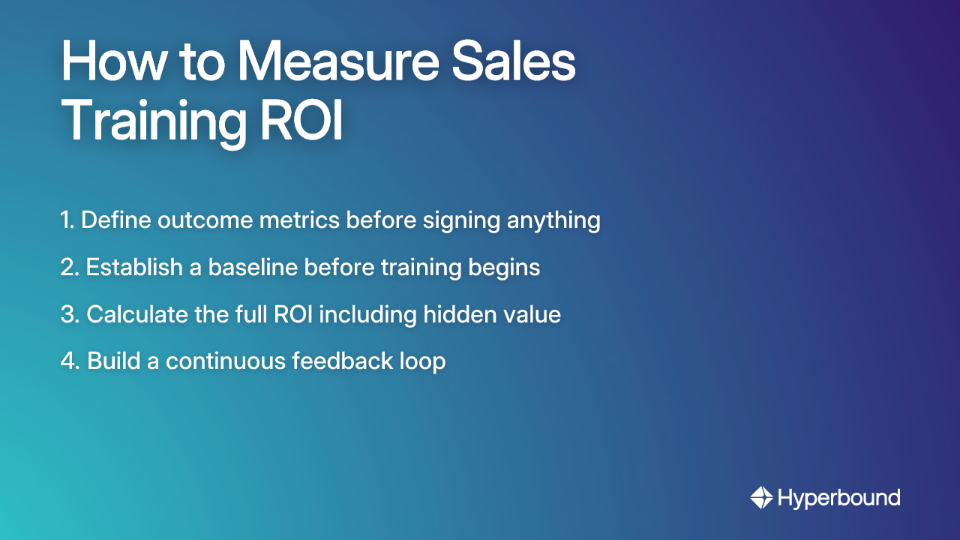
Before you select any enterprise sales training program, you need a measurement framework. A great program provides the data — but you need to know what to look for before you buy.
Don't let a vendor tell you what success looks like. Choose the 3–4 metrics that matter for your business:
Leading indicators (behavioral):
Lagging indicators (revenue):
Track your chosen metrics for at least one full sales cycle before implementing new training. You cannot prove a 50% reduction in ramp time if you don't know your current average. This sounds obvious — but most organizations skip this step and end up with no way to demonstrate training value to the CFO.
Training isn't a one-time event. The programs that drive the best ROI are the ones that create feedback cycles between practice and live performance.
Use call scoring to check whether reps are actually applying new techniques on real calls — not just completing modules. If your data shows that reps are struggling with objection handling (a skill gap affecting roughly 47% of sales reps), assign targeted practice immediately. Tools like Hyperbound Practice let managers route specific AI roleplay scenarios to struggling reps in days — not the next training cycle.
The operational model that separates good training programs from great ones is this: score real calls → identify the skill gap → assign targeted practice → measure improvement on the next real call. That's a loop. Most enterprise sales training programs deliver a lecture. The loop is what drives ROI.
The era of judging enterprise sales training program success by how many reps clicked through a module is over. The metrics that matter — ramp time, win rate, deal velocity, quota attainment — are all measurable, and the programs that can't show movement on them shouldn't be getting your budget.
The five programs outlined here each offer a credible path to revenue outcomes when evaluated and implemented correctly. But no vendor can do the measurement work for you. Define your baseline, set your outcome metrics upfront, and build the feedback loop that connects practice to live performance.
If you want a program where the ROI data does the talking from day one, Hyperbound is built to deliver it — with real customer results from companies like Vanta, Nivoda, and LinkedIn to back it up. But whatever program you choose, start with the framework. The program is only as good as your ability to prove it's working.
The biggest failure in enterprise sales training is measuring success with activity metrics like course completion rates instead of outcome metrics that impact revenue. This leads to massive investments with no provable ROI, as high completion scores often fail to translate into improved win rates, shorter ramp times, or increased pipeline.
You measure sales training ROI by tracking changes in key business outcomes. First, establish a baseline for metrics like win rate, deal velocity, and new hire ramp time before the training starts. After implementation, compare the performance of the trained cohort against the baseline over at least one full sales cycle to calculate the financial impact relative to the program's cost.
The most important metrics are lagging, revenue-focused indicators that directly connect to business results. These include win rate from qualified opportunities, average sales cycle length (deal velocity), quota attainment percentage, and time to first won deal for new hires. These are more valuable than leading indicators like methodology adherence, which are useful but don't represent the final outcome.
AI roleplay is effective because it provides a scalable and safe environment for reps to practice real-world sales conversations and receive instant, objective feedback. Unlike traditional roleplays, AI tools like Hyperbound can simulate realistic buyer objections and behaviors based on real call data, allowing reps to build muscle memory and apply learned methodologies before engaging with actual prospects.
You can expect to see changes in leading behavioral indicators (like methodology use on calls) within the first quarter. However, to see a measurable impact on lagging revenue indicators like win rate and sales cycle length, you should plan to measure over at least two full sales cycles, as it takes time for behavioral changes to influence deal outcomes.
To choose the right program, first identify the specific outcome you want to improve—whether it's reducing ramp time, increasing competitive win rates, or shortening your sales cycle. Then, evaluate potential programs based on their ability to provide a clear methodology and data-driven proof that they can impact that specific metric, as shown through case studies and a focus on outcome-based reporting.










Use Cases
Legal