
You've successfully grown your company beyond the founder-led sales stage. Congratulations! Now comes the challenging part: scaling that early success into a high-performing enterprise sales organization.
Many leaders struggle with this transition. As one sales leader candidly shared, "The hard truth is that when you are starting up, the best salesperson is you, the founder(s)." But how do you scale that passion, expertise, and success across an entire enterprise team?
The answer lies in two critical components: a strategic organizational structure and a scalable, continuous coaching engine. While structure provides the blueprint, coaching is the engine that drives results. Unfortunately, most organizations excel at one but neglect the other.
This guide will walk you through both elements, exploring optimal team structures for enterprise-level sales operations and contrasting traditional coaching approaches with AI-augmented solutions that provide personalized feedback to every rep.
Before diving into coaching methodologies, you need a solid foundation. Let's examine when and how to build your enterprise sales team structure.
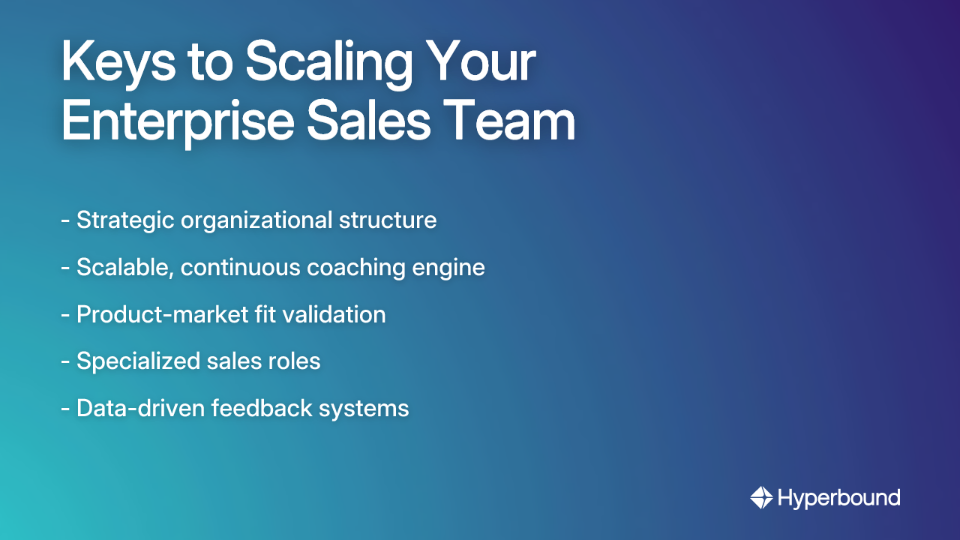
Many startups fail because they hire a sales team prematurely. As one experienced founder advised on Reddit, "Don't hire any salespeople until you prove PMF (Product-Market Fit)." He further emphasized, "Until you have successfully sold this, until you've proven the model, you'll most likely just waste tons of money on salespeople."
Before hiring your first Account Executive (AE), ensure your founding team has:
Only after validating these elements should you begin building your enterprise sales structure.
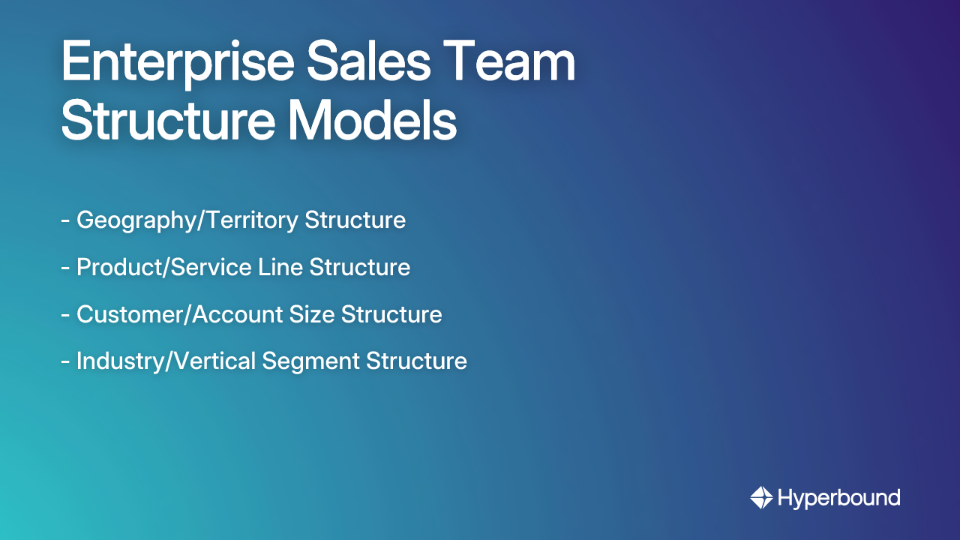
According to Frank V. Cespedes in Aligning Strategy and Sales, there are four main organizational models to consider for enterprise-level sales teams:
Modern enterprise-level sales teams thrive on specialization to improve efficiency. Key specialized roles include:
With your structure in place, it's time to focus on the engine that drives performance: coaching.
The data is clear: coaching works. Organizations with a formal coaching process achieve 91.2% of their quota, compared to just 84.7% in companies with informal processes. Additionally, 94% of employees prefer companies that invest in their career growth, making coaching essential for retention in competitive markets.
Based on research from Korn Ferry, here's how to build an effective coaching program for your enterprise sales team:
.png)
Despite best intentions, traditional enterprise sales coaching faces significant limitations:
These challenges are amplified in today's environment, where 90% of B2B sales have shifted to remote models, making coaching even more difficult but essential.
Hyperbound's AI Coaching platform transforms how enterprise sales teams learn and perform by:
Traditional coaching relies on manager intuition, but AI coaching platforms use data to identify systemic issues across your enterprise sales organization:
This objective analysis enables targeted, data-driven enablement programs across your enterprise sales organization.
As one sales leader noted in a discussion about top performers, "Top salespeople are obsessive about getting better."
With an "always-on" AI coach, every enterprise sales rep can adopt this mindset. They don't have to wait for their manager to get feedback—they can self-correct and improve after every single call, creating a virtuous cycle of continuous improvement.
Here's how structure, cadence, and AI technology work together in a practical weekly workflow for an enterprise sales team:
Monday Prep: An Account Executive preparing for an enterprise deal demo practices their pitch and objection handling using Hyperbound's AI Sales Roleplays against a simulated "skeptical CFO" persona.
Tuesday-Thursday Calls: The AE conducts their live customer calls. Hyperbound's AI Coaching provides immediate post-call feedback, highlighting that they forgot to ask a key discovery question about decision criteria.
Friday 1:1: The sales manager comes to the meeting prepared. Instead of listening to random calls, they review the AI-generated call summaries and scores. The conversation becomes strategic: "I see the AI flagged that you struggled with pricing objections on two enterprise calls this week. Let's roleplay that scenario now."
End of Month: Sales leadership reviews the team's analytics in Hyperbound and discovers a team-wide skill gap in articulating the value proposition for a new product feature. They assign a targeted roleplay simulation to the entire enterprise sales organization to certify them on the new talk track.
An effective enterprise sales organization isn't just about a clever org chart. It's a living system built on a solid structure and fueled by a continuous coaching engine.
Traditional coaching methods can no longer keep pace with the demands of modern enterprise sales. By embracing AI-augmented solutions like Hyperbound, you can provide every rep with the personalized coaching they need, scaling excellence and unlocking your team's maximum potential.
Stop letting manager bandwidth be your bottleneck. Explore how Hyperbound's AI Coaching Platform can help you build a culture of continuous improvement and drive predictable revenue growth for your enterprise sales organization.
You should build an enterprise sales team only after you have validated your product-market fit (PMF). Before hiring your first Account Executive, your founding team should have developed a repeatable sales motion, defined a clear value proposition and Ideal Customer Profile (ICP), and generated initial revenue, often recommended to be around $3-5M in ARR. Hiring a sales team prematurely is a common reason for failure.
The four most common enterprise sales team structures are based on geography, product line, customer size, and industry vertical. The best structure depends on your business needs: a geography model is great for local markets, a product line model works for complex offerings, a customer size model tailors the approach for SMB vs. Enterprise, and an industry model builds deep vertical expertise.
Sales coaching is critical because it directly impacts performance and retention. Organizations with a formal coaching process achieve significantly higher quota attainment (91.2% vs. 84.7%). Furthermore, investing in employee development through coaching is a key factor in retaining top talent in a competitive market.
To build a successful sales coaching program, you should follow five key steps: 1) Define specific, observable goals, 2) Develop a consistent coaching plan with a regular cadence, 3) Train your managers on effective coaching frameworks like the GROW model, 4) Set clear expectations that coaching is for development, and 5) Regularly collect feedback from your reps to improve the process.
Traditional sales coaching has three main challenges: it's limited by manager bandwidth, it can be subjective and inconsistent across different managers, and the feedback is often delayed. Managers can typically only review a few calls per rep per month, and feedback given days later is less effective than immediate reinforcement.
AI helps overcome traditional coaching limits by providing scalable, objective, and immediate feedback. AI platforms can analyze 100% of sales calls, deliver personalized feedback instantly, and enable reps to practice in risk-free roleplay environments. This frees up managers to focus on strategic coaching and helps foster a culture of continuous self-improvement across the entire team.








Use Cases
Legal