
Enterprise reps don't lose deals because they don't know the right words. They lose because they've never practiced the specific, high-stakes objections that only surface in complex enterprise sales cycles.
Think about it: you've run dozens of discovery calls and demos. You know your pitch cold. But then a new VP gets looped in at the 11th hour, procurement demands a line-item teardown, or your champion suddenly can't get the CFO to sign off — and you're caught flat-footed. As reps on Reddit have shared, "[n]ew stakeholders constantly disrupt the flow of deals," and relying on a single point of contact can derail everything when stakeholders shift.
The objections in enterprise sales aren't generic price pushback. They're nuanced, politically charged, and laden with procurement jargon, compliance requirements, and competing departmental agendas. Yet only 41% of sales reps feel prepared to respond to objections — a gap that's especially dangerous when the deal size has six or seven zeros.
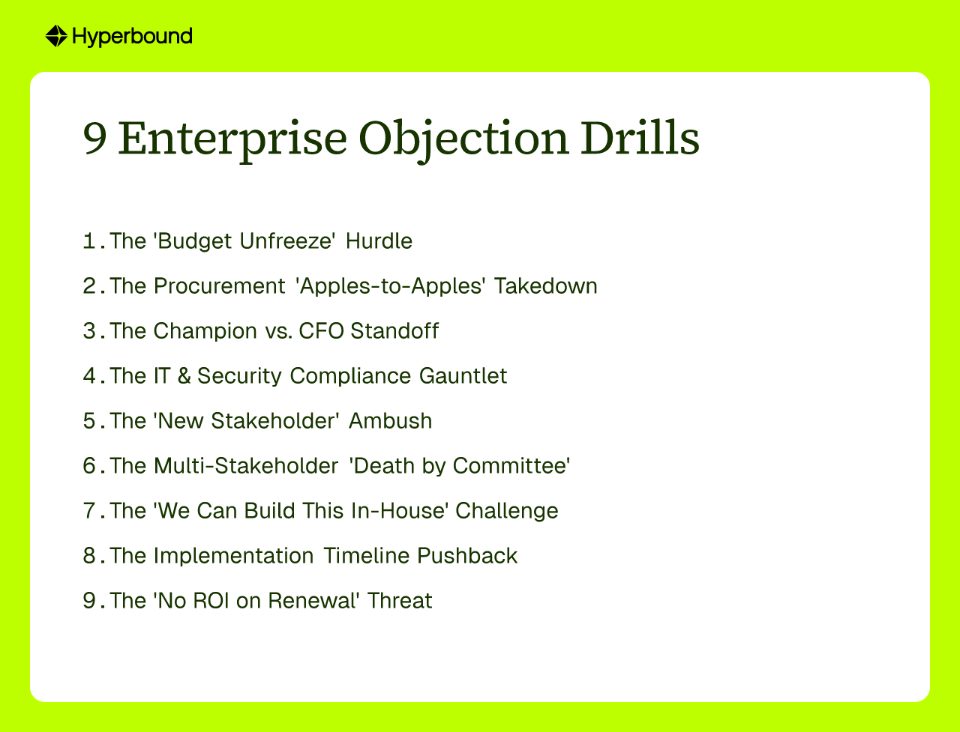
The nine enterprise sales objection handling practice drills below are designed to be run immediately — with a manager, a peer, or an AI buyer persona tool like Hyperbound Practice. Each drill includes a scenario setup, the verbatim objection, a roleplay prompt, the persona pushing back, and the deal stage where it typically surfaces.
Persona: Economic Buyer | Deal Stage: Mid-to-Late Stage (Evaluation/Proposal)
Scenario Setup: Discovery and demos are done. Your champion is enthusiastic. But the economic buyer has gone cold, citing a budget freeze. The deal is in limbo and the clock is ticking on your quarter.
The Objection:
"I like what I see, but our budget is frozen for the rest of the quarter. We'll need to revisit this in six months."
Roleplay Prompt: Your practice partner plays the Economic Buyer. Your task is not to offer a discount. Instead, pivot to the cost of inaction. Acknowledge the constraint empathetically, then surface the financial impact of the pain uncovered in discovery:
"I completely understand the budget pressure. Given the bottlenecks you mentioned costing you roughly X per month, what's the plan to address that in the interim? At what point does waiting become more expensive than acting?"
Persona: Procurement Manager | Deal Stage: Late Stage (Negotiation)
Scenario Setup: Business stakeholders have selected your solution. Now procurement has entered the conversation with a competitor quote in hand and a mandate to cut costs.
The Objection:
"Your price is 20% higher than Competitor X. From our perspective, the solutions are functionally the same. We need you to match their price to move forward."
Roleplay Prompt: Practice responding without getting dragged into a feature comparison. Re-anchor on the outcomes the business stakeholders agreed were non-negotiable:
"I appreciate the diligence. Before we go line by line, can we revisit the three outcomes your VP of Sales said were must-haves? I want to make sure we're measuring each solution against those business goals — not just the feature list."
Persona: Champion & CFO (Economic Buyer) | Deal Stage: Late Stage (Proposal/Closing)
Scenario Setup: Your champion is fully bought in, but they can't get the CFO to sign off. The CFO sees your solution as a "nice-to-have" rather than a strategic investment. CFOs hold final decision-making power in 42% of software purchases — this objection is a deal-killer if left unaddressed.
The Objection (from your Champion):
"I'm having trouble getting this past our CFO. She's not convinced of the ROI and thinks we can make do with our current process."
Roleplay Prompt: Run this as a two-part drill. First, coach your champion on how to frame the business case for the CFO. Then simulate a three-way meeting: you, your champion, and an AI-played CFO. Your job is to help the champion package the value in the CFO's language — risk reduction, cost avoidance, and revenue impact. Avoid vendor-speak. CFOs respond to numbers, not features.
Persona: Legal / IT Security / Compliance Officer | Deal Stage: Mid-Stage (Technical Evaluation)
Scenario Setup: The business unit is ready to sign. IT and Legal have flagged the deal for a mandatory security review and sent over a 100-question questionnaire. Concerns about data residency and legacy system integration are threatening to kill momentum.
The Objection:
"Your solution doesn't appear to meet our data residency requirements, and we have major concerns about integration risks with our legacy systems. We can't approve this until these are fully resolved."
Roleplay Prompt: Practice a call with the Head of IT Security — not as a defensive rep, but as a trusted technical partner. Walk them through your compliance certifications (SOC 2 Type II, GDPR, ISO 27001), provide specific examples of integrations at similar enterprise customers, and ask clarifying questions to narrow the scope of their concerns:
"Which specific data residency requirement are you most concerned about? Let me walk you through exactly how we handle that — and I can connect you with our security team for a deeper technical review if needed."
Persona: New Executive Stakeholder | Deal Stage: Late Stage (Final Approval)
Scenario Setup: The deal is on the one-yard line. Everyone is aligned. Then a newly hired executive is added to the final review meeting with zero context on the project — and they immediately start questioning everything.
The Objection:
"I'm new here, so forgive me, but why are we spending this much on this problem? It doesn't seem like a top priority from where I'm sitting. Can you walk me through the history of this?"
Roleplay Prompt: Practicing this drill builds your ability to protect deal momentum without dismissing the new stakeholder. Validate their question, anchor to the living deal brief you've maintained throughout the cycle, and offer a separate onboarding session:
"Absolutely — that's a fair question, and I want to make sure you have everything you need. Let me give you a quick 90-second summary of where we are and why this was prioritized. I'd also love to set up a dedicated session to walk you through the full picture — I don't want to take this group's time rehashing it all right now."
As reps who've navigated this know, "frequent repetition of information creates frustration" — both for your team and the existing stakeholders. The goal is to bring the new executive in without derailing the room.
Persona: Multiple Stakeholders (via Champion) | Deal Stage: Mid-Stage (Evaluation)
Scenario Setup: You're working with a buying committee of six. Marketing wants lead gen features, Sales needs CRM integration, and Customer Success is worried about implementation complexity. The deal has stalled because no one can agree on priorities.
The Objection (from your Champion):
"We're stuck. I can't get the other department heads to agree on what matters most. Everyone has different opinions and we've hit a standstill."
Roleplay Prompt: This drill is about facilitation, not selling. Your practice partner plays the champion. Your task is to coach them to run a stakeholder alignment workshop anchored on a shared business outcome — not individual departmental wish lists:
"Let's step back from the feature debate. What's the one business outcome every department head would agree matters most in Q3? If we can align on that, I can show you how each team's needs maps back to achieving it."
This is multi-threading in practice: building consensus across a committee before it turns into a veto.
Persona: Technical Buyer / Engineering Lead | Deal Stage: Mid-Stage (Technical Evaluation)
Scenario Setup: Business stakeholders are sold. Then the engineering team reviews the proposal and convinces leadership they can build a comparable solution for a fraction of the cost. The "build vs. buy" debate is back on the table.
The Objection:
"Our engineering team is confident they can build something similar for a fraction of the cost. Why would we buy when we can build?"
Roleplay Prompt: Roleplay this with both the Engineering Lead and Economic Buyer in the room. Acknowledge their team's capability, then walk through the true total cost of ownership (TCO) — the costs most teams underestimate:
"I have no doubt your team could build this. The question worth answering together is: what's the true cost when you factor in ongoing maintenance, security updates, and the opportunity cost of pulling engineers off your core product roadmap? For most teams, the build option ends up costing 3–5x more by year two."
Persona: Project Manager / Head of Operations | Deal Stage: Late Stage (Proposal/Negotiation)
Scenario Setup: A previous failed implementation has left your prospect gun-shy. They're interested in your solution but terrified of the disruption a major rollout could cause their already stretched team.
The Objection:
"We've been burned by long implementations before. I'm worried this will take six-plus months and pull my best people off their core projects. We just don't have the bandwidth right now."
Roleplay Prompt: Practice de-risking the implementation narrative. Come in with a phased onboarding plan, clear RACI (who does what), a realistic timeline with specific milestones, and a customer story from a similar enterprise deployment:
"I hear you — we've had customers come to us after exactly that experience. Let me walk you through how our phased rollout works and show you how [Customer X] got to value in 60 days with their team's involvement capped at two hours per week in phase one."
Persona: Champion / Key User | Deal Stage: Post-Sales (Renewal)
Scenario Setup: A large enterprise customer is up for renewal. Usage data is lower than projected, and a key stakeholder is questioning whether the investment was worth it — and whether it will be next year.
The Objection:
"To be honest, I'm not sure we're seeing the value to justify renewing at this price. My team isn't using it like we hoped, and I'm not convinced we've achieved the ROI we talked about last year."
Roleplay Prompt: This drill is for AMs and CSMs. Come prepared to the call with usage data, documented outcomes against the original success criteria, and a forward-facing success plan. Don't be defensive — be a partner:
"I appreciate you being direct with me — that's exactly what I need to hear. Let's look at the numbers together and also revisit what success looked like when we started. Then I want to show you what the team that's seeing the strongest results is doing differently. I think there's a real path to getting your team there in Q2."
No calendar coordination needed.
Hyperbound Practice lets you spin up any of these exact drills as an AI roleplay in minutes — before a big meeting, between pipeline reviews, or embedded directly in your Slack or calendar. You can build a digital twin of a specific stakeholder from their LinkedIn profile and practice against a realistic simulation of their personality and objection style.
Hyperbound's AI buyer personas are trained on 2M+ hours of real B2B sales conversations — not generic scripts — which means the pushback your reps get in practice actually mirrors what they'll face in the room. AI Scorecards give instant, objective feedback after every session, flagging whether reps reframed on value, caved on price, or missed a key discovery question.
Teams like Vanta cut ramp time by 60% (from 210 to 72 days) and scaled their BDR team 4x using Hyperbound Practice. It's the fastest way to turn these drills from something you read about into skills your team owns.
Reading about enterprise sales objection handling isn't enough. Winning complex deals requires building the muscle memory to deliver the right response under pressure, in the moment, with a skeptical CFO on the line.
The recommendation: Embed two drills per week into your team's existing rhythm. Drop them in a dedicated Slack channel with a prompt, assign them as a calendar block before team calls, or run them live in your weekly enablement session. Consistency beats intensity — two focused sessions a week compound faster than a quarterly training marathon that reps forget within 30 days.
Start with Drills 1 and 3 this week. They cover the two most common enterprise deal killers: budget hesitation and the champion-CFO gap. By the time your next QBR rolls around, your team will have the reps — not just the knowledge — to handle whatever the buying committee throws at them.
Enterprise sales objections are more complex because they involve multiple stakeholders, nuanced internal politics, and specific challenges like procurement processes and IT security reviews. Unlike generic price pushback, enterprise objections are often tied to competing departmental agendas, compliance requirements, and high-stakes financial decisions. They can surface late in the sales cycle from new stakeholders and require a deep understanding of the customer's business to navigate successfully.
Practicing is crucial because enterprise objections are high-stakes and can derail deals worth six or seven figures if a rep is caught unprepared. While reps may know their pitch, they often lack experience with the specific, politically charged objections that arise in complex deals. Consistent practice builds the muscle memory needed to respond effectively under pressure, protecting deal momentum and building credibility with senior stakeholders.
You can practice handling enterprise objections by running roleplay drills with a manager, a peer, or by using an AI buyer persona tool. The article provides nine specific drills designed for immediate practice. For realistic and scalable practice, AI tools like Hyperbound Practice allow you to simulate conversations with different personas (like a CFO or Head of IT) trained on real B2B sales calls, providing instant feedback without needing to coordinate with a colleague.
The best way to handle the "build in-house" objection is to acknowledge the internal team's capability and then shift the conversation to the total cost of ownership (TCO). Instead of debating features, focus on the hidden costs the engineering team might underestimate. This includes ongoing maintenance, security updates, and, most importantly, the opportunity cost of pulling valuable engineering resources away from the company's core product roadmap.
When a new stakeholder joins late, you should validate their question, provide a concise summary of the project's history and priority, and offer a separate, dedicated session to bring them up to speed. The goal is to bring the new executive into the loop without derailing the meeting or frustrating the existing stakeholders who are already aligned. By offering a separate meeting, you show respect for the new person's role while protecting the deal's momentum.
Sales teams should practice objection handling consistently, ideally by embedding two focused drills into their weekly rhythm. Consistency is more effective than intensity. A quarterly training marathon is often forgotten quickly. By making practice a regular weekly habit—for example, in a Slack channel or before a team call—reps build lasting muscle memory that ensures they are always prepared for high-stakes conversations.










Use Cases
Legal