
You've set up your USB device to record the meeting notes, engaged in stimulating discussion with your colleagues, and now you're ready to move on to your next task. But wait—how do you extract yourself from this conversation without giving someone the cold shoulder or appearing rude?
For many of us, especially those working in a white collar environment, ending conversations can be more anxiety-inducing than starting them. While you might be confident initiating small talk, the art of the graceful exit often feels like an elusive social skill.
"It's really hard to END a conversation with a particular person without either feeling incredibly awkward in my attempts or feeling like a complete jerk," confesses one Reddit user, echoing a sentiment many of us share.
The good news? Research published in the Proceedings of the National Academy of Sciences reveals that most conversations don't end when people want them to—meaning both parties are often secretly ready to wrap things up but unsure how to do so politely. This common mismatch validates that feeling of "am I the only one who wants this to end?" and removes the self-blame from the equation.
This comprehensive guide will equip you with strategies to exit any conversation confidently and politely, preserving both relationships and your peace of mind—whether you're dealing with chatty coworkers or navigating social events.
.png)
Before diving into exit strategies, it's important to recognize when a conversation has run its natural course. The goal is to end on a high note, shortly after the conversation peaks and before it hits an awkward lull.
Even in non-sociable settings, body language speaks volumes:
For those who struggle with reading people, these physical cues can be easier to spot than subtle verbal hints. As one person noted, "When someone starts glancing away, looks at their watch, or starts making short non-committal answers, it's probably time to wrap up the conversation."
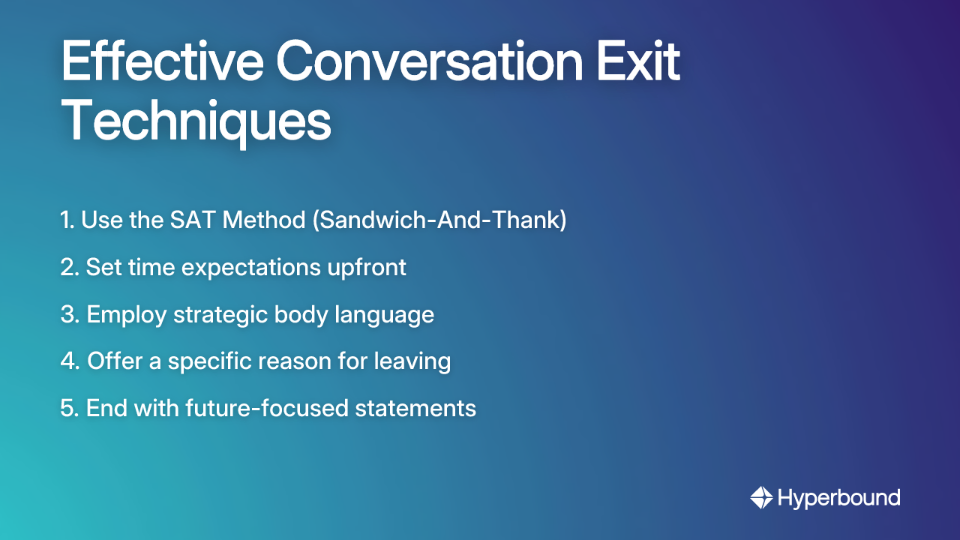
This simple three-step formula provides a polite and effective framework for any exit:
Prevent awkward exits by setting time expectations at the beginning of conversations:
"I only have about 10 minutes before I need to jump on a call, but I'd love to hear about your weekend."
This approach is particularly useful in lower-stress positions where you might have more flexibility but still need to manage your time effectively.
Your body language can telegraph your intentions before your words do:

Here's your arsenal of ready-to-use phrases for various scenarios. These scripts help you avoid developing an office-wide persona as someone who's difficult to approach or too abrupt.
In the Office:
With Chatty Coworkers:
At Networking Events:
When you disagree:
When using assertive communication:
When a boundary is crossed:
When you're caught with someone who dominates the conversation, more direct approaches may be necessary:
If you constantly worry about seeming rude:
Even in virtual settings, clear endings matter:
Remember that conversation norms vary across cultures:
The most effective conversation exits combine three elements:
Situation: Your coworker has cornered you in the break room to discuss weekend plans while you have an impending deadline.
Step 1: Non-verbal signals
Step 2: Verbal exit using SAT method
Step 3: Actionable follow-through
This blueprint works in nearly any situation with slight modifications. The key is consistency between your words and body language, which prevents sending mixed signals.
Mastering conversation exits isn't just about social convenience—it demonstrates emotional intelligence and respect for boundaries. In white collar environments especially, how you navigate social interactions contributes significantly to your professional reputation.
Research indicates that the end of an interaction often leaves a stronger impression than its beginning or middle—a psychological principle called the "recency effect." By ending conversations on a positive note, you shape how others remember the entire exchange.
Moreover, clear endings actually strengthen relationships rather than damage them. They demonstrate:
For those in non-sociable roles who still need to collaborate with teams, these skills become even more crucial as your interactions may be fewer but need to be more impactful.
Remember that ending conversations gracefully, like any social skill, improves with practice. Many people worry excessively about appearing rude when exiting conversations, but a confident, direct approach is usually appreciated by others—who are often also looking for a way out!
Start by practicing these techniques in low-stakes situations, like using the SAT method with a friendly barista. To apply these skills to more important professional relationships, AI coaching platforms like Hyperbound provide a risk-free environment to practice and build confidence for high-stakes conversations.
As you become more comfortable with these strategies, you'll find that conversations flow more naturally from beginning to end. You'll spend less time feeling trapped in interactions and more time enjoying the connections you make.
The ability to gracefully conclude a conversation is not about giving someone the cold shoulder—it's about respecting both your time and theirs. By mastering this essential social skill, you'll navigate your personal and professional worlds with greater confidence and authenticity.
After all, a thoughtful goodbye leaves the door open for a future hello.
Ending a conversation feels awkward because there's often a mismatch between when each person wants it to end, and social norms make it difficult to signal your exit without feeling rude. Research shows most conversations don't end when either party wants them to. This shared, unspoken desire to wrap things up creates a feeling of tension as people worry about offending the other person or being perceived as a "jerk."
The most polite way to end a conversation is to use a positive, appreciative closing statement combined with a clear reason for your departure. A highly effective technique is the "Sandwich-And-Thank" (SAT) method. You start with a positive comment ("I've really enjoyed our chat"), state your reason for leaving ("and I need to get back to my desk"), and finish with gratitude or a forward-looking statement ("Thanks for the insights, let's talk again soon!").
To end a conversation with a very talkative person, you need to be polite but firm by gently interjecting at a pause and stating your need to leave. Wait for a brief pause in their speech and say something like, "I hate to interrupt, but I really have to get going." Combine this with non-verbal cues, such as gathering your belongings or turning your body toward an exit. Mentioning a specific reason, like a deadline, adds weight to your exit.
Good excuses to leave a conversation are typically honest, brief, and related to your responsibilities. Some of the most effective reasons include needing to prepare for a meeting, returning a call, finishing a report before a deadline, or grabbing a coffee before your next task. For a smoother exit, you can set expectations upfront by saying, "I only have a few minutes before my next call," which creates a natural endpoint.
Key non-verbal cues that a conversation should end include glancing at a watch or phone, turning feet towards an exit, breaking eye contact, and giving short, non-committal responses like "uh-huh." When you or the other person starts repeating points, pauses become longer, or body language shifts away from the conversation, it's a strong indicator that the interaction has run its natural course and it's time for a polite exit.
You can end a conversation without making someone feel bad by using positive, future-oriented language that focuses on your obligations rather than a desire to escape. Phrases like "It was so great catching up with you!" or "Let's continue this another time" reinforce that you enjoyed the interaction. The key is to convey appreciation for the conversation while clearly stating that it needs to conclude, which preserves the relationship and leaves a positive final impression.

Have you struggled with ending conversations gracefully? Which of these strategies do you think will work best for your situation? Share your experiences in the comments below!










Use Cases
Legal