
Sales enablement teams are hired to build programs. Job descriptions emphasize strategy: design curricula, map competencies, build coaching frameworks, reduce ramp time. Budgets are approved on that basis.
After launch, the calendar fills with continuous administrative work.
Scorecards need updating because a behavior changed. A manager in a new vertical needs a practice bot that is almost identical to the one already built, except for the industry framing and two terminology changes. A product update means the learning module is now factually wrong, and so is the competition tied to it. Another manager sends a message asking for one more variant. Then another.
None of these tasks is difficult; the issue is volume. Each individual task is a fifteen-minute job, but there are four hundred of them, they arrive continuously, and none appears as a line item on the project plan.
This is the sales enablement admin problem: the hours nobody budgets for, the work nobody owns, and the primary reason enablement programs ship narrower than planned.
A program is never finished. Teachable's guide on channel partner enablement frames this directly: successful enablement requires assigning content owners to flag changes, reviewing materials after every product update, and notifying teams about new content on an ongoing basis. That is a maintenance function, not a build function, and it runs permanently from the moment a program launches.
The Sales Enablement Collective puts the scope of a modern enablement team's operational responsibilities across content management, LMS administration, coaching tooling, and performance tracking. Each of those categories generates its own maintenance queue.
What that looks like in practice:
The Salesforce enablement platform documentation describes role management, content assignment, and coaching program administration as standard platform tasks. These are standard platform tasks, but they are not light. The volume of routine configuration work across a mature program runs into the hundreds of touches per quarter, and almost none of it appears on a Gantt chart because each individual touch is too small to schedule.
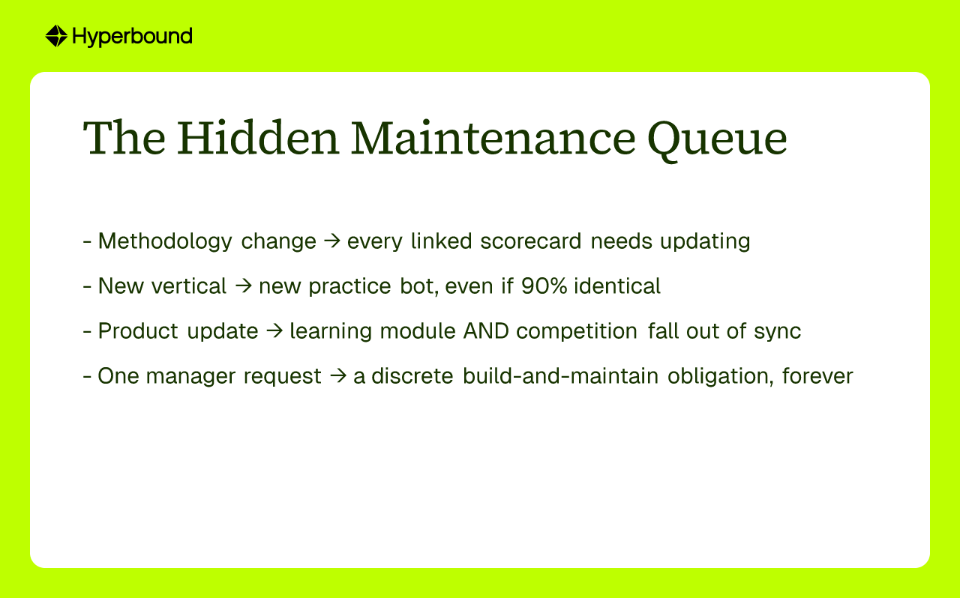
The result is a function that spends most of its hours on manual configuration rather than strategic work.
Unbudgeted maintenance hours produce a program that ships narrower than designed.
The plan calls for six regions. The team ships two because the full maintenance surface for six regions breaks the original resourcing assumption. Six sets of scorecards require updates. Six localized practice environments require maintenance. Six sets of learning modules and competitions require synchronization across product release cycles. Six queues of variant requests arrive from regional managers.
The descoping decision occurs once an enablement leader examines that full maintenance surface. It is rarely announced as a resource failure; it is announced as a phased rollout.
The downstream effect on sales teams is real. The customization intended to make training relevant to each vertical or region is reduced. Sales teams receive the same content, and generic content produces the pattern observed consistently across sales teams: training that does not reflect current products, does not match the rep's market, and does not connect to how quota is achieved. Training delivered on a recently sunsetted product is typically a maintenance failure rather than a strategy failure. The update was on the list; the list was too long.
Ramp time stretches because programs are not kept current. Pipeline metrics suffer because coaching frameworks drift out of alignment with the actual sales motion. The ROI case for enablement, which depends on those numbers, weakens, and the budget conversation in the next cycle is harder.
All of it traces back to the same source: the maintenance hours were not budgeted, so they consumed the hours that were.

The instinctive response to an overloaded enablement team is to question the process, the tooling, or the team's capacity to manage complexity. The work is not complex. Updating a scorecard, cloning a learning module, and adding a user to a permission group are straightforward tasks.
The constraint is that these easy tasks exist in volumes that a manually operated system cannot absorb without displacing everything else. The operational model demands a one-to-one relationship between the number of records being changed and the number of manual actions required to change them. One hundred scorecards means one hundred edits. Twenty regional variants mean twenty individual maintenance obligations. The cause is a systems problem rather than a skills deficiency.
The standard responses do not fix the underlying equation. Hiring another admin doubles the budget for a function that was supposed to be lean. Process improvements reduce minutes per task but leave the task count unchanged. Better documentation helps the next person do the same volume of manual work more consistently.
None of these interventions change the core mechanic: the number of records requiring updates still determines the total cost of the operation.
The only intervention that changes the equation decouples the cost of a change from the number of records it applies to. Not faster one-at-a-time work. One action, any number of records.
This is where Kota Actions comes in. Describe the change you want and the records it should touch, and Kota applies it across every matching scorecard, bot, module, and competition at once, then shows you a diff before anything publishes. Kota Actions is live now, and it is the direct answer to the volume problem: Hyperbound Practice with Kota Actions makes it possible to build, clone, and update practice bots in under 10 minutes without the admin drag.
The sales enablement admin hours that currently go toward maintenance return to the work the team was hired to do: 1:1 coaching, call analysis, program design, and strategic iteration that improves conversion rate and shortens ramp time.
The six-region program does not have to become a two-region program. A variant request from a manager no longer entails a three-hour ongoing obligation. Product updates no longer produce a backlog.
When the volume constraint is lifted, the scope of the program that enablement teams can deliver and sustain on existing resources expands substantially. The programs that get built match the programs that got planned. Sales teams receive content that is current, relevant to their market, and aligned to the sales motion.
Administrative drag on enablement functions follows from an operating model in which scale and cost are directly linked, rather than from any inherent property of the work. Changing that model restores the team's strategic mandate as the primary focus.

Sales enablement admin hours are the routine, manual tasks required to keep enablement programs current: updating scorecards, cloning practice bots, fixing outdated learning modules, assigning content, and managing variants. They are separate from strategic program design and often go unbudgeted because each task is small, even though the total volume is high.
Maintenance causes scope cuts because every update creates a new queue of manual changes across all affected records. When leaders calculate the total maintenance surface for multiple regions, verticals, or product lines, the hours exceed the original resourcing plan, leading to scope reductions, often announced as a phased rollout.
Product updates make any related learning module, scorecard, competition, or practice bot factually outdated. Because many enablement systems require one-at-a-time edits, a single product change can force dozens or hundreds of manual corrections, which quickly fills the admin queue and delays other enablement work.
When maintenance hours are not budgeted, they consume the hours that were intended for strategic work. Training falls out of date, ramp times stretch, coaching frameworks drift out of alignment, and the ROI case for enablement weakens, leading to more difficult budget conversations later.
Sales enablement teams can reduce manual admin work by using enablement platforms that support bulk edits, cloning, and reusable templates, such as Hyperbound, so one action updates many records at once. This removes the one-to-one relationship between the number of records and the number of manual tasks, freeing time for coaching and program design.
The best way to update scorecards at scale is to use an enablement tool that allows bulk editing or linked updates across all scorecards tied to a behavior or competency. Instead of opening and editing each scorecard individually, a single change should propagate to every relevant scorecard at once.
Programs often skip localization because each region, vertical, or language variant adds a separate build-and-maintain obligation that persists indefinitely. The plan may call for six regions, but when the maintenance surface is fully mapped, the team often ships only two because the administrative load is too high relative to resources.
Building a sales enablement program is a one-time project: designing curricula, mapping competencies, and launching initial content. Maintaining it is an ongoing operational function: flagging outdated content, syncing scorecards with product changes, cloning practice bots for new segments, and responding to variant requests. Maintenance is permanent and often invisible on a project plan.
Admin drag pulls enablement resources away from high-impact activities like 1:1 coaching, call analysis, and content personalization. As a result, programs become outdated, reps receive generic training that does not match their market, ramp time lengthens, pipeline metrics suffer, and the overall ROI of enablement drops.
Sales enablement leaders should look for tools that decouple the cost of a change from the number of records it affects: bulk editing, automated propagation, reusable templates, and quick cloning. Hyperbound, for example, lets teams build and scale practice bots without the admin drag, so the team can focus on strategy instead of clicking.









Use Cases
Legal